Loading...

From appetizer to main course: A taste of 2025’s marketing trends

Published: January 28, 2025 by Hayley Schneider

Three 2025 trends to spice up your marketing strategy

Agencies, platforms, and marketers stand at the crossroads of transformation, as privacy regulations tighten, technology accelerates, and consumer behaviors evolve. Yet these challenges also present extraordinary opportunities.

Our 2025 Digital trends and predictions report highlights five trends that will shape 2025 and digs into:

  • What’s changing in the market
  • How to keep learning about your customers
  • How to reach your customers in different places
  • How to measure what’s really working along the way

In this blog post, we’ll give you a sneak peek of three of these trends — from cracking the code of signal loss to tapping into the buzz around connected TV (CTV) and stepping up your omnichannel game. Think of it as a taste test before the main course. Ready for the full menu? Download our report to get the lowdown on all five trends.

1. Signal loss: A rich appetizer of alternate ingredients

As traditional cookies crumble, marketers need fresh ingredients to keep the flavor coming. Already, about 40% of browser traffic doesn’t support third-party cookies, and marketers are spicing things up with first-party data, alternative identifiers like Unified I.D. 2.0 (UID2) and ID5, and contextual targeting strategies. In fact, 50% more of our clients received alternative IDs (UID2, ID5, Hadron ID) in their Digital Graph in 2024 compared to 2023. The number of alternative IDs resolved to individuals in our Digital Graph increased by 30% year-over-year – as everyone looks beyond the cookie jar.
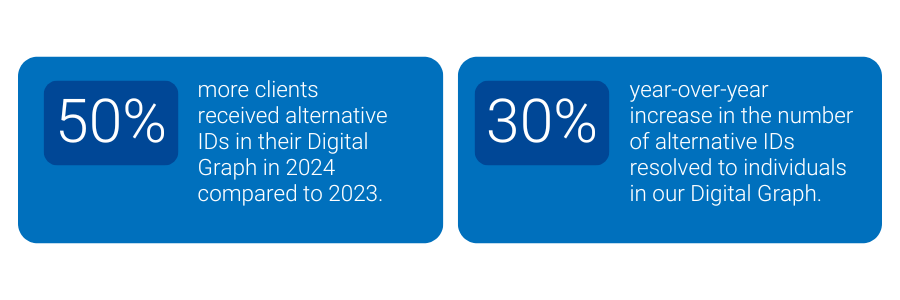
50% more clients received alternative IDs in their Digital Graph in 2024 compared to 2023. 30% year-over-year increase in the number of alternative IDs resolved to individuals in our Digital Graph.

There is no secret sauce to replace cookies. Instead, expect a multi-ID recipe that brings together different identifiers, unified by an identity graph. This approach turns a fragmented pantry of data into a cohesive meal, giving you a complete view of your customer on every plate.

2. The rising power of CTV: A hearty entrée of opportunities

CTV is quickly becoming the main dish on the streaming menu, as viewers load up on their favorite shows. While CTV is slated to make up 20% of daily U.S. media consumption by 2026, advertisers are still holding back on pouring in the ad spend. To unlock its full flavor, marketers need to whip up solutions like frequency capping and unified audience activation.

Although CTV will account for 20% of daily U.S. media consumption by 2026, it’s projected to command only 8.1% of ad spend. Frequency capping and unified audience activation solutions will be key to unlocking CTV’s full potential.
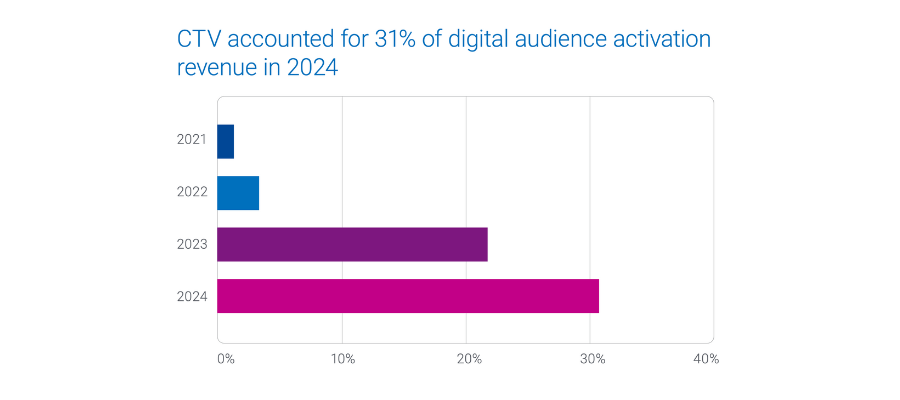
A chart that shows connected TV (CTV) accounted for 31% of digital audience activation revenue in 2024

By 2025, nearly half of CTV “diners” will choose free ad-supported streaming TV (FAST). Marketers need strategies to prevent ad overexposure. With 50% of U.S. consumers avoiding products due to ad overload, and 30% of marketers willing to increase their CTV spend if frequency capping improves, unified identity solutions help ensure every impression is served just right.

3. Omnichannel: A flavorful fusion plate

No one likes a one-flavor meal. Marketers are moving beyond single-channel “side dishes” to omnichannel “fusion feasts” that blend direct mail, digital, CTV, and retail media networks (RMNs) into a truly cohesive culinary experience. Even though only 21% of global B2C professionals currently put omnichannel at the top of their shopping list, the growing demand for seamless, audience-first campaigns is heating up.
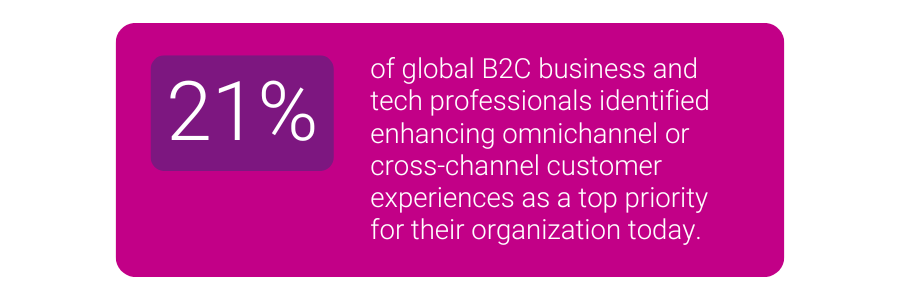
21% of global B2C business and tech professionals identified embracing omnichannel or cross-channel customer experiences as a top priority for their organization today.

In 2025, having an audience-first approach will be like having a perfect pairing for every course. Unified identity solutions act as your master sommelier, ensuring that each channel complements the next, and every customer enjoys a well-rounded, memorable journey.

Vertical trends: A dessert sampler from four unique kitchens

Different markets have their own signature flavors.

  • In Auto, crossover utility vehicles (CUVs) claim 51% of new vehicle registrations, and consumers in the 35-54 age group and families are the primary buyers. Automotive marketers should prioritize CUV advertising with a strong focus on family-oriented and income-appropriate messaging
  • In Financial Services, marketers need to anticipate shifts in consumer behavior tied to economic conditions, such as increasing demand for deposit products when interest rates are high. For insurance, aligning campaigns with life events, like new home purchases or marriage, can maximize engagement.
  • In Healthcare, advertisers are prioritizing personalized, regulation-compliant campaigns that address social determinants of health (SDOH).
  • In Retail, advertisers are increasingly activating on both CTV and social platforms, with many managing their own in-house campaigns. While larger brands often rely on media agencies, a shift toward in-house media buying is emerging among some bigger players, offering more control over audience targeting and performance metrics.

Our report covers each vertical’s unique menu, helping you select the right “ingredients” for your customers. With the top Experian Audiences on hand, you can create feasts that delight, nourish, and convert.

Hungry for more? Download our full menu

The three “samples” you’ve just tasted are just the starters. Our 2025 Digital trends and predictions report serves up five insights, complete with strategies, data, and tools to help you adapt, scale, and thrive in 2025.

Ready for the full menu? Download our report now and discover all five trends that will shape your marketing “cookbook” in 2025. Bon appétit!


Latest posts

Loading…
Talking Taxes: Exploring trends in tax preparation and deductions

As sure as the sun rises and sets, Tax Day comes around every year, whether it falls on April 15th or a day or two thereafter. As part of the Simmons National Consumer Study, Experian Simmons collects information on the various ways Americans file their taxes. In the following post, we will explore a few tax trends in the Land of the Free as well as some deductions available to many. Software for the Hard Stuff Long gone are the days of preparing our taxes the old-fashioned way using pen and paper (and hopefully a calculator). Last year, just 8.7% of U.S. tax filers prepared their taxes manually, down from 16.4% of filers who prepared their taxes this way in 2006. Software (including both online and offline versions, such as Turbo Tax or H&R Block At Home) have risen to replace their graphite-powered ancestors. In 2005, 21.5% of tax filers said they used software to prepare their taxes. Specifically, 6.8% used offline software and another 14.7% used online software. Today, 21.5% of filers use online tax software and 7.4% use offline software, bringing the total share of software preparers to 28.9%. But tax software isn’t just replacing at-home pencil pushers. The share of filers using a CPA, a private accountant or a notary public to prepare their taxes has also declined slightly in recent years as has the share of filers that use a professional on-site service, like H&R Block of Jackson Hewitt. In 2011, 30.8% of filers had their taxes prepared by a CPA, private accountant or notary, down from 32.9% who employed this type of professional in 2006. Likewise, 17.7% of last year’s filers used a professional on-site service to prepare their taxes, compared with 19% who used such a service in 2006. Filing Trends of Business Owners Much attention in Washington has been paid to small business owners, especially when the topic of tax policy is concerned. Rest assured, we’re not going to explore the political implications of proposed tax code changes on business owners, but we will examine the way these Americans prepare their personal taxes. A business owner’s tax prep work depends a lot on how many employees they have working for them. Those who own very small companies with between 2 and 9 employees, including the owner, are the most likely to have a CPA, private accountant or notary prepare their taxes. In fact, 65% of these small business owners do their taxes this way, compared with 52% of those who own companies with between 10 and 99 employees. Interestingly, only 35% of tax filers who own companies with 100 employees or more use a CPA, a private accountant or a notary to prepare their taxes, a rate equal to that of the national average. Larger business owners are actually more likely than average to have their taxes done by an on-site professional. While few business owners do their taxed by hand, the self-employed who have no employees are actually among the few that still do their taxes the old-fashioned way. In fact, 11% of business owners who list only themselves as employees say they did their taxes manually last year, a rate 30% above than the U.S. average. Most of those who don’t to their taxes themselves have them done by a CPA, a private accountant or a notary. Fifty-two percent of the self-employed with no other employees chose this method to prepare their taxes last year, which is a rate 45% higher than the average filer.   Deduction Time Deductions are a common way for reducing one’s tax liability. Here we’ll explore how many Americans could benefit from several common deductions allowed by the Internal Revenue Service. For more information about consumer trends, visit www.experian.com/simmons.

Apr 10,2012 by

Facebook acquires photo-sharing network Instagram

Yesterday, Facebook announced the acquisition of Instagram, a popular photo sharing network with over 30 million users, for $1 billion. Visits to the Instagram website have steadily increased over the past 24 weeks and reached 3.8 million last week, up from 68,800 visits for the week ending October 22, 2012. While the majority of activity takes place within the Instagram application, the website provides links to the Apple App Store and Google Play as well as some account management tools, so the growth marks increased consumer interest. The audience for Instagram is relatively young, with over half of the visitors to the Instagram website are under the age of 35. This is an interesting contrast to the visitors of Facebook’s website, which reflects a more mainstream audience with a higher share of older users. These differences can certainly offer opportunities to promote and grow usage of each of the networks across age groups. Many users of Instagram share their photos across a number of social networks since within the Instagram application, you can link to your share photos with Twitter, Facebook, Flickr, Tumblr, Posterous (recently acquired by Twitter) and Foursquare accounts. As a result of this integration and heavy use of social networks in general, social networks refer the majority of traffic to the Instagram website. Last week, 25% of the traffic to Instagram from social networks was from new visitors, most likely interested in learning more about Instagram after seeing photos within the feeds of their friends. Last week, there was considerable excitement around the launch of Instagram app for Android phones, which became available on Google’s recently relaunched digital media store, Google Play. The app reached over 1 million downloads on the first day of availability. Visits to the Instagram website increased 59% over the previous week and Google Play ranked 6th among the downstream websites visited immediately after the Instagram website. Please note this data does not include mobile traffic.

Apr 10,2012 by

Direct mail vs. Email

According to Epsilon Targeting’s latest Consumer Channel Preference Study of 5,000 consumers in North America, 60% of consumers report an "emotional boost" from receiving direct mail, agreeing that they enjoying checking their mailbox. This report showed that across all categories, direct mail continues to be a trusted source of information. It's always good to reach out to consumers via email, but the disadvantage to this is that the consumer has the ability to receive emails from you on their own terms, which may be infrequent or not at all. The use of direct mail has shown to be a pleasing emotional hook. Even with the ever growing digital world, consumers are still responding to your direct mail pieces. Don't let your businesses address contact data fall to the wayside – this is still just as important as ever to have. To ensure as timely delivery, make sure you're using address validation tools to make sure you're saving money and getting the most out of your direct mail campaigns.

Mar 27,2012 by

Subscribe to our newsletter

Enter your name and email for the latest updates

This site is protected by reCAPTCHA and the Google Privacy Policy and Terms of Service apply.

About Experian Marketing Services

At Experian Marketing Services, we use data and insights to help brands have more meaningful interactions with people. As leaders in the evolution of the advertising landscape, Experian Marketing Services can help you identify your customers and the right potential customers, uncover the most appropriate communication channels, develop messages that resonate, and measure the effectiveness of marketing activities and campaigns.

Visit our website

Subscribe to our newsletter

Stay up to date on the latest industry news and receive expert tips from our marketing experts.
Subscribe now!