At A Glance
Pharma marketers can support more informed health journeys when patient and HCP messaging is relevant, privacy-forward, and optimized against meaningful outcomes. In this Ask the Expert conversation, Experian and DeepIntent discuss how health marketers can coordinate education, CTV, activation workflows, and measurement without entering private clinical decisions.Privacy-forward pharma media supports more informed healthcare journeys
Effective pharma marketing depends on reaching patients, caregivers, and healthcare professionals (HCPs) with useful information in appropriate, privacy-forward ways. The goal is to make relevant education easier to find, support more informed conversations, and help brands understand how media contributes across the health journey.
In this Ask the Expert session, Natalie Mancuso, SVP, Data Partnerships at DeepIntent, joins Sheila Wirick, who leads the health team at Experian, to discuss how to craft patient and HCP campaigns, privacy-safe activation workflows, connected TV (CTV), and measurement approaches built for pharma.
Why should your media plan start with understanding the patient and provider
The patient-and-provider journey should inform your media plan, as treatment decisions in pharma are increasingly informed, personal, and patient-driven. With more health information available than ever, patients are playing a more active role in understanding their options and participating in treatment conversations. As other industries become more customer-centric, pharma media planning needs to become more patient-centric.

“We’ve got patients who are more informed, more involved in their treatment decisions than ever. The accessibility of data and information and the ways we can consume it with just AI alone is so vast that if we’re not arming people with the right information in real time, we’re missing the boat.”
DeepIntentNatalie Mancuso, SVP, Data Partnerships
This means media should be aligned to where a patient or provider is in the decision journey and what they need at that moment. Early on, media may play an educational role by building awareness of a condition, symptom, or treatment category. Later, it may help support more specific questions, treatment consideration, access, affordability, or adherence.
The patient-provider conversation remains the key boundary. That exchange should stay private and clinically led. Media can play a valuable role before and after those moments by offering information that helps patients and providers feel more informed.
How can brands connect patient and HCP messaging responsibly?
It’s critical for agencies and brands to deliver relevant messaging to inform each stakeholder’s needs throughout the treatment journey, especially ahead of key clinical milestones. To execute this, brands must exercise privacy-forward activation, keeping patient and HCP identity, activation, and measurement paths separate, while using a common workflow layer to support the same brand goal.

Experian helps pharma marketers do this by acting as an independent, privacy-forward identity, data, and workflow layer. We bring together high-fidelity matching, governed onboarding, and non-clinical consumer context, so patient and HCP engagement can be activated more accurately across channels and connected to reporting.
The distinction is not only where each audience is reached. HCPs may be engaged in both professional and personal environments, but their needs are different from patients’. For example, an HCP may receive messaging about co-pay savings for eligible patients, while a patient may receive information about patient support programs. These are different messages for different audiences, but they ladder up to the same goal: informing both parties in a privacy-forward, relevant way.
Hear from Natalie Mancuso in our 2026 State of advertising report
In our 2026 State of advertising report, Natalie shares why identity serves as the connective infrastructure that links planning, activation, and measurement across connected TV (CTV), programmatic, commerce media, and walled garden environments.
What does privacy-forward activation look like in pharma?
Pharma brands often start with fragmented patient and HCP signals. Privacy-forward activation turns those inputs into usable audiences by first confirming that the data can be used, then translating identity in controlled environments that protect personally identifiable information through tokenization or other methodologies.
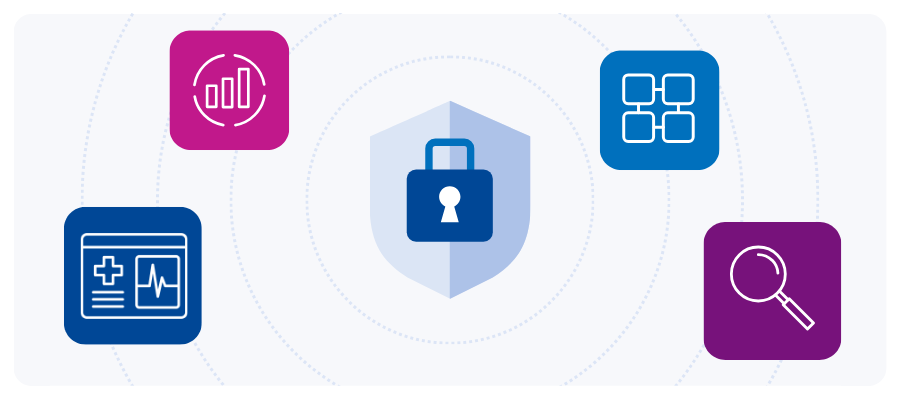
For DTC, that means building and matching audiences without relying on inferred health conditions from browsing behavior. For HCPs, it means connecting professional identity to verified sources in a way that supports activation and measurement. In a category shaped by HIPAA, state privacy laws, internal review, and consumer sensitivity, building privacy in from sourcing through activation is what makes responsible health media possible.
How can CTV play a more useful role in pharma?
CTV can play a more useful role in healthcare when it’s connected to a larger, privacy-forward plan and not treated as just an awareness channel.
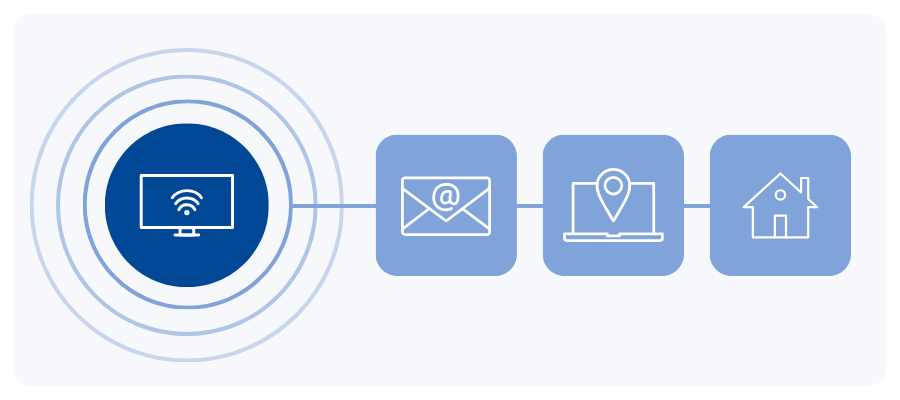
DeepIntent connects CTV and digital exposure data using identity signals, such as National Provider Identifiers (NPIs), hashed email addresses, IP addresses, device IDs, and household signals, where permitted and reviewed. That identity layer helps support sequencing and suppression across streaming, endemic, mobile, and digital settings.
In practice, CTV can introduce targeted education or broad brand awareness, and later touchpoints can provide sequential information in the right channels. Instead of repeating the same message, brands can make pivots based on engagement and context.
“For us, it starts with identity and not panels. When we’re resolving CTV and digital exposures to the same person, we’re leveraging signals so that every touchpoint across streaming, endemic, and mobile is recognized as the same individual, not model lookalikes.”
DeepIntentNatalie Mancuso, SVP, Data Partnerships
For pharma, campaign performance should not be measured by reach alone. A stronger approach looks at whether sequenced engagement contributes to meaningful downstream signals, including:
- Prescription activity
- Provider engagement
- Referral patterns
- Patient compliance
- Adherence signals, where measurement is permitted
Why should messaging and reporting change in pharma?
Pharma campaigns are journeys with changing information needs. Reporting should guide the campaign optimization.
“If I’m launching into a market with a new class of drug, I’m asking what education needs to be put into the market – from both an HCP and a consumer standpoint – to build awareness?”
DeepIntentNatalie Mancuso, SVP, Data Partnerships
Clicks and website visits still have a place, but they can’t tell the full pharma story. DeepIntent processes data in real time, giving brands an up-to-date read on how media connects to campaign engagement. Campaign signals can help teams optimize audience logic, creative, channel mix, or sequencing during a live campaign.

Heading Test for Media & Text Block
Content Test for Media &Text Block
Heading Test for Media & Text Block
Content Test for Media &Text Block
Heading Test for Media & Text Block
Content Test for Media &Text Block
Explore how privacy-safe pharma activation can make an impact
Experian brings marketing data and identity expertise for health marketing and DeepIntent adds pharma-specific activation experience. Together, we help brands connect patient and HCP strategies responsibly, with privacy built in from the start.

Watch the full video with our experts to hear Sheila Wirick and Natalie Mancuso discuss patient and HCP messaging, CTV, privacy-safe activation, and outcome measurement for pharma brands.
About our experts
Natalie Mancuso
SVP, Data Partnerships, DeepIntent
Natalie Mancuso is SVP, Data Partnerships at DeepIntent and a leader in health-focused AdTech and DSP strategy. With over 20 years of experience growing billion-dollar healthcare brands, she turns complex data into scalable, performance-driven solutions that keep marketers ahead of industry change.
Sheila Wirick
Director of Health Sales, Experian
Sheila Wirick is the Director of Health Sales at Experian with more than 20 years of experience in data and analytics. As Director of Health Sales at Experian Marketing Services, she collaborates with healthcare, pharmaceutical, and nonprofit organizations to apply data and insights that enhance customer retention, brand awareness, and acquisition. She is committed to helping organizations use data to deliver measurable results and meaningful impact.
FAQs
A pharma audience is activation-ready when patient or HCP inputs can be translated into usable audiences with the right accuracy, controls, interoperability, and destination readiness. For patient engagement, that may include privacy-safe cohort construction, caregiver logic, non-clinical enrichment and appropriate exclusion rules. For HCP engagement, it may include governed identity inputs such as NPI, specialty, practice location, professional address and other verified attributes where appropriate.
Pharma brands can sequence messages responsibly by giving each channel a clear role and using audience logic to maintain continuity. CTV and out-of-home can support awareness, social can reinforce the message, search can capture active research and point-of-care or rep-triggered channels can support decision moments. The workflow should preserve separation between patient and HCP identity strategies.
Pharma marketers should measure whether media connects to outcomes such as audience quality, prescription activity, qualified HCP engagement, verified delivery, referral patterns, therapy starts or adherence signals where permitted. These outcomes often depend on partner-enabled workflows, clean rooms, and aggregated outputs rather than direct end-to-end tracking.
Experian acts as an independent privacy-first identity, data, and workflow layer for pharma marketers. We help brands bring together identity, high-fidelity matching, governed onboarding, non-clinical consumer context, and partner interoperability so patient and HCP engagement can be activated more accurately across channels and connected more cleanly to partner-enabled measurement.
Latest posts

One of the biggest challenges marketers face when planning digital advertising campaigns is getting an adequate number of impressions that yields measurable results at the lowest possible cost. As agencies, operators and advertisers are increasingly challenged about media budget, it is more important than ever to plan campaigns that generate enough information at the lowest possible cost. Through our design, deployment and measurement of advertising on a variety of platforms, Experian has developed best practices when planning digital advertising campaigns. We share some of these here, to help marketers with future campaign planning to maximize marketing effectiveness at a minimal cost. Using Path to Purchase to Determine the Right Number of Touch Points The Path to Purchase Funnel provides a framework to determine the number of touchpoints required to turn a prospect into a buyer. There are various phases the consumer goes through at each contact, and these phases dictate the number of touch points (or ‘touches’) required to induce a purchase. In the table below, we’ve described what these phases are, and the number of touch points required for those phases. The required number of touches will vary greatly among marketers, who must consider the expected time for a prospect to make decisions, competition in the marketplace, the novelty of the offer, and the level of engagement of the audience. For example, 15-second or 30-second audio and video ads played during scheduled breaks in programming may require more repetition than an ad played at a moment of high engagement, such as when the user interacts with the app, or during a “pre-roll” advertisement view prior to streamed content. Determining the Target Number of Impressions Needed to Persuade The next step involves determining how many exposures will be required to get the impressions or touch points needed to satisfy the consumer’s path to purchase. Let’s say a marketer has decided that four impressions are enough to make the case for the consumer to purchase, and that the marketer plans to reach 1 million prospects during the campaign. Perhaps the most intuitive solution is to provide four impressions for each reached prospect, such that 4 million impressions would be served during the campaign. However, during a normal digital campaign, some prospects will have zero impressions while others will have many. Because of this, we recommend planning to reach a target fraction (typically 80%) of the audience to receive the required number of impressions for purchase. The following table shows the predicted percent of audience exposed by average number of impressions served. Factoring Advertising Half-Life into Impressions Required Advertisement decay, or the fading consumer memory that reduces ad effectiveness, should also be factored into determining the right number of impressions for a successful campaign. For example, if a campaign length is planned to be 6 weeks, but the half-life of the advertisement is only three weeks, then more impressions would be needed to attain the number of touches required for the path to purchase. When planning campaigns for our partners, we adjust the target mean exposure frequency by the square root of the proportion of campaign length over advertisement half-life. For example, assuming a 3-week half-life and a 6-week campaign, we should multiply our target 5.5MM impressions by to get 7.78MM impressions. In the table below, we’ve demonstrated several scenarios of varying advertisement half-life. Other Considerations During Post-Campaign Analysis Once the campaign is completed, Experian recommends analyzing the distribution of impression frequency to determine how closely the actual impression frequencies matched to what was predicted. If frequencies do not align with the predicted, check to see if these assumptions are met: Make sure that advertising impressions are independent of each other. If rules are in place such that a prior impression affects the likelihood of a subsequent impression, this can affect the impression frequency. Check that the entire targeted population is on the ad platform long enough to be available for targeting. Some campaigns may have been instructed to be deployed in phases, which could limit the number of impressions to be delivered. Confirm that exposures can only occur one at a time, so that the impressions are deployed at distinct time intervals, giving the consumer the opportunity to view the advertisement Planning a successful campaign is critical for a test-measure-learn environment for an agency, operator, platform or advertiser. While initial up-front costs can be expensive, the long-term value to the business is significantly greater if tests are designed and administered appropriately. As a result, spending a little extra time thinking about your consumer’s path to purchase, exposure frequency, and the half-life of your advertisement can pay significant dividends in developing your digital advertising strategy.
To our valued customers and partners,It’s been an exciting week here at Tapad! As announced in a press release this morning, Tapad is now a member of the Experian family. We’re thrilled to continue to grow as a leader in identity resolution under the umbrella of a global expert in data, analytics and technology. Tapad and Experian are deeply connected by our commitment to serving the needs of our customers; and with a focus on quality of the data we provide, we have a common goal for the future of identity in the advertising ecosystem. As part of this announcement, we wanted to assure you, our valued customer, that we remain deeply committed to serving you today just as we always have. Nothing will change in your daily operations with Tapad. Experian immediately recognized that the success and growth of Tapad was directly tied to the strength and depth of its team members. As such, the acquisition will not result in any changes to day-to-day contacts at Tapad, or processes with weekly graph deliveries and other product support. Experian’s faith and investment in Tapad’s future and the future of identity resolution underscores what we’ve always believed our products could achieve and that we will be able to continue serving brands, advertisers, publishers, and the advertising and marketing ecosystem for years to come. On a personal note, I am excited to be transitioning my role as Chief Operating Officer of Tapad to the General Manager position of a global business that’s achieved exponential growth over the past several years; culminating in this strategic acquisition that will no doubt bring even more value to our customers in the future. We remain committed to open communication and welcome any questions you may have. Thank you, Mark Connon | General Manager, Tapad
Addressable TV has been through a transformation in the past year. Streaming content has become the most coveted space for creators and advertisers with the rise of new apps and platforms; but the influx of stay-at-home orders around the country have shifted television viewership as we know it, and streaming apps are popping up in droves to take advantage. So, how can you? With no shortage of opportunities to advertise on addressable TV and CTV, how does it fit into the media mix? And furthermore, how can you attribute this household-level device into your overall strategy? Tying it all together Layering addressable TV within digital ad campaigns couldn’t be easier today — but applying the right targeting and cadence between all of your digital efforts; and tying them together in attribution takes the right kind of data. Marketers can use CTV identifiers coupled with other device identifiers available in The Tapad Graph to not only target impressions but also map addressable TVs within the consumer journey; and unify strategies between household decision makers to better personalize messaging. Let’s get to work, together At Tapad, we provide actionable insights for marketers to deliver better ad experiences to their consumers through identity resolution. Interested in learning more? Contact us today at sales@tapad.com for a more personal conversation about your identity strategy. 1 The Trade Desk Q2 2020 Earnings Call Transcript, August 2020; 2 iSpot Report, via Deadline, July 2020; 3 Flixed.io, January 2020