A successful back-to-school campaign strategy starts with identifying the key audience segments to target. Over half of all searches related to back-to-school happen within a select group of consumers – knowing which ones can go a long way in forming an effective marketing strategy. Focus on this smaller, targeted set to maximize your efforts.
With over $72 billion projected in total U.S. back-to-school retail sales this year, you can capture more spend than ever before during this big shopping season by tailoring your strategy to a smaller set of targeted shoppers. Experian data can help you make the most of your back-to-school campaigns by uncovering the top five back-to-school audiences.
Five audience segments for 2023
Our data provides key insights into who these shoppers are and how to reach them, allowing you to create personalized content tailored to their needs. What are the top five audiences you should add to your 2023 back-to-school campaign?
- High-Net-Worth Households
- Bilingual Multi-Generational Households
- Suburban Savvy Shoppers
- Young Suburban Families
- Tech-Savvy Families
What do these audiences look like? Who are they? Where do they shop? Let’s review each audience in a little more detail.
High-Net-Worth Households
This group consists of households with above-average income and education levels. They often lease luxury cars, purchase products in every channel, travel extensively, and are philanthropic supporters of the arts.

Key features
- Wealthy
- Highly educated
- Lease luxury cars
- Purchase products in every channel
- Travelers
- Philanthropic supporters of the arts
Bilingual Multi-Generational Households
Large households in multilingual neighborhoods, filled with married parents and their kids. They are financially cautious, bilingual, and participate in team sports.

Key features
- Bilingual
- Large households
- Married with kids
- Financially cautious
- Team sports
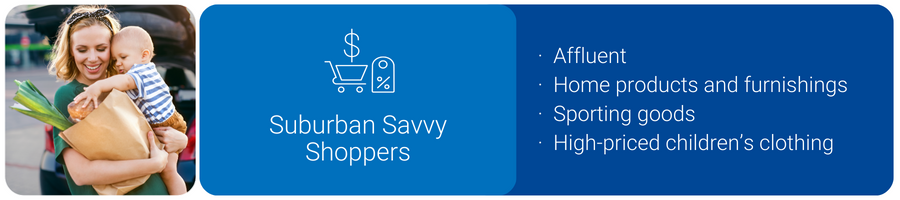
Suburban Savvy Shoppers
Middle-aged couples and families who earn above-average incomes, maintain active lifestyles, and spend their money on quality home products and furnishings.
Key features
- Affluent
- Athletic activities
- Home products & furnishings
- Sporting goods
- High-priced children’s clothing
Young Suburban Families
This segment includes households in the middle child-rearing stages of life, typically with a dual income household and multiple children of school age. They typically have spacious single-family residences in suburban neighborhoods that are slightly above average in housing values. On weekends, these suburban young families often engage in activities like skateboarding, biking, and video games with their children.

Key features
- Comfortable lifestyle
- Children’s games
- Wholesale members
- Family-centric activities
Tech-Savvy Families
Highly educated, affluent couples in their peak earning years, with a preference for both traditional and digital media, who live in upscale housing and are savvy investors and environmental philanthropists.

Key features
- Highly educated
- Affluent
- Upscale housing
- Savvy investors
- Environmental philanthropists
- Tech apprentices
Watch our 2024 video for tips from industry leaders for back-to-school
In our new Q&A video with Experian experts, we explore changing consumer behaviors surrounding back-to-school shopping in 2024. In the video, we discuss:
- Anticipated shifts in consumer behaviors and shopping habits
- Tactics we predict marketers will employ to navigate signal loss
- Which channels will be the most successful
- And more!
Latest posts

According to Experian Simmons, just over 5% of all U.S. adults and nearly a quarter of adult NCAA men’s tournament viewers (24%) qualify as likely online game streamers. How do you know which ones they are?
While WOM sites like Yelp.com continue to grow, their participants continue to be a very distinct subset of U.S. Internet users.
The audiences for the men’s and women’s NCAA Basketball Tournaments are decidedly different from one another. How do they stack up head-to-head?