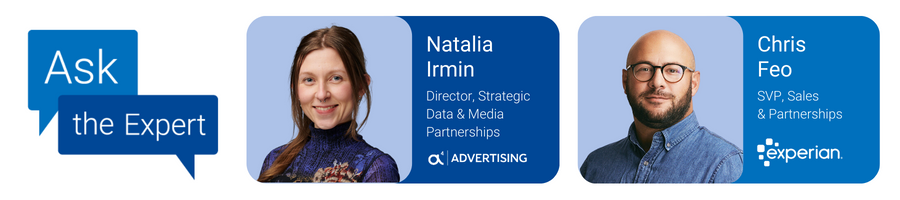
Our next segment in our Ask the Expert series dives into the importance of data enrichment and its benefits across connected TV (CTV) advertising. Ask the Expert features a series of conversations with product experts where we focus on topics that matter the most in AdTech. In our latest segment, Natalia Irmin, Director of Strategic Data & Media Partnerships at a4 Advertising, joins us to chat with Experian’s SVP of Sales & Partnerships, Chris Feo.
a4 is an advanced advertising and data company that offers audience-based, multiscreen advertising solutions for local and national advertising businesses.
In their conversation, Natalia and Chris review:
- The benefits of data enrichment
- First-party data enrichment across advertising
- Data enrichment in CTV advertising
- How Experian and a4 work together

What is data enrichment?
Data enrichment enhances first-party data sets using third-party data sources. This process involves merging first-party data from internal sources with data gathered from other internal sources or from external third-party sources.
Examples of data that can be part of the enrichment process include:
- Demographic information
- Contextual signals
- Behavioral patterns
- Interests
- Purchase-intent
The more you know about your customers, the better equipped you are to reach them where they are with the right message. By enriching your data, you can enhance your messaging, provide personalized offers, and establish a loyal customer base.
First-party data enrichment across advertising
Businesses are transitioning from cookie-based third-party targeting to first-party data enrichment solutions as a result of cookie deprecation. When data enrichment is paired with internal first-party data, you can generate a more holistic customer profile.
a4 has a rich set of first-party data, based on the subscriptions to their services. a4 uses first-party data enrichment across advertising in two ways:
- Measure performance using their viewership data
- Advise their customers on where they should focus their advertising efforts based on the customer’s viewing behavior
a4 supports the enrichment of their customers’ first-party data so they can get the most out of their insights.With Experian’s privacy-first approach, a4 can continue to rely on their first-party data while protecting personally identifiable information (PII).
Data enrichment in CTV advertising
CTV advertising refers to digital advertising that appears through a streaming service during a viewer’s video content, like a movie or TV show. CTV ad campaigns allow businesses to personalize their digital marketing messages while the viewer watches content on various platforms. CTV offers a highly measurable opportunity to increase brand awareness.
Benefits of data enrichment in CTV advertising
Data enrichment provides three key benefits that can enhance targeting, personalization, and campaign effectiveness in CTV advertising.
Understand your target audience
By using enriched data such as demographic information, viewing behavior, and interests, you can gain deeper insights into your target audience, refine your targeting strategies, and create highly personalized ad experiences. Data enrichment also enables better measurement and optimization of ad campaigns, maximizing ROI.
Integrate enriched data with other marketing channels
You can integrate enriched data into CTV with data from other marketing channels. This enables the creation of comprehensive and cohesive marketing strategies that provide consistent messaging and enhance cross-channel targeting.
Enhance the value of ad inventory
Data enrichment can also benefit content publishers and broadcasters by enhancing the value of ad inventory and providing more targeted and effective advertising opportunities.
Enabling your marketers to target specific audiences will result in improved campaign performance. Through data enrichment, you can increase return on your ad spend and boost the value of your publisher’s ad inventory. a4 and Experian can help your business attract additional demand with audience enrichment. a4 uses Experian’s vast offering of audiences and combines it with Experian’s Graph. This data can later be used to activate across a4’s parent company, Altice’s owned and operated properties, as well as beyond Altice’s own footprint via premium publisher partners.
How Experian and a4 work together
a4 and Experian have a long-standing partnership that enables a4 to enhance its data. Through our Consumer View and Consumer Sync products, a4 can add audience attributes to its subscriber and viewer data to precisely pinpoint the audience that its clients are targeting. Experian helps a4 in building a comprehensive customer profile, which helps expand the customer base for a4’s advertising clients.
We form partnerships, like we do with Experian, to enhance our data further, so that we can combine the power of the viewership and exposure data for those other attributes that clients might need.” – Natalia Irmin, Director, Data & Strategic Partnerships, a4 Advertising
Through Experian’s audience attributes and Graph, a4 can assist advertisers in targeting audiences beyond their usual reach, creating a better user experience. a4 can personalize experiences and promotions to prioritize customers with a higher likelihood of making a purchase. By tailoring messages and promotions to individual customer preferences, businesses can improve their advertising efforts and deliver them through their preferred channels.
Watch the full Q&A
Visit our Ask the Expert content hub to watch Natalia and Chris’s full conversation about data enrichment and its benefits across the advertising world. In the Q&A, Natalia and Chris also share their thoughts on the importance of first-party data enrichment, addressability, and measurability in CTV advertising.
About our experts

Natalia Irmin, Director, Strategic Data & Media Partnerships, a4 Advertising
Natalia Irmin is the Director of Strategic Data & Media Partnerships for a4 Advertising. With over 10 years of experience working with data in the Defense, Finance, and Advertising industries, Natalia currently leads the a4 Strategic Partnerships team in the development of advanced data and media products in support of the organization’s media planning, buying, and advanced analytics business. Natalia holds an MBA from the NYU Stern School of Business and a Bachelor of Arts from Tel Aviv University in Israel.

Chris Feo, SVP, Sales & Partnerships, Experian
As SVP of Sales & Partnerships, Chris has over a decade of experience across identity, data, and programmatic. Chris joined Experian during the Tapad acquisition in November 2020. He joined Tapad with less than 10 employees and has been part of the executive team through both the Telenor and Experian acquisitions. He’s an active advisor, board member, and investor within the AdTech ecosystem. Outside of work, he’s a die-hard golfer, frequent traveler, and husband to his wife, two dogs, and two goats!
Latest posts
As today’s digital landscape gets more and more complicated there are more ways for brands to connect with users and drive purchases and more ways for ad tech to target and measure those touch points. As in-person shopping picks up steam due to the re-normalization of society post-COVID 19; the connection between digital ads and in-person purchases needs to be made once again. With the rise of Connected TV throughout the pandemic there are even more digital opportunities to target a user. But how do you make sure that those brand engagements are captured and correctly attributed to offline purchases and conversions? The answer lies in a holistic identity resolution strategy. Cross-device identity resolution with The Tapad Graph connects the identifiers and devices of individuals within a household to each other; enabling targeting, frequency capping, extension, segmentation and measurement or attribution between devices; including Connected TV and hashed (privacy-protected) email addresses along with Cookies, Mobile Ad Ids and IP Address. Brands can join their first-party data to The Tapad Graph to execute strategies that connect online and offline data for pre, mid and post-campaign efficiencies. Let’s imagine a scenario in which an outdoor retail brand is targeting users watching specific content on a Connected TV device. Powered by identity resolution, they start with a general ad on CTV and continue targeting down individual paths with each user. When one of them converts in store and makes a purchase; the outdoor retailer can connect that action through location and in-store traffic data with the cross-device identity resolution used to execute the digital campaign. Now the actions of the user online and offline are resolved for more accurate measurement and attribution after the campaign ends. But it doesn’t stop there– the brand's CRM data can be reactivated for the next digital campaign and leveraged to capitalize on the most effective media mix for the user who made the purchase previously. These combined insights can be invaluable in shaping up future campaign strategies with geo-contextual ads, recommended additional products and personalization to help drive more conversions and purchases in-store or online. As in-person shopping picks back up and marketers are tasked once again with balancing online and in-store KPIs, the right identity resolution strategy can unlock necessary efficiencies for retailers, ad tech vendors and agencies tasked with supporting these initiatives. Get started with The Tapad Graph For personalized consultation on the value and benefits of The Tapad Graph for your business, email Sales@tapad.com today!
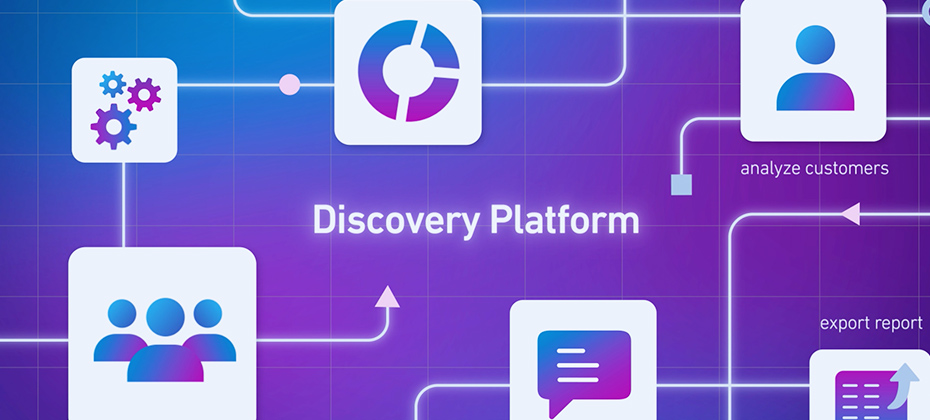
With Discovery Platform, you can find meaningful consumer insights and activate that data to reach growth audiences using content messaging that speaks to their motivations and interests. Take your marketing campaigns from audience discovery to media planning, execution and reporting.

Experian Marketing Services and Data Quality President Genevieve Juillard recently sat down with Zach Rodgers, host of the AdExchanger Talks podcast to discuss the future of identity, the importance of data transparency and privacy, and our recent acquisition of Tapad. Genevieve focused on the opportunity for our industry to reimagine an advertising ecosystem that is resilient and adaptable; one that takes advantage of emerging data and prioritizes data transparency and consumer privacy. She also discussed the importance of advertising strategies that put consumers at the heart of every decision and give them more control over their data. Genevieve shared with AdExchanger that Experian’s acquisition of Tapad, a global leader in digital identity resolution, was a natural fit for our company. Tapad’s approach and role in the ecosystem is very much aligned with Experian’s, which is to develop solutions that are resilient to industry and consumer changes. The combination of our capabilities supports interoperability across all types of identifiers, both online and offline, and will position us to help our clients navigate the post-third-party cookie world. To learn more about Experian’s plans to support an effective advertising ecosystem that will evolve with our dynamic industry, listen to the full podcast Embracing ‘Healthy Fragmentation’ In Ad Tech, With Genevieve Juillard.