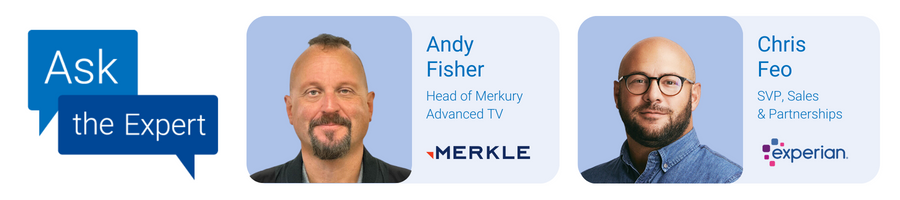
Centralized data access is emerging as a key strategy for advertisers. In our next Ask the Expert segment, we explore this topic further and discuss the importance of data ownership and the concept of audience as an asset.
We’re joined by industry leaders, Andy Fisher, Head of Merkury Advanced TV at Merkle, and Chris Feo, Experian’s SVP of Sales & Partnerships who spotlight Merkle’s commitment to centralized data access and how advertisers can use our combined solutions to navigate industry shifts while ensuring consumer privacy. Watch our Q&A to learn more about these topics and gain insights on how to stay ahead of industry changes.

The concept of audience as an asset
In order to gain actionable marketing insights about your audience, you need to identify consumers who are actively engaged with your brand and compare them against non-engaged consumers, or consumers engaged with rival brands.
Audience ownership
Audience ownership is a fundamental marketing concept where marketers build, define, create, and own their audience. This approach allows you to use your audiences as an asset and deliver a customized journey to the most promising prospects across multiple channels. With this strategy, you enhance marketing effectiveness and ensure ownership over your audience, no matter the platform or channel used.
Merkle enables marketers to own and deploy said asset (audience) so that marketers can have direct control over their audience. With audience strategy, you can tie all elements together – amplify your marketing reach, while maintaining control of your audience. Merkle connects customer experiences with business results.
Data ownership
Data ownership refers to the control organizations have over data they generate, including marketing, sales, product, and customer data. This data is often scattered across multiple platforms, making it difficult to evaluate their effectiveness. Alternatively, owning this data, which is typically housed in a data warehouse, allows the creation of historical overviews, forecasting of customer trends, and cross-channel comparisons. With advertisers and publishers both claiming ownership over their respective data and wanting to control its access, there has been a growing interest in data clean rooms.
Data clean rooms
The growing interest in data clean rooms is largely due to marketers increasing preference to maintain ownership over their audience data. They provide a secure environment for controlled collaboration between advertisers and publishers while preserving the privacy of valuable data. Data clean rooms allow all parties to define their usage terms – who can access it, how it is used, and when it is used. The rise in the use of data clean rooms strengthens data privacy and creates opportunities for deeper customer insights, which leads to enhanced customer targeting. Data clean rooms unlock new data sets, aiding brands, publishers, and data providers in adapting to rapidly changing privacy requirements.
Why is centralized data access important?
Centralized data access is crucial for the effective organization and optimization of your advertising campaigns. It involves consolidating your data in one place, allowing for the identification of inconsistencies.
Merkle’s Merkury platform
The concept of centralized data is a key component of Merkle’s Merkury platform, an enterprise identity platform that empowers brands to own and control first-party identity at an individual level. A common use case involves marketers combining their first-party data with Merkury’s data assets and marketplace data assets to build prospecting audiences. These are later published to various endpoints for activation.
The Merkury platform covers three classes of data:
- Proprietary data set – Permissioned data set covering the entire United States, compiled from about 40 different vendors
- Marketplace data – Includes contributions from various vendors like Experian
- First-party data from marketers – Allows marketers to bring in their own data
Merkury’s identity platform empowers brands to own and control first-party identity at an individual level, unifying known and unknown customer and prospect records, site and app visits, and consumer data to a single, person ID. This makes Merkury the only enterprise identity platform that combines the accuracy and sustainability of client first-party data, quality personally identifiable information (PII) data, third-party data, cookie-less media, and technology platform connections in the market.
End-to-end management of data
Data ownership and management enables you to enhance the quality of your data, facilitate the exchange of information, and ensure privacy compliance.
The Merkury platform provides a comprehensive, end-to-end solution for managing first-party data, all rooted in identity. Unlike data management platforms (DMPs) that are primarily built on cookies, the Merkury platform is constructed on a person ID, allowing it to operate effectively in a cookie-free environment.
A broader perspective with people-based views
The Merkury platform is unique because it contains data from almost every individual in the United States, providing a broader perspective compared to customer data platforms (CDPs) which only contain consumer data. The platform provides a view of the world in a people-based manner, but also offers the flexibility to toggle between person and household views. This enables you to turn data into actionable insights and makes it possible to target specific individuals within a household or consider the household as a whole.
How Experian and Merkle work together
Experian and Merkle have established a strong partnership that magnifies the capabilities of Merkle’s Merkury platform. With Experian’s robust integration capabilities and extensive connectivity opportunities, customers can use this technology for seamless direct integrations, resulting in more effective onboarding to various channels, like digital and TV.
“Experian’s role in Merkury’s data marketplace is essential as they are considered the gold standard for data. It significantly contributes to our connectivity through direct integrations and partnerships. Experian’s presence in various platforms and technologies ensures easy connections and high match rates. Our partnership is very important to us.”
andy fisher, head of merkury advanced tv
Through this partnership, Merkle can deliver unique, personalized digital customer experiences across multiple platforms and devices, highlighting their commitment to data-driven performance marketing.
Watch the full Q&A
Visit our Ask the Expert content hub to watch Andy and Chris’s full conversation about data ownership, innovative strategies to empower you to overcome identity challenges, and navigating industry shifts while protecting consumer privacy.
Tune into the full recording to gain insights into the captivating topics of artificial intelligence (AI), understanding how retail networks can amplify the value of media, and the growing influence of connected TV (CTV). Dive into the Q&A to gain rich insights that could greatly influence your strategies.
About our experts

Andy Fisher, Head of Merkury Advanced TV
As the Head of Merkury Advanced TV, Andy’s primary responsibility is driving person-based marketing and big data adoption in all areas of Television including Linear, Addressable, Connected, Programmatic, and X-channel planning and Measurement. Andy has held several positions at Merkle including Chief Analytics Officer and he ran the Merkle data business. Prior to joining Merkle, Andy was the EVP, Global Data & Analytics Director at Starcom MediaVest Group where he led the SMG global analytics practice. In this role, he built and managed a team of 150 analytics professionals across 17 countries servicing many of the world’s largest advertisers. Prior to that role, Andy was Vice President and National Lead, Analytics at Razorfish, where he led the digital analytics practice and managed a team of modeling, survey, media data, and business intelligence experts. He and his team were responsible for some of the first innovations in multi-touchpoint attribution and joining online/offline data for many of the Fortune 100. Andy has also held leadership positions at Personify and IRI. Andy holds a BA in mathematics from UC Berkeley and an MA in statistics from Stanford.

Chris Feo, SVP, Sales & Partnerships, Experian
As SVP of Sales & Partnerships, Chris has over a decade of experience across identity, data, and programmatic. Chris joined Experian during the Tapad acquisition in November 2020. He joined Tapad with less than 10 employees and has been part of the executive team through both the Telenor and Experian acquisitions. He’s an active advisor, board member, and investor within the AdTech ecosystem. Outside of work, he’s a die-hard golfer, frequent traveler, and husband to his wife, two dogs, and two goats!
Latest posts
London – 24 November, 2017 – Tapad, part of Experian, is the leader in cross-device marketing technology and continues to broaden its reach across EMEA. The business today reported a 20 percent growth in the scope of its regional device graph, a data set used by organisations to map consumers to their devices, enabling better, more personalised cross-device marketing. This news complements Tapad’s recent expansion of its UK team with the hire of experienced solutions engineer, Davide Rosamilia. As the demand for cross-device technology solutions continues to grow around the globe, coupled with the emergence of regulations such as Europe’s General Data Protection Regulation (GDPR), Tapad is committed to offering suppliers the greatest level of insight without compromising consumer privacy. Since Tapad started licensing its proprietary Tapad Device GraphTM just over a year ago, demand for the company’s technology has experienced significant growth. New supply partnerships and proactive data sourcing have also meant an increase in devices across key markets, which contribute to the overall 20 percent growth of the EMEA device graph, including a 44 percent increase in the U.K., 47 percent in France, and 85 percent in Germany. “We’re continuing to invest heavily in growing our regional device graph, allowing us to better meet the needs of EMEA marketers as they strive to reach individuals with greater precision in some of the most tightly regulated marketplaces worldwide,” said Tom Rolph, VP EMEA, Tapad. “This year, we have also welcomed 10 new data suppliers whom we’ve helped to increase cross-device amplification, attribution and audience extension, helping to further set us apart in the marketplace and successfully expand our EMEA presence.” Available around the world, the Device Graph provides access to Tapad’s globally compliant and privacy-safe datasets across EMEA, APAC and the U.S., and offers deeper knowledge of consumer preferences, purchase intent, and conversion behaviors. “Tapad has shown a unique ability to adapt to the nuances of the local EMEA market and display impressive growth without sacrificing dedication to privacy,” said Alistair Hill, CEO and Co-founder at On Device Research. “When we started vetting technology vendors, we needed to be sure that we selected a partner that could offer compliant and privacy-safe datasets to operate within our stringent data standards. Tapad’s probabilistic solution offered us greater scale, greater device reach, and increased engagement without compromising on privacy.” For information more about the Tapad Device Graph™, or to request a demo, contact us today. Get started with us
The Tapad Device Graph™ Will Expand Sizmek’s Cross-Device Reach and Improve the Efficiency and Precision of Digital Advertising NEW YORK, November 16, 2017 — Tapad, part of Experian and a leader in cross-device marketing technology, today announced a new global partnership with Sizmek, the largest independent buy-side advertising platform delivering impressions that inspire. By integrating the Tapad Device Graph™, Sizmek will enhance its AI-powered predictive capabilities to deliver accurate, cross-device messaging at global scale in a privacy-safe environment. Combined with Sizmek’s existing data enablement, creative optimization and media execution capabilities, the proprietary Tapad Device Graph improves the efficiency and precision of digital advertising by accurately matching people and devices. This enables advertisers to get a clear view of individual customer journeys, achieve scale without compromising on efficiency, and uncover new opportunities for conversion. Sizmek’s customers will have access to Tapad’s globally compliant and privacy-safe datasets across the Americas, EMEA, and APAC. With deeper knowledge of consumer preferences, purchase intent and conversion behaviors, Sizmek and its customers are able to enhance advertising strategies including cross-device audience identification and more. “Tapad is known for their strong cross-device capabilities, and their offering is an excellent addition to our growing program for best-of-breed data and measurement partners" says Mike Caprio, Sizmek’s Chief Growth Officer. “For our customers, this partnership will add further people-based marketing precision and reach to our comprehensive offerings around creative optimization, data enablement and media execution." “Sizmek’s adoption of industry-leading AI and machine learning campaigns will be a great complement for the Device Graph,” said Chris Feo, SVP, strategy & global partnerships at Tapad. “Our ability to create smaller, more customized segments in conjunction with Sizmek’s AI modeling will deliver efficiency, effectiveness and increased ROI for marketers worldwide.” This partnership comes at a time of a massive shift in the marketing technology industry. Companies like Tapad and Telenor, as well as Rocket Fuel and Sizmek, are joining forces to adopt those technologies that are most efficient and accurate at reaching consumers at scale in a personalized and non-intrusive way. The combination of Tapad and Sizmek’s offerings will provide international marketers with exceptional resources to lead a more cost effective and results driven campaign. For information more about the Tapad Device Graph™, contact us today. Get started with us

The Tapad Device Graph™ increases Throtle’s amplification by 475 percent. NEW YORK, Nov. 1, 2017 /PRNewswire/ — Tapad, now a part of Experian, the leader in cross-device marketing technology, today announced a partnership with Throtle, a leading data onboarding company. The Tapad Device Graph™ will enhance Throtle's best-in-class onboarding capabilities by providing accurate and privacy-safe cross-device reach as well as precise audiences at scale. In partnership with Tapad, Throtle will deterministically link its services to a corroborated individual with hundreds of targeting attributes. This linkage allows Throtle to offer true cross-device identity management and identity resolution services to accompany its robust onboarding capabilities. Throtle will also work with Tapad to validate its device graph, building larger, more comprehensive audience segments. To date, the Tapad Device Graph™ has connected 61 percent of Throtle IDs to related ones in the graph, with an average amplification rate of 475 percent for Throtle's IDs, or 4.8 new IDs per each of Throtle's. Throtle has also seen its overall match rates involving Tapad's identity insights rise an average of 15 percent since the inception of the partnership. More specifically, Tapad's mobile advertising IDs (MAIDs) have increased Throtle's in-app identity inventory by 35 percent. "Tapad has proven to be a trusted source for cross-device matching and has a tremendous reputation in the advertising and marketing technology industries for delivering superior precision and scale with the utmost dedication to privacy," says Paul Chachko, CEO, Throtle. "Since we first began our test phase, and continuing through to this day, Tapad has met and exceeded our expectations for what a partner should be." With Tapad's strong commitment to precision and accuracy, Throtle was confident that this partnership would prove to be the right choice for the strategic expansion of its platform. Not only does Tapad deliver in-depth insights, parsing deterministic from probabilistic linkages, but its pool of device-level touchpoints enables Throtle to increase scale without seeing a decline in precision. "Accuracy and precision are core characteristics of our proprietary Device Graph," explains Chris Feo, SVP, Strategy & Global Partnerships, Tapad. "When Throtle approached our team, we knew we would be the right partner to assist their leading onboarding technology. We're excited to work with Throtle to achieve cross-device reach, audience scale and precise deterministic and probabilistic linkages for its clients." For more information about the Tapad Device Graph™, or to request a demo, visit https://www.experian.com/marketing/consumer-sync About TapadTapad Inc. is a marketing technology company renowned for its breakthrough, unified, cross-device solutions. The company's signature Tapad Device Graph™ connects millions of consumers across billions of devices. The world's largest brands and most effective marketers entrust Tapad to provide an accurate, privacy-conscious, and unified approach to connecting with consumers across screens. In 2015, Tapad began licensing the Tapad Device Graph™ and swiftly became the established gold-standard throughout the ad tech ecosystem. Tapad is based in New York and has offices in Boston, Chicago, Dallas, Detroit, London, Los Angeles, Miami, Oslo, San Francisco, Singapore, and Tokyo. Tapad's numerous awards include: Forbes' Most Promising Companies, Deloitte's Technology Fast 500, Crain's Fast 50, TMCnet Tech Culture Award, and Global Startup Award's "Startup Founder of the Year". In 2016, Tapad was acquired by the Telenor Group, one of the world's largest mobile operators. About ThrotleThrotle is a data onboarding company focused on deterministic matching and identity resolution, empowering brands with true individual-based marketing. Our data centric onboarding approach guarantees the highest level of accuracy, scale, and responsiveness for our clients. For more information on Throtle, please visit, throtle.io. Contact us today!