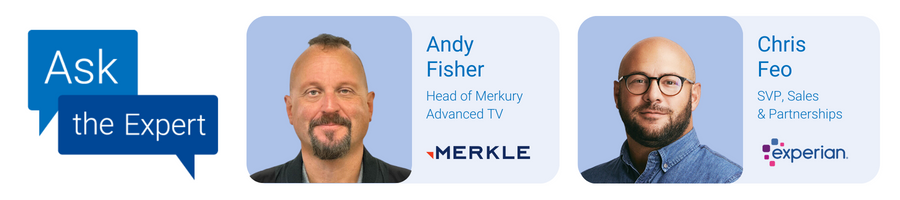
Centralized data access is emerging as a key strategy for advertisers. In our next Ask the Expert segment, we explore this topic further and discuss the importance of data ownership and the concept of audience as an asset.
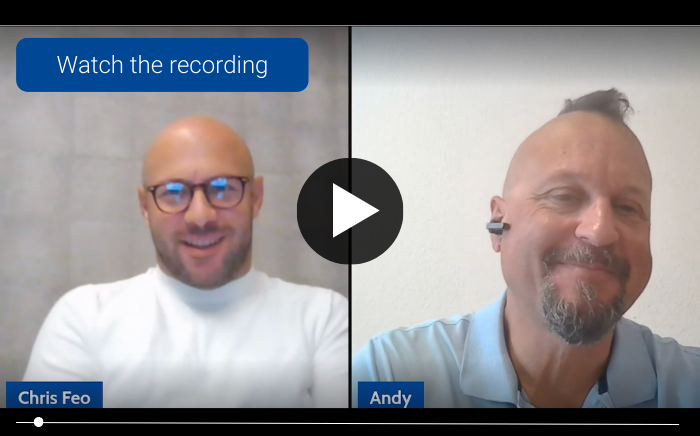
We’re joined by industry leaders, Andy Fisher, Head of Merkury Advanced TV at Merkle, and Chris Feo, Experian’s SVP of Sales & Partnerships who spotlight Merkle’s commitment to centralized data access and how advertisers can use our combined solutions to navigate industry shifts while ensuring consumer privacy. Watch our Q&A to learn more about these topics and gain insights on how to stay ahead of industry changes.
The concept of audience as an asset
In order to gain actionable marketing insights about your audience, you need to identify consumers who are actively engaged with your brand and compare them against non-engaged consumers, or consumers engaged with rival brands.
Audience ownership
Audience ownership is a fundamental marketing concept where marketers build, define, create, and own their audience. This approach allows you to use your audiences as an asset and deliver a customized journey to the most promising prospects across multiple channels. With this strategy, you enhance marketing effectiveness and ensure ownership over your audience, no matter the platform or channel used.
Merkle enables marketers to own and deploy said asset (audience) so that marketers can have direct control over their audience. With audience strategy, you can tie all elements together – amplify your marketing reach, while maintaining control of your audience. Merkle connects customer experiences with business results.
Data ownership
Data ownership refers to the control organizations have over data they generate, including marketing, sales, product, and customer data. This data is often scattered across multiple platforms, making it difficult to evaluate their effectiveness. Alternatively, owning this data, which is typically housed in a data warehouse, allows the creation of historical overviews, forecasting of customer trends, and cross-channel comparisons. With advertisers and publishers both claiming ownership over their respective data and wanting to control its access, there has been a growing interest in data clean rooms.
Data clean rooms
The growing interest in data clean rooms is largely due to marketers increasing preference to maintain ownership over their audience data. They provide a secure environment for controlled collaboration between advertisers and publishers while preserving the privacy of valuable data. Data clean rooms allow all parties to define their usage terms – who can access it, how it is used, and when it is used. The rise in the use of data clean rooms strengthens data privacy and creates opportunities for deeper customer insights, which leads to enhanced customer targeting. Data clean rooms unlock new data sets, aiding brands, publishers, and data providers in adapting to rapidly changing privacy requirements.
Why is centralized data access important?
Centralized data access is crucial for the effective organization and optimization of your advertising campaigns. It involves consolidating your data in one place, allowing for the identification of inconsistencies.
Merkle’s Merkury platform
The concept of centralized data is a key component of Merkle’s Merkury platform, an enterprise identity platform that empowers brands to own and control first-party identity at an individual level. A common use case involves marketers combining their first-party data with Merkury’s data assets and marketplace data assets to build prospecting audiences. These are later published to various endpoints for activation.
The Merkury platform covers three classes of data:
- Proprietary data set – Permissioned data set covering the entire United States, compiled from about 40 different vendors
- Marketplace data – Includes contributions from various vendors like Experian
- First-party data from marketers – Allows marketers to bring in their own data
Merkury’s identity platform empowers brands to own and control first-party identity at an individual level, unifying known and unknown customer and prospect records, site and app visits, and consumer data to a single, person ID. This makes Merkury the only enterprise identity platform that combines the accuracy and sustainability of client first-party data, quality personally identifiable information (PII) data, third-party data, cookie-less media, and technology platform connections in the market.
End-to-end management of data
Data ownership and management enables you to enhance the quality of your data, facilitate the exchange of information, and ensure privacy compliance.
The Merkury platform provides a comprehensive, end-to-end solution for managing first-party data, all rooted in identity. Unlike data management platforms (DMPs) that are primarily built on cookies, the Merkury platform is constructed on a person ID, allowing it to operate effectively in a cookie-free environment.
A broader perspective with people-based views
The Merkury platform is unique because it contains data from almost every individual in the United States, providing a broader perspective compared to customer data platforms (CDPs) which only contain consumer data. The platform provides a view of the world in a people-based manner, but also offers the flexibility to toggle between person and household views. This enables you to turn data into actionable insights and makes it possible to target specific individuals within a household or consider the household as a whole.
How Experian and Merkle work together
Experian and Merkle have established a strong partnership that magnifies the capabilities of Merkle’s Merkury platform. With Experian’s robust integration capabilities and extensive connectivity opportunities, customers can use this technology for seamless direct integrations, resulting in more effective onboarding to various channels, like digital and TV.
“Experian’s role in Merkury’s data marketplace is essential as they are considered the gold standard for data. It significantly contributes to our connectivity through direct integrations and partnerships. Experian’s presence in various platforms and technologies ensures easy connections and high match rates. Our partnership is very important to us.”
andy fisher, head of merkury advanced tv
Through this partnership, Merkle can deliver unique, personalized digital customer experiences across multiple platforms and devices, highlighting their commitment to data-driven performance marketing.
Watch the full Q&A
Visit our Ask the Expert content hub to watch Andy and Chris’s full conversation about data ownership, innovative strategies to empower you to overcome identity challenges, and navigating industry shifts while protecting consumer privacy.
Tune into the full recording to gain insights into the captivating topics of artificial intelligence (AI), understanding how retail networks can amplify the value of media, and the growing influence of connected TV (CTV). Dive into the Q&A to gain rich insights that could greatly influence your strategies.
About our experts

Andy Fisher, Head of Merkury Advanced TV
As the Head of Merkury Advanced TV, Andy’s primary responsibility is driving person-based marketing and big data adoption in all areas of Television including Linear, Addressable, Connected, Programmatic, and X-channel planning and Measurement. Andy has held several positions at Merkle including Chief Analytics Officer and he ran the Merkle data business. Prior to joining Merkle, Andy was the EVP, Global Data & Analytics Director at Starcom MediaVest Group where he led the SMG global analytics practice. In this role, he built and managed a team of 150 analytics professionals across 17 countries servicing many of the world’s largest advertisers. Prior to that role, Andy was Vice President and National Lead, Analytics at Razorfish, where he led the digital analytics practice and managed a team of modeling, survey, media data, and business intelligence experts. He and his team were responsible for some of the first innovations in multi-touchpoint attribution and joining online/offline data for many of the Fortune 100. Andy has also held leadership positions at Personify and IRI. Andy holds a BA in mathematics from UC Berkeley and an MA in statistics from Stanford.

Chris Feo, SVP, Sales & Partnerships, Experian
As SVP of Sales & Partnerships, Chris has over a decade of experience across identity, data, and programmatic. Chris joined Experian during the Tapad acquisition in November 2020. He joined Tapad with less than 10 employees and has been part of the executive team through both the Telenor and Experian acquisitions. He’s an active advisor, board member, and investor within the AdTech ecosystem. Outside of work, he’s a die-hard golfer, frequent traveler, and husband to his wife, two dogs, and two goats!
Latest posts

Question #1 Lorem ipsum dolor sit amet, consectetur adipiscing elit. Nullam interdum odio in viverra mattis. Praesent at lectus vitae massa convallis vehicula. Vivamus et ex sed ex aliquet ultrices sed nec ante. Vestibulum a tincidunt massa. Vivamus tincidunt condimentum magna in tempor. Suspendisse dictum, elit at commodo dignissim, sem nisl luctus erat, nec consectetur leo mi sit amet nibh. Vestibulum at nisi ac libero aliquet volutpat congue ut mi. Morbi in congue eros, a faucibus nibh. Vivamus consequat a purus eu tempor. Morbi eu diam dui. Aliquam erat volutpat. Sed odio felis, sollicitudin consequat pellentesque ac, congue sed nisl. Maecenas sagittis mauris at ante ultricies elementum. Pellentesque vestibulum dolor ut tincidunt cursus. Question #2 Lorem ipsum dolor sit amet, consectetur adipiscing elit. Nullam interdum odio in viverra mattis. Praesent at lectus vitae massa convallis vehicula. Vivamus et ex sed ex aliquet ultrices sed nec ante. Vestibulum a tincidunt massa. Vivamus tincidunt condimentum magna in tempor. Suspendisse dictum, elit at commodo dignissim, sem nisl luctus erat, nec consectetur leo mi sit amet nibh. Vestibulum at nisi ac libero aliquet volutpat congue ut mi. Morbi in congue eros, a faucibus nibh. Vivamus consequat a purus eu tempor. Morbi eu diam dui. Aliquam erat volutpat. Sed odio felis, sollicitudin consequat pellentesque ac, congue sed nisl. Maecenas sagittis mauris at ante ultricies elementum. Pellentesque vestibulum dolor ut tincidunt cursus. Question #3 Lorem ipsum dolor sit amet, consectetur adipiscing elit. Nullam interdum odio in viverra mattis. Praesent at lectus vitae massa convallis vehicula. Vivamus et ex sed ex aliquet ultrices sed nec ante. Vestibulum a tincidunt massa. Vivamus tincidunt condimentum magna in tempor. Suspendisse dictum, elit at commodo dignissim, sem nisl luctus erat, nec consectetur leo mi sit amet nibh. Vestibulum at nisi ac libero aliquet volutpat congue ut mi. Morbi in congue eros, a faucibus nibh. Vivamus consequat a purus eu tempor. Morbi eu diam dui. Aliquam erat volutpat. Sed odio felis, sollicitudin consequat pellentesque ac, congue sed nisl. Maecenas sagittis mauris at ante ultricies elementum. Pellentesque vestibulum dolor ut tincidunt cursus.
H2 Heading Lorem ipsum dolor sit amet, consectetur adipiscing elit. Aenean quis ipsum et orci dictum accumsan eget nec purus. Sed varius finibus augue, sed egestas risus posuere et. Donec elit sem, finibus ut tellus a, maximus hendrerit diam. Suspendisse commodo metus nec nisi consectetur, interdum fringilla sem ultricies. Integer semper molestie viverra. Cras a pharetra nisi, ac vulputate lorem. Vestibulum vitae efficitur odio, vel pharetra sem. Duis vel arcu mauris. Donec nec elementum magna. Orci varius natoque penatibus et magnis dis parturient montes, nascetur ridiculus mus. Nulla vel consectetur risus. Donec quis feugiat ante. Morbi quis lacus ac augue bibendum hendrerit vitae vel purus. Orci varius natoque penatibus et magnis dis parturient montes, nascetur ridiculus mus. Orci varius natoque penatibus et magnis dis parturient montes, nascetur ridiculus mus. Orci varius natoque penatibus et magnis dis parturient montes, nascetur ridiculus mus. Lorem ipsum dolor sit amet, consectetur adipiscing elit. Aenean quis ipsum et orci dictum accumsan eget nec purus. Sed varius finibus augue, sed egestas risus posuere et. Donec elit sem, finibus ut tellus a, maximus hendrerit diam. Suspendisse commodo metus nec nisi consectetur, interdum fringilla sem ultricies. Integer semper molestie viverra. Cras a pharetra nisi, ac vulputate lorem. Vestibulum vitae efficitur odio, vel pharetra sem. Duis vel arcu mauris. Donec nec elementum magna. Orci varius natoque penatibus et magnis dis parturient montes, nascetur ridiculus mus. Nulla vel consectetur risus. Donec quis feugiat ante. Morbi quis lacus ac augue bibendum hendrerit vitae vel purus. Icon Heading #1 Lorem ipsum dolor sit amet, consectetur adipiscing elit. Aenean quis ipsum et orci dictum accumsan eget nec purus. Sed varius finibus augue, sed egestas risus posuere et. Donec elit sem, finibus ut tellus a, maximus hendrerit diam. Suspendisse commodo metus nec nisi consectetur, interdum fringilla sem ultricies. Icon Heading #2 Lorem ipsum dolor sit amet, consectetur adipiscing elit. Aenean quis ipsum et orci dictum accumsan eget nec purus. Sed varius finibus augue, sed egestas risus posuere et. Donec elit sem, finibus ut tellus a, maximus hendrerit diam. Suspendisse commodo metus nec nisi consectetur, interdum fringilla sem ultricies. Icon Heading #3 Lorem ipsum dolor sit amet, consectetur adipiscing elit. Aenean quis ipsum et orci dictum accumsan eget nec purus. Sed varius finibus augue, sed egestas risus posuere et. Donec elit sem, finibus ut tellus a, maximus hendrerit diam. Suspendisse commodo metus nec nisi consectetur, interdum fringilla sem ultricies. Lorem ipsum dolor sit amet, consectetur adipiscing elit. Aenean quis ipsum et orci dictum accumsan eget nec purus. Sed varius finibus augue, sed egestas risus posuere et. Donec elit sem, finibus ut tellus a, maximus hendrerit diam. Suspendisse commodo metus nec nisi consectetur, interdum fringilla sem ultricies. Integer semper molestie viverra. Cras a pharetra nisi, ac vulputate lorem. Vestibulum vitae efficitur odio, vel pharetra sem. Duis vel arcu mauris. Donec nec elementum magna. Orci varius natoque penatibus et magnis dis parturient montes, nascetur ridiculus mus. Nulla vel consectetur risus. Donec quis feugiat ante. Morbi quis lacus ac augue bibendum hendrerit vitae vel purus.
This is my test Test 2 "Lorem ipsum dolor sit amet, consectetur adipiscing elit, sed do eiusmod tempor incididunt ut labore et dolore magna aliqua. Ut enim ad minim veniam, quis nostrud exercitation ullamco laboris nisi ut aliquip ex ea commodo consequat. Duis aute irure dolor in reprehenderit in voluptate velit esse cillum dolore eu fugiat nulla pariatur. Excepteur sint occaecat cupidatat non proident, sunt in culpa qui officia deserunt mollit anim id est laborum.""Lorem ipsum dolor sit amet, consectetur adipiscing elit, sed do eiusmod tempor incididunt ut labore et dolore magna aliqua. Ut enim ad minim veniam, quis nostrud exercitation ullamco laboris nisi ut aliquip ex ea commodo consequat. Duis aute irure dolor in reprehenderit in voluptate velit esse cillum dolore eu fugiat nulla pariatur. Excepteur sint occaecat cupidatat non proident, sunt in culpa qui officia deserunt mollit anim id est laborum.""Lorem ipsum dolor sit amet, consectetur adipiscing elit, sed do eiusmod tempor incididunt ut labore et dolore magna aliqua. Ut enim ad minim veniam, quis nostrud exercitation ullamco laboris nisi ut aliquip ex ea commodo consequat. Duis aute irure dolor in reprehenderit in voluptate velit esse cillum dolore eu fugiat nulla pariatur. Excepteur sint occaecat cupidatat non proident, sunt in culpa qui officia deserunt mollit anim id est laborum." This is my 2nd test