With over one billion shoppers eagerly preparing to shop for gifts, decorations, and seasonal essentials, now is the perfect time to refine your marketing tactics and connect with these shoppers. With holiday retail sales set to reach $1.37 trillion, it’s time to unwrap holiday spending insights to ensure that your holiday advertising campaigns light up the festive season. The holiday shopping frenzy offers marketers and retailers a chance to capture attention, drive sales, and build lasting customer relationships.
In this blog post, we’ll reveal holiday shopping audiences, including 19 new audiences, designed for you to reach the most relevant shoppers for your campaigns. These audiences are available for activation on-the-shelf of most major ad platforms, including TV and programmatic. You can find the complete audience segment name in the appendix.
2024 Holiday spending trends and insights report
Download our latest report for data-driven insights you can use to refine your messaging and reach the right audience in their preferred channels this holiday season.
Download nowHoliday shopping styles
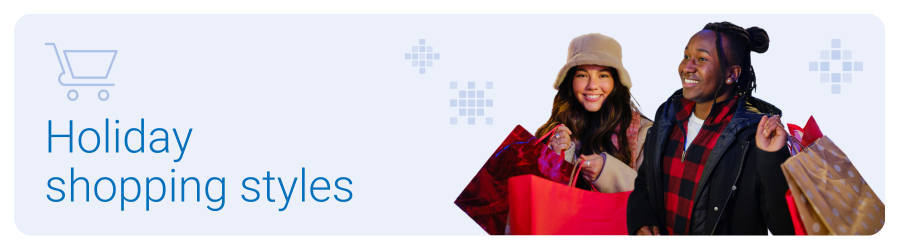
It’s important to understand how your holiday shopper “shops,” with individual shopping styles varying from a last-minute dash to the store to the one-stop shopper. One in three consumers anticipate beginning their holiday shopping before October this year, with Millennials and Gen Xers being the most proactive, due to concerns about items running out of stock. In contrast, 42% of Boomers are generally less inclined to shop early, wanting to start their holiday shopping in November or December. All generations are motivated to shop early by discounts.1
By choosing and activating the right audience segments, you can deliver messages that resonate with the consumer’s preferred shopping style, ensuring your holiday campaign will align with their shopping preferences and behaviors.
Here are five audiences that you can activate based on shopping style:
- Last-Minute Holiday Shoppers
- One Stop Holiday Shoppers/Power Shoppers: In-Store or Online
- Impulse Buyers
- eCommerce Diehards
- Brick & Mortar Diehards
Discount-seeking shoppers
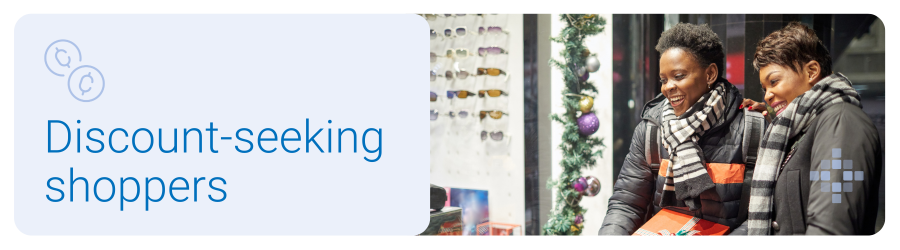
The holiday season is a time of giving, but also saving! Consumers are driven to shop early by discounts and early sales — 52% of consumers said discounts are their biggest motivator to shop early. Price is another crucial factor — 47% of consumers said price is the most important factor when deciding where to shop during the holiday season. Major holiday shopping events, such as Thanksgiving Day, Black Friday, and Cyber Monday, are expected to attract a significant portion of consumers this upcoming year.2
Here are eight audiences you can activate to reach discount-seeking shoppers:
- NEW! Discount Holiday Shoppers
- NEW! Cyber Monday Holiday Shoppers
- NEW! Black Friday Holiday Shoppers
- NEW! Big Box/Club Stores Holiday Shoppers
- NEW! Online Coupon Users
- TrueTouch: Online Coupon Site
- Department Store Deal Shoppers: In-Store or Online
- Post Holiday Shoppers
Gift givers
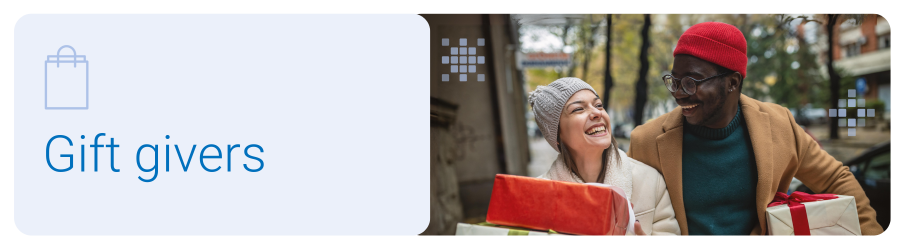
Holiday shoppers are torn between saving and splurging. Nearly a third of consumers anticipate spending more on holiday shopping this year, while the same number of consumers say they’ll be spending less. Boomers anticipate spending the most on gift cards, Gen Z on clothing, and Millennials on toys, electronics, and experiences.3
Given holiday shoppers’ varied spending habits, it’s important to target the right audience segments to maximize your impact. Targeting specific audience segments allows advertisers to better reach those most interested in their products.
Here are six audiences you can activate to target gift givers:
- NEW! Luxury Gift Shoppers
- NEW! Holiday Shopping High Spenders
- NEW! Holiday Shopping Moderate Spenders
- NEW! Holiday Charitable Donations
- High Spend Gift Shoppers
- Heavy Buyer/Spenders Holiday Shoppers: In-Store or Online
Holiday travelers

In 2023, nearly three million travelers passed through airports on the Sunday after Thanksgiving alone. Take advantage of the busy travel season with our audience segments. By targeting specific travel preferences and behaviors, you can capture the attention of individuals planning trips this holiday season.
Here are seven audiences to tailor your campaign according to travel preferences:
- NEW! Holiday International Travelers
- NEW! Holiday Travel-Train
- NEW! Holiday Budget Savvy Airline Travelers
- Vacation/Leisure Travelers: Domestic Trips
- Air Travel (FLA/Fair Lending Friendly)4
- Vacation/Leisure Travelers: Frequent Spenders
- Hotels: Frequent Spend
When you work with Experian, you work with a single data provider that gives you access to audiences across multiple verticals and categories, such as travel and retail.
Targeted advertising this holiday season with Experian audiences
The holiday season is the busiest time of the year for advertisers. Experian’s data, ranked #1 in accuracy by Truthset, allows advertisers to reach people based on demographic, geographic, and behavioral attributes (e.g. websites visited and purchase history). By using Experian’s audiences in your holiday advertising campaigns, you can reach last-minute shoppers, discount-seeking shoppers, gift-givers, and holiday travelers.
Just as shoppers seek the perfect gifts, with the right strategy, your holiday advertising campaigns can capture the right shoppers this holiday season. Can’t find the audience you’re looking for or need a custom audience? Connect with our audience team for more information.
You can activate our syndicated audiences on-the-shelf of most major platforms. For a full list of Experian’s syndicated audiences and activation destinations, download our syndicated audiences guide.
Explore our other seasonal audiences that you can activate today.
Footnotes
- Online survey conducted in June, 2024 among n=1,000 U.S. adults 18+. Sample balanced to look like the general population on key demographics (age, gender, household income, ethnicity, and region). n = 204 Gen Z, n = 234 Millennials, n = 270 Gen X, n = 272 Baby Boomers.
- Online survey.
- Online survey.
- “Fair Lending Friendly” indicates data fields that Experian has made available without use of certain demographic attributes that may increase the likelihood of discriminatory practices prohibited by the Fair Housing Act (“FHA”) and Equal Credit Opportunity Act (“ECOA”). These excluded attributes include, but may not be limited to, race, color, religion, national origin, sex, marital status, age, disability, handicap, family status, ancestry, sexual orientation, unfavorable military discharge, and gender. Experian’s provision of Fair Lending Friendly indicators does not constitute legal advice or otherwise assures your compliance with the FHA, ECOA, or any other applicable laws. Clients should seek legal advice with respect to your use of data in connection with lending decisions or application and compliance with applicable laws.
Appendix
Here are the complete audience segment names (taxonomy paths) for all audience segments discussed in this blog post.
Holiday shopping styles
- Retail Shoppers: Purchase Based > Seasonal > Holiday Shoppers: Last-Minute Holiday Shoppers
- Retail Shoppers: Purchased Based > Seasonal > Holiday Shoppers: One Stop Holiday Shoppers/Power Shoppers: In-Store
- Retail Shoppers: Purchased Based > Seasonal > Holiday Shoppers: One Stop Holiday Shoppers/Power Shoppers: Online
- TrueTouch: Communication Preferences > Purchase Behavior > Impulse buyers
- Retail Shoppers: Purchase behavior > Shopping Behavior > In-Store vs. Online: eCommerce Diehards
- Retail Shoppers: Purchase behavior > Shopping Behavior > In-Store vs. Online: Brick & Mortar Diehards
Discount-seeking shoppers
- NEW! Retail Shoppers: Purchase Based > Seasonal > Holiday Shoppers: Cyber Monday
- NEW! Retail Shoppers: Purchase Based > Seasonal > Holiday Shoppers: Black Friday
- NEW! Retail Shopper: Purchase Based > Seasonal > Holiday Shoppers: Big Box/Club Stores Shoppers
- NEW! Retail Shoppers: Purchase Based >> Discount Holiday Shoppers
- NEW! Retail Shoppers: Purchased Based > Shopping Behavior > Online Coupon Users
- TrueTouch: Communication Preferences> Purchase Behavior > Online Coupon Site
- Retail Shoppers: Purchased Based > Shopping Behavior > Department Store Deal Shoppers Online Spenders
- Retail Shoppers: Purchased Based > Shopping Behavior > Department Store Deal Shoppers In-Store Spenders
- Retail Shoppers: Purchased Based > Seasonal > Holiday Shoppers: Post holiday
Gift givers
- NEW! Retail Shoppers: Purchase Based > Seasonal > Holiday Shoppers: Luxury Gift Shoppers
- NEW! Retail Shoppers: Purchase Based > Seasonal > Holiday Shoppers: High Spenders
- NEW! Retail Shoppers: Purchase Based > Seasonal > Holiday Shoppers: Moderate Spenders
- NEW! Retail Shoppers: Purchase Based > Seasonal > Holiday Charitable Donations
- Retail Shoppers: Purchase Based > Shopping Behavior > Gift Shoppers High Spend Spenders
- Retail Shoppers: Purchase Based > Seasonal > Holiday Shoppers: Heavy Buyer/Spenders: Online
- Retail Shoppers: Purchase Based > Seasonal > Holiday Shoppers: Heavy Buyer/Spenders: In Store
Holiday travelers
- NEW! Retail Shoppers: Purchase Based > Seasonal > Holiday International Travelers
- NEW! Retail Shoppers: Purchase Based > Seasonal> Holiday Travel-Train
- NEW! Retail Shoppers: Purchase Based > Seasonal > Holiday Budget Savvy Airline Travelers
- Retail Shoppers: Purchase Based > Travel > Vacation/Leisure Travelers: Domestic Trips
- Lifestyle and Interests (Affinity) > Travelers > Air Travel (FLA/Fair Lending Friendly)
- Retail Shoppers: Purchase Based > Travel > Vacation/Leisure Travelers: Frequent Spenders
- Retail Shoppers: Purchase Based > Travel > Hotels: Frequent Spend
Latest posts

Forward thinking marketers leverage the power of social networking sites like Facebook, MySpace, Twitter and more to connect to consumers in a more personal and meaningful way. That’s why Experian Simmons is focusing on social networking in this issue of Consumer Insights, featuring the freshest insights available from the latest Simmons New Media Study. The 2010 Social Networking Report provides the hard data behind this consumer revolution, including the fact that fully 66% of online Americans use social networking sites today, up from just 20% in 2007. Social networking is an increasingly addictive activity, with nearly half of those who access such sites (43%) reporting that they visit them multiple times per day. While users of social networking sites may have initially signed up to better keep in touch with friends, a growing number say they now use sites like Facebook to connect with family members. An astounding 70% of social networkers keep in touch with family via their various online networks, up from 61% a year ago. Fully two-thirds of all online adults today have visited a social networking site in the last 30 days, up from 53% in 2008 and 20% in 2007. Social networks have most thoroughly penetrated the young adult market, as nearly 9-in-10 online 18-to 34-year-olds visit such sites today. But even older Americans are tapping into social networks, with 41% of online adults age 50 and older making monthly visits to sites like Facebook, MySpace and Twitter. The rise of social networking tracks closely with that of Facebook. As of April 26, 2010, 46% of the U.S. online adult population reported having visited Facebook in the past 30 days. While keeping in touch with others is an important part of social networking, the popularity of games like Farmville and Mafia Wars illustrate that fun is a big part of the appeal of social networking. Whether it’s keeping in touch with others, playing games, debating politics or any of the other reasons people use social networking sites, it cannot be denied that there’s a sense of addictiveness to it all. Visiting social networking sites multiple times a day is up 28% over last year, while less frequent visits are down across the board. As social networking sites extend their reach across generations, Americans are increasingly using such sites to connect with more than just their friends. Today, 17% of social networkers communicate with their parents via those sites and 22% connect with their kids, up from 9% and 15%, respectively, a year ago. An astounding two-thirds of social networking site visitors (68%) say they have shown their support of a product, service, company or musical group by becoming a “fan” or a “friend” on a social networking site. One year earlier, only 57% of social networkers had publicly declared their “like” for a product, service, company or musical group. Knowing that social networkers are comfortable connecting with products and brands they support, it’s important to understand which brands have the best opportunity to connect with this group. Top retail brands among Facebook users, for instance, include H&M, Hot Topc and Forever 21. Specifically, Facebook users are full twice as likely as the average American adult to shop at H&M. Twitter visitors are 3.7 times more likely to shop at Nordstrom. Heavy users of social networking sites are primarily concentrated in the Northwest and markets that are heavily influenced by major colleges or universities.
The vast majority of Facebook visitors—like most Internet users—say they like websites that take special care to protect their privacy. Yet as the popularity of Facebook grew during 2009 among both younger and older adults, there was a general waning in visitors’ advocacy of online privacy. In fact, the share of Facebook visitors sensitive to privacy protection experienced a 9% relative decline between January and November of 2009. That decline may have continued, were it not for a series of privacy policy updates issued by the social networking giant. In November 2009, Facebook changed its default settings to publicly reveal a larger than before amount of its users’ information. Then in December 2009, the privacy settings were entirely removed from certain categories of users’ information. And lastly, in April 2010, users’ General Information became publicly exposed whenever they connected to certain applications or websites, a move that seriously angered many Facebook adherents. Following these changes, the share of Facebook users who are sensitive to privacy protection rose. Specifically, between November 2009 and April 2010, the percent of users who like sites that protect their privacy increased a relative 7%. Facebook’s decision to return, and even simplify, control over privacy settings to account holders may appease users, but whether a subsequent drop in support of online privacy will ensue down the line is far from certain.
Same-sex marriage is a hot button topic no matter on which side of the issue you stand. But there can be no denying that same-sex couples are finding an expanding number of options in the U.S. and abroad should they decide to legally wed. The 2010 LGBT Consumer Report explores the household arrangements and behaviors of America’s LGBT consumers—in particular, those associated with marriage—compared to America’s heterosexual population. You will learn that despite being less than half as likely to be married, lesbian, gay and bisexual adults are 22% more likely than their “straight” counterparts to have recently wed or to be planning nuptials for the next year. Looking for that perfect gift for the newly wed couple? You will also get some shopping tips for identifying favored retailers of lesbian, gay and bisexual shoppers. We’ll start by sizing the LGBT market. An estimated 3.7% of the non-Hispanic adult population (7.1 million adults) self-identifies as LGBT, which can be broken down as follows: The average heterosexual adult lives in a household with 1.9 other individuals, including adults and kids. By comparison, the average lesbian shares her home with only 1.6 other people. Gay men live in the smallest households, sharing their home with only one other person, on average. Over a third of gay or bisexual men (38%) share their home with at least one other adult male, compared with only 24% of heterosexual men who live under the same roof as another adult male. Thirty-five percent of gay or bisexual men say they live with one (and only one) other adult male, a living arrangement that has a higher chance of consisting of a same-sex, co-habiting couple. Over half of lesbians or bisexual women (53%) share their home with at least one other adult female, compared with only 23% of heterosexual women who live under the same roof as another adult female. Forty-three percent of lesbian or bisexual women say they live with one (and only one) other adult female, a living arrangement that has a higher chance of consisting of a same-sex, co-habiting couple. Lesbian, Gay and Bisexual adults (LGB) as a group are less than half as likely as heterosexuals to be married. Only 26% of LGB adults are wed, compared with 57% of “straight” adults. Of all LGB adults, bisexuals are the most likely group to be married, with over 4 in 10 reporting they are presently wed. Lesbians are more than four and a half times more likely than gay men to be married, with 23% of lesbians having tied the knot versus only 5% of gay men. Lesbian, gay and bisexual adults as a group are 22% more likely than heterosexual adults to have either tied the knot in the last 12 months or have plans to wed in the coming year. 5.7% of lesbian, gay or bisexual adults are newly weds or “soonly” weds vs. 4.6% of heterosexual adults. Lesbian, gay and bisexual adults are twice as likely to shop at Neiman Marcus, making the department store the number one retailer with a wedding registry program among LGB shoppers. With many retailers ending their registry programs in favor of gift cards, we looked at how stores without registry programs stack up among lesbian, gay and bisexual shoppers. LGB adults are almost twice as likely to shop at J. Crew, making the store the number one retailer without a wedding registry program among LGB shoppers.