Loading...

Introducing Experian’s Collaboration in clean rooms offering

Published: July 15, 2024 by Lucy Simmonds

Enhance data security and maximize match rates with Collaboration in clean rooms

At Experian, we power data-driven advertising through connectivity. Today, we’re excited to introduce our newest offering, which helps drive that connectivity: Experian’s Collaboration in clean rooms. This offering is now generally available in InfoSum, AWS Clean Rooms, and others. Experian can now facilitate successful data collaboration across multiple secure environments, such as at Experian, through crosswalks, and now in clean rooms.

Whether you are a marketer or partner, introducing Experian’s signal-agnostic offline and digital identity graphs into your clean rooms lets you run identity resolution directly in the clean room. This means your data remains secure, while you and your partner experience higher match rates and you maximize your clean room investment, leading to:

  • More resolved data
  • More valuable insights and smarter activation
  • More accurate and complete measurement

A leap forward in data collaboration

Backed by Experian’s Global Data Principles, Experian’s deep roots in identity and data security offer the most effective and trusted ways to match data and protect consumer privacy. Our signal-agnostic approach means we can resolve all types of offline and digital identity signals, which is valuable now and will become even more valuable as third-party cookies go away. Additionally, data hygiene is built right into our collaboration offering, helping to improve match rates.

The benefits of working with Experian’s rich identity data in a clean room environment are obvious so it is no surprise to see that 55% of data clean room users are using identity solutions in data clean rooms.
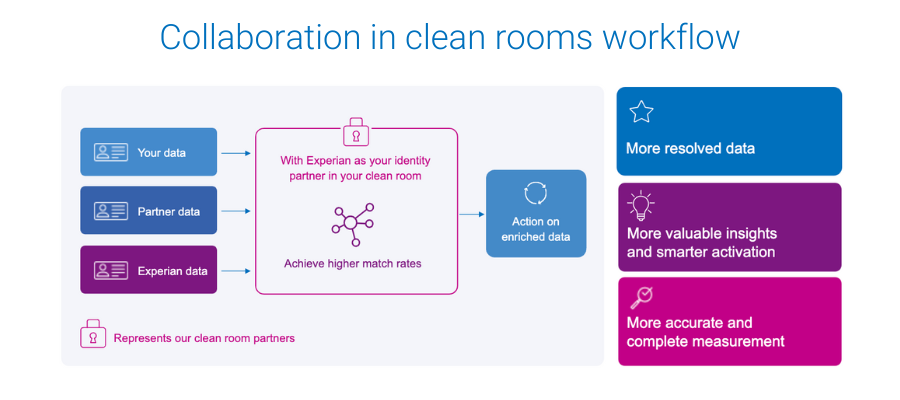
Collaboration in clean rooms workflow

What are data clean rooms?

Data clean rooms are a tool typically used for data sharing, built on top of cloud providers such as AWS clean rooms. They protect data privacy while facilitating data collaboration among clients, marketers, businesses, and their partners. As the industry places greater emphasis on data security, clean rooms have emerged as secure environments that allow companies to:

  • Enhance user privacy protection
  • Minimize the impact of cookie deprecation
  • Secure collaboration with data partners

The industry has quickly realized that, for what clean rooms offer by way of privacy and security, they lack resolution capabilities, typically yielding subpar match rates.

Benefits of Experian’s Collaboration in clean rooms offering

Built upon Experian’s rich offline and digital identity foundation, with support for various identifiers across platforms, Collaboration in clean rooms helps clients maximize the value of their data and meet the diverse needs of modern business.

Through Experian’s Collaboration in clean rooms offering, you can:

  • Collaborate with partners for richer data insights
  • Achieve higher match rates
  • Improve audience building
  • Produce more accurate and complete reports
  • Ensure data privacy

Regardless of the identifier type you are looking to collaborate on, Experian has the identity data to support you and your partner. This leads to higher match rates and more resolved data for you to use to benefit your media initiatives.

Get started with Collaboration in clean rooms today

Get the most out of your first-party data with Collaboration in clean rooms, which is essential for businesses that want to compete in a fast-paced market and connect with consumers in today’s data-driven world. We understand the importance of data collaboration and make seamless, secure data sharing possible between partners.

Connect with us today to find out how Experian’s Collaboration in clean rooms offering ensures privacy while allowing you to extract valuable data insights for smarter data-driven advertising.


Latest posts

Loading…
Talking Taxes: Exploring trends in tax preparation and deductions

As sure as the sun rises and sets, Tax Day comes around every year, whether it falls on April 15th or a day or two thereafter. As part of the Simmons National Consumer Study, Experian Simmons collects information on the various ways Americans file their taxes. In the following post, we will explore a few tax trends in the Land of the Free as well as some deductions available to many. Software for the Hard Stuff Long gone are the days of preparing our taxes the old-fashioned way using pen and paper (and hopefully a calculator). Last year, just 8.7% of U.S. tax filers prepared their taxes manually, down from 16.4% of filers who prepared their taxes this way in 2006. Software (including both online and offline versions, such as Turbo Tax or H&R Block At Home) have risen to replace their graphite-powered ancestors. In 2005, 21.5% of tax filers said they used software to prepare their taxes. Specifically, 6.8% used offline software and another 14.7% used online software. Today, 21.5% of filers use online tax software and 7.4% use offline software, bringing the total share of software preparers to 28.9%. But tax software isn’t just replacing at-home pencil pushers. The share of filers using a CPA, a private accountant or a notary public to prepare their taxes has also declined slightly in recent years as has the share of filers that use a professional on-site service, like H&R Block of Jackson Hewitt. In 2011, 30.8% of filers had their taxes prepared by a CPA, private accountant or notary, down from 32.9% who employed this type of professional in 2006. Likewise, 17.7% of last year’s filers used a professional on-site service to prepare their taxes, compared with 19% who used such a service in 2006. Filing Trends of Business Owners Much attention in Washington has been paid to small business owners, especially when the topic of tax policy is concerned. Rest assured, we’re not going to explore the political implications of proposed tax code changes on business owners, but we will examine the way these Americans prepare their personal taxes. A business owner’s tax prep work depends a lot on how many employees they have working for them. Those who own very small companies with between 2 and 9 employees, including the owner, are the most likely to have a CPA, private accountant or notary prepare their taxes. In fact, 65% of these small business owners do their taxes this way, compared with 52% of those who own companies with between 10 and 99 employees. Interestingly, only 35% of tax filers who own companies with 100 employees or more use a CPA, a private accountant or a notary to prepare their taxes, a rate equal to that of the national average. Larger business owners are actually more likely than average to have their taxes done by an on-site professional. While few business owners do their taxed by hand, the self-employed who have no employees are actually among the few that still do their taxes the old-fashioned way. In fact, 11% of business owners who list only themselves as employees say they did their taxes manually last year, a rate 30% above than the U.S. average. Most of those who don’t to their taxes themselves have them done by a CPA, a private accountant or a notary. Fifty-two percent of the self-employed with no other employees chose this method to prepare their taxes last year, which is a rate 45% higher than the average filer.   Deduction Time Deductions are a common way for reducing one’s tax liability. Here we’ll explore how many Americans could benefit from several common deductions allowed by the Internal Revenue Service. For more information about consumer trends, visit www.experian.com/simmons.

Apr 10,2012 by

Facebook acquires photo-sharing network Instagram

Yesterday, Facebook announced the acquisition of Instagram, a popular photo sharing network with over 30 million users, for $1 billion. Visits to the Instagram website have steadily increased over the past 24 weeks and reached 3.8 million last week, up from 68,800 visits for the week ending October 22, 2012. While the majority of activity takes place within the Instagram application, the website provides links to the Apple App Store and Google Play as well as some account management tools, so the growth marks increased consumer interest. The audience for Instagram is relatively young, with over half of the visitors to the Instagram website are under the age of 35. This is an interesting contrast to the visitors of Facebook’s website, which reflects a more mainstream audience with a higher share of older users. These differences can certainly offer opportunities to promote and grow usage of each of the networks across age groups. Many users of Instagram share their photos across a number of social networks since within the Instagram application, you can link to your share photos with Twitter, Facebook, Flickr, Tumblr, Posterous (recently acquired by Twitter) and Foursquare accounts. As a result of this integration and heavy use of social networks in general, social networks refer the majority of traffic to the Instagram website. Last week, 25% of the traffic to Instagram from social networks was from new visitors, most likely interested in learning more about Instagram after seeing photos within the feeds of their friends. Last week, there was considerable excitement around the launch of Instagram app for Android phones, which became available on Google’s recently relaunched digital media store, Google Play. The app reached over 1 million downloads on the first day of availability. Visits to the Instagram website increased 59% over the previous week and Google Play ranked 6th among the downstream websites visited immediately after the Instagram website. Please note this data does not include mobile traffic.

Apr 10,2012 by

Direct mail vs. Email

According to Epsilon Targeting’s latest Consumer Channel Preference Study of 5,000 consumers in North America, 60% of consumers report an "emotional boost" from receiving direct mail, agreeing that they enjoying checking their mailbox. This report showed that across all categories, direct mail continues to be a trusted source of information. It's always good to reach out to consumers via email, but the disadvantage to this is that the consumer has the ability to receive emails from you on their own terms, which may be infrequent or not at all. The use of direct mail has shown to be a pleasing emotional hook. Even with the ever growing digital world, consumers are still responding to your direct mail pieces. Don't let your businesses address contact data fall to the wayside – this is still just as important as ever to have. To ensure as timely delivery, make sure you're using address validation tools to make sure you're saving money and getting the most out of your direct mail campaigns.

Mar 27,2012 by

Subscribe to our newsletter

Enter your name and email for the latest updates

This site is protected by reCAPTCHA and the Google Privacy Policy and Terms of Service apply.

About Experian Marketing Services

At Experian Marketing Services, we use data and insights to help brands have more meaningful interactions with people. As leaders in the evolution of the advertising landscape, Experian Marketing Services can help you identify your customers and the right potential customers, uncover the most appropriate communication channels, develop messages that resonate, and measure the effectiveness of marketing activities and campaigns.

Visit our website

Subscribe to our newsletter

Stay up to date on the latest industry news and receive expert tips from our marketing experts.
Subscribe now!