Loading...

Introducing Experian’s Collaboration in clean rooms offering

Published: July 15, 2024 by Lucy Simmonds

Enhance data security and maximize match rates with Collaboration in clean rooms

At Experian, we power data-driven advertising through connectivity. Today, we’re excited to introduce our newest offering, which helps drive that connectivity: Experian’s Collaboration in clean rooms. This offering is now generally available in InfoSum, AWS Clean Rooms, and others. Experian can now facilitate successful data collaboration across multiple secure environments, such as at Experian, through crosswalks, and now in clean rooms.

Whether you are a marketer or partner, introducing Experian’s signal-agnostic offline and digital identity graphs into your clean rooms lets you run identity resolution directly in the clean room. This means your data remains secure, while you and your partner experience higher match rates and you maximize your clean room investment, leading to:

  • More resolved data
  • More valuable insights and smarter activation
  • More accurate and complete measurement

A leap forward in data collaboration

Backed by Experian’s Global Data Principles, Experian’s deep roots in identity and data security offer the most effective and trusted ways to match data and protect consumer privacy. Our signal-agnostic approach means we can resolve all types of offline and digital identity signals, which is valuable now and will become even more valuable as third-party cookies go away. Additionally, data hygiene is built right into our collaboration offering, helping to improve match rates.

The benefits of working with Experian’s rich identity data in a clean room environment are obvious so it is no surprise to see that 55% of data clean room users are using identity solutions in data clean rooms.
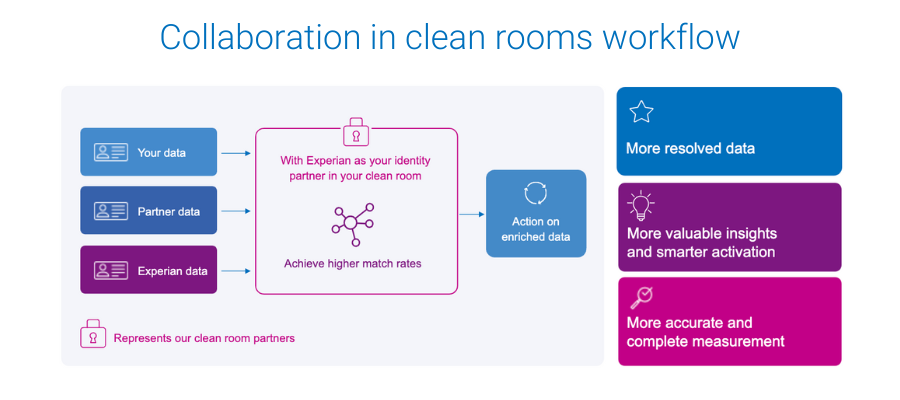
Collaboration in clean rooms workflow

What are data clean rooms?

Data clean rooms are a tool typically used for data sharing, built on top of cloud providers such as AWS clean rooms. They protect data privacy while facilitating data collaboration among clients, marketers, businesses, and their partners. As the industry places greater emphasis on data security, clean rooms have emerged as secure environments that allow companies to:

  • Enhance user privacy protection
  • Minimize the impact of cookie deprecation
  • Secure collaboration with data partners

The industry has quickly realized that, for what clean rooms offer by way of privacy and security, they lack resolution capabilities, typically yielding subpar match rates.

Benefits of Experian’s Collaboration in clean rooms offering

Built upon Experian’s rich offline and digital identity foundation, with support for various identifiers across platforms, Collaboration in clean rooms helps clients maximize the value of their data and meet the diverse needs of modern business.

Through Experian’s Collaboration in clean rooms offering, you can:

  • Collaborate with partners for richer data insights
  • Achieve higher match rates
  • Improve audience building
  • Produce more accurate and complete reports
  • Ensure data privacy

Regardless of the identifier type you are looking to collaborate on, Experian has the identity data to support you and your partner. This leads to higher match rates and more resolved data for you to use to benefit your media initiatives.

Get started with Collaboration in clean rooms today

Get the most out of your first-party data with Collaboration in clean rooms, which is essential for businesses that want to compete in a fast-paced market and connect with consumers in today’s data-driven world. We understand the importance of data collaboration and make seamless, secure data sharing possible between partners.

Connect with us today to find out how Experian’s Collaboration in clean rooms offering ensures privacy while allowing you to extract valuable data insights for smarter data-driven advertising.


Latest posts

Loading…
5 tips for back-to-school marketers

School may be out for the summer, but this is the perfect time for marketers to begin back-to-school planning. Follow these five simple tips and be on your way to back-to-school success. Searchers are actively seeking out ideas around clothes, hairstyles and dorm room décor as they prepare for the school year to start. Leverage sites like Pinterest to promote back to school merchandise and content. Don’t forget to include DIY and customization options as these appeal to today’s students. Don’t underestimate the influence of moms and college students. These consumers are more likely to actively search for the best deals online so test using deal-seeking terms like “free” and “sales” in promotional campaigns. In 2013, Marketers experienced a 35 percent lift in unique clicks when they used the word ‘college’ in the subject line. This year, try targeting specific ages for back-to-school by including terms like “college” and kids” in the subject line. Timing of back-to-school campaigns matters. While August is the key month for back-to-school campaigns, there may be more opportunity to mail additional campaigns for school supplies in July, and clothing and accessories in early September. Don’t forget to personalize! Last year, we saw a 44 percent increase in unique open rates for emails that contained personalization in the subject line. These tactics should be included in a strong back-to-school mailing program. For more information on back-to-school planning, download the 5 Lessons for Back-to-school Marketers in 2014 report.

Jul 01,2014 by

Hispanics are mobile-dominant. Are your campaigns?

Experian Marketing Services conducted an analysis into the attitudes, language preferences, spending habits and media behaviors of Hispanic Consumers, some of which were featured in the 2014 Hispanic Market Overview presented by López Negrete Communications. This post highlights findings from that analysis, which focus on Hispanic consumers’ adoption and use of smartphones. Hispanic consumers, who today account for 15 percent of the total U.S. adult population and 22 percent of Millennials, represent an ideal audience for mobile engagement and mobile advertising. While cell phone ownership rates among Hispanic and non-Hispanic adults are equal, Hispanics are more likely to own a smartphone and use it as their primary device to connect to the Internet. According to the latest estimates from Experian Marketing Services, 63 percent of Hispanic adults own a smartphone versus 60 percent of non-Hispanics. That’s up from 52 percent and 51 percent, respectively, since 2012. Among smartphone owners, Hispanics are 17 percent more likely than non-Hispanics to say that they access the Internet more through their phone than through a computer. In fact, 45 percent of Hispanic smartphone owners are mobile-dominant when it comes to going online compared with 38 percent of non-Hispanics. Marketers courting the influential Hispanic consumer must consider this fact and take a mobile-first approach to ensure that online marketing efforts, including everything from email to websites to e-commerce, are designed to engage the customer as effectively on a mobile device as on a computer. Even traditional marketing tactics such as television ads should reflect the growing likelihood that Hispanics have a smartphone either nearby or physically in their hand and are ready to engage. In fact, 37 percent of all Hispanic adults say that they often use their cell phone while watching television compared with 29 percent of non-Hispanics. Among smartphone owners, the share of Hispanics who use their phone while watching television shoots up to 50 percent versus 42 percent of non-Hispanics. Millennial smartphone owners are among the most likely to be splitting their attention between the big and small screen with 61 percent of Hispanic Millennials and 58 percent of non-Hispanic Millennials doing so. Knowing what specific mobile activities Hispanics are engaging in is critical for marketers in identifying the best tactics for reaching them via mobile. The chart below shows that Hispanics engage in most smartphone activities at above average rates, but they are much more likely than non-Hispanics to IM/chat on their phone. As a result they are slightly less likely than non-Hispanics to email from their phone, though the vast majority of Hispanic smartphone owners still use mobile email. Other activities that marketers will find Hispanics engaging in at above average rates include watching videos, using mobile GPS and listening to music. Learn more about how Experian Marketing Services can help your organization more effectively target, reach and engage today’s Hispanic consumer.

May 19,2014 by

Rise in cord-cutting creates opportunities for marketers

Published in MediaPost With the explosion of smartphones and digital tablets and the steady rise of Internet-connected televisions, gaming consoles, and more, consumers are increasingly watching online video when and where they want. New research from Experian Marketing Services on cross-device video found that as of October 2013, 48% of all U.S. adults and 67% of those under the age of 35 watched online video during a typical week, up from 45% and 64%, respectively, just six months earlier. At the same time, the share of households considered “cord-cutters” — those with high speed Internet but no cable or satellite TV — is on the rise, and that has a real impact on marketers and on the medium of television, the recipient of the largest share of advertising dollars. While the growing trend in cord-cutting is understandably disturbing to cable and satellite companies and disruptive to the television advertising revenue model overall, the growth in online viewing creates opportunities for marketers. Online video viewers can be more easily targeted and served up advertising that is more relevant, responsive and measureable. Marketers can also be more confident that their online ad was actually seen given that viewers are typically unable to skip ads. And while CPMs for online video ads may generally be lower than those of TV, marketers can use that savings to negotiate costs based on clicks or transactions rather than impressions, giving them a better picture into audience interest and insights to inform their budget allocation. Expect “Cutting the cord” to continue Today, over 7.6 million U.S. homes or 6.5% of households are cord-cutters, up from 5.1 million in 2010 or 4.5% of households. One thing enabling consumers to cut the cord is the rise in Internet-connected TVs, which allows viewing of Internet video on demand without sacrificing screen size. In fact, a third of adults (34%) now have at least one TV in the home that is connected to the Internet either directly or through a separate device like an Apple TV or Roku, up from 25% in 2012. With the launch of devices like Google’s Chromecast and the Amazon Fire TV, those numbers are sure to rise even more in the months and years ahead. Cord-cutters like the bigger screen Our analysis found that the act of watching streaming or downloaded video on any device is connected to higher rates of cord-cutting but the act of watching on a television is the most highly correlated. In fact, adults who watch online video on a television are 3.2 times more likely than average to be cord-cutters. Those who watch video on their phone (the device identified in the analysis as that most commonly used for watching online video) are just 50% more likely to be cord-cutters. Millennials are more likely to be cord-cutters We found that households with an adult under the age of 35 are almost twice as likely to be cord-cutters. Throw a Netflix or Hulu account into the mix and the rate of cord-cutting among young adult households jumps to nearly one-in-four. Given these surprising stats, many Millennials may be cord-cutters without ever having “cut” a cord.  And that’s an important trend to watch since it means a significant portion of this generation will never pay for TV. Millennials are also the most device-agnostic, with over a third saying they don’t mind watching video on a portable device even if it means a smaller screen. That’s more than double the rate of those ages 35 and older. This decentralized viewing can create headaches for marketers who need to start a relationship with Millennials during this stage of their lives when they’re most open to trying out new brands and have yet to settle down. On the plus side, marketers who do manage to reach this audience will find them much more open to advertising than average. In fact, Millennials are more than four times more likely to say that video ads that they view on their cell phone are useful. So while the challenge is big, so is the potential reward.  

May 06,2014 by

Subscribe to our newsletter

Enter your name and email for the latest updates

This site is protected by reCAPTCHA and the Google Privacy Policy and Terms of Service apply.

About Experian Marketing Services

At Experian Marketing Services, we use data and insights to help brands have more meaningful interactions with people. As leaders in the evolution of the advertising landscape, Experian Marketing Services can help you identify your customers and the right potential customers, uncover the most appropriate communication channels, develop messages that resonate, and measure the effectiveness of marketing activities and campaigns.

Visit our website

Subscribe to our newsletter

Stay up to date on the latest industry news and receive expert tips from our marketing experts.
Subscribe now!