
Ditch the cookie, not the data with the next evolution of contextual targeting
Today, we’re excited to announce Contextually-Indexed Audiences, a game-changer in contextual targeting. Experian’s new solution offers advertisers a powerful, privacy-safe solution that combines the precision of deterministic audience targeting with the flexibility of contextual targeting. Powered by real-time analysis from two million websites, access to 1,400 trusted audience segments, and easy activation through the top demand-side platform’s contextual marketplace or Audigent private marketplaces (PMPs), this solution offers advertisers a scalable way to reach their target consumers.
With this solution, advertisers can reach consumers on websites that over-index for visitors with the demographics, behaviors, or interests, they are looking to target. For example, an automotive brand can select Experian’s “Contextually-indexed in-market for a luxury electric car” audience segment and reach consumers when they are browsing websites that often attract that exact segment. Best of all, this is done in a privacy-safe way since it’s not reliant on cookies, mobile ad IDs (MAIDs) or other user identifiers.
How Contextually-Indexed Audiences work
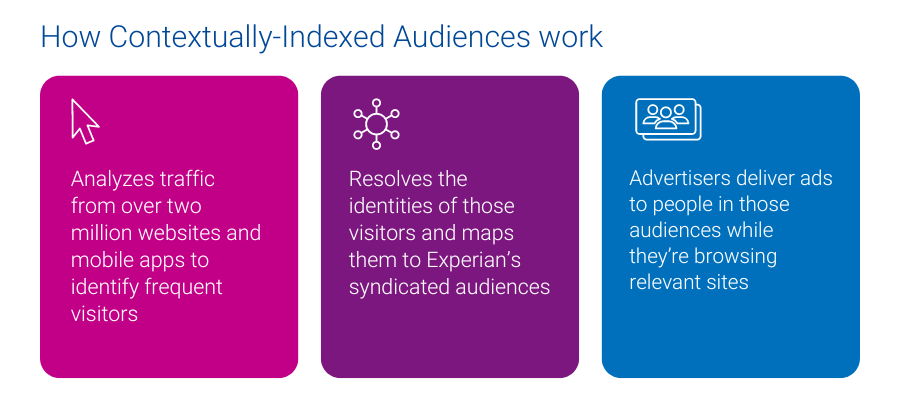
Contextually-Indexed Audiences harness advanced machine learning technology to move beyond traditional keyword-based strategies. The solution works in three steps:
- First, it analyzes traffic from over two million websites and mobile apps to identify the types of frequent visitors to those platforms.
- Next, using Experian’s Digital Graph, it resolves the identities of those visitors and maps them to more than 1,400 of Experian’s Syndicated Audiences, determining which audiences are most overrepresented on each site.
- Finally, the relevant audiences are assigned to those sites, allowing advertisers to deliver ads to people in those audiences while they are actively browsing the websites — without relying on user identifiers.
Customer success story
A leading auto manufacturer was among the first clients to activate this new solution while we were in beta. The goal was to identify new contextual targeting solutions that focus on privacy while maintaining scale and performance. The client identified two key target audiences: first-time vehicle buyers and experienced buyers. The initial campaigns using this new solution were highly successful. Even as the campaign scaled to twice the original volume, it continued to deliver three times the targeted click-through rate (CTR) goal.
“Partnering with industry leaders like Experian, we’re pushing the boundaries of contextual targeting with innovative data strategies that offer buyers greater flexibility and improved performance. These advanced contextual solutions are exciting as they not only drive results but also have the same privacy safeguards as traditional contextual targeting.”
Matt Griffith, CTO & Co-Founder, Audigent
Benefits of Contextually-Indexed Audiences
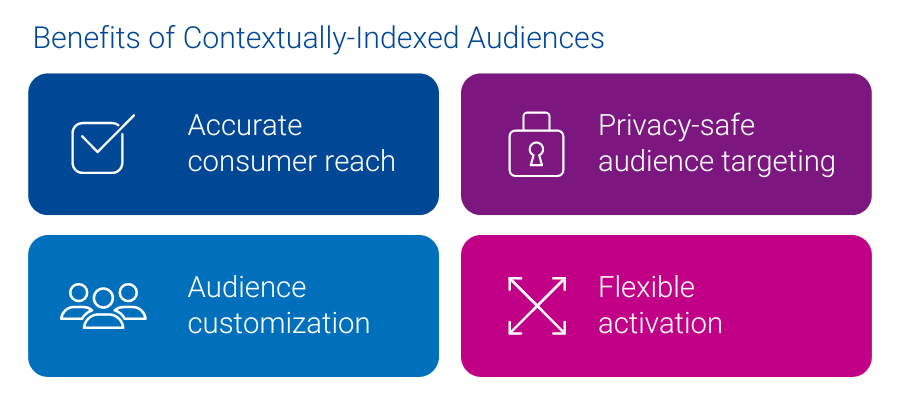
- Accurate consumer reach: Real-time integrations with over two million websites and apps coupled with machine-learning indexing technology ensure audience segments are constantly refreshed, which means advertisers reach consumers based on their latest habits.
- Privacy-safe audience targeting: These audiences are not reliant on cookies or any other user identifiers for targeting.
- Audience customization: Create the right audience segment for your campaign by using a combination of over 1,400 audiences across 12 data categories like demographics, politics, health, travel, finance, and TV.
- Flexible activation: Activate these audiences instantly in the top demand-side platform’s contextual marketplace or utilize our partnership with Audigent to create a custom private marketplace (PMP), where they can be activated across any media buying platform. When using a PMP, advertisers benefit from additional performance optimization capabilities.
Experian’s Contextually-Indexed Audiences offer advertisers a powerful solution that combines the precision of audience targeting with the flexibility of contextual targeting. With real-time analysis of over two million sites and access to 1,400 trusted audience segments, advertisers can reach consumers based on their exact behaviors and interests. This is done in a privacy-safe, yet scalable way since it’s not reliant on cookies or other user identifiers. Whether activating instantly through the top demand-side platform or customizing through Audigent PMPs, this is the future of audience targeting.
Ditch the cookie, not the data, and elevate your strategy today.
Latest posts

In 2013 and beyond, marketers will have to work even harder to gain and maintain position in organic search results. They’ll also need to spend more effectively on paid search ads by knowing how their target customers use search, and by applying insight into their behaviors and attitudes to plan and execute better content and campaigns. Here’s an excerpt on the search landscape from the upcoming 2013 Digital Marketer Report: Five Websites captured 20 percent of all search activity in Q4 2012, while the top 500 captured nearly 50 percent. Expansion to the top 1,000 Websites reached nearly 75 percent, highlighting the challenges for marketers to reach potential customers through search, even for those with a large Web presence. Top five Websites to capture search clicks Websites Domain Q4 2012 – share of search clicks Facebook www.facebook.com 8.48% YouTube www.youtube.com 5.55% Yahoo! www.yahoo.com 2.63% Wikipedia www.wikipedia.org 2.01% Amazon.com www.amazon.com 1.40% Source: Experian Marketing Services’ Hitwise Source: Experian Marketing Services’ Hitwise Even through paid search, the landscape changes very little — the top 10 Websites captured 16 percent of all paid search clicks, and the top 500 captured 56 percent. Top five Websites to capture paid search clicks Websites Domain Q4 2012 – share of paid search clicks Amazon www.amazon.com 4.19% eBay www.ebay.com 3.46% eHow www.ehow.com 2.44% BestBuy www.bestbuy.com 1.06% Yahoo! Shopping shopping.yahoo.com .85% Source: Experian Marketing Services’ Hitwise Source: Experian Marketing Services’ Hitwise Breaking through the clutter is key to reaching customers who are in the market for your product and services. Understanding who your ideal customers are can help to focus your search campaigns on these consumers and see greater campaign effectiveness. For more digital consumer insights, pre-order The 2013 Digital Marketer Report today.

With the New Year upon us, many Americans have turned to the Internet to help with their 2013 resolution of losing weight. According to Experian Marketing Services’ data, the most searched for diet was the “Paleo diet” for the week ending January 5, 2013. Searches for diets are one of the more predictable patterns on the Internet, with the high point always being the first of the year, and the low-point being around Thanksgiving week. Marketers can benefit from this trend by understanding and planning around the seasonality of this interest. Other top 10 searches that contained the term diet for last week included popular diets such as the Atkins diet, Gluten Free diet, and the 8-hour diet. Additional top 2013 diet searches included the Cabbage Soup diet, South Beach diet, Shred diet and the HCG diet. The Paleo diet, Gluten Free diet and Shred diet are all new to the top 10 list. Looking back at the same week in 2012 the Dash diet owned the #1 spot, and in 2011 the HCG diet was #1. The actual top overall search term this past week was Paula Deen diet, as she announced that she lost more than 30 pounds after revealing she had diabetes earlier in 2012. Interestingly enough, the term diabetic diet made the top 10 searches for the second straight year. Other trends we noticed include the continued popularity of low carb diets with the Paleo, Atkins, South Beach diets all taking top place in search term data. We’re also seeing the return of a religion based diet (the Jesus diet was popular in 2010) with the Daniel's diet among the top 20 searches in 2013. Many fad diets pop-up this time year usually with a time period attached – 2-day, 17-day or 3-day diets. So who is doing all the searching? Females accounted for 58% of diet searches this past week and households who earn between $30K-60K a year made up the majority of searches with 33%. The states with highest index of diet searches include: Delaware, North Dakota, Wyoming, Wisconsin and Nebraska. For more insights like this please follow us on twitter @ExperianMKT. Learn more about the author, Matt Tatham

The home stretch for the holidays is nearing as second wind for retailers is just starting as Experian Marketing Services analyzes the post-Christmas retail trend. Christmas Day 2012 saw a 27% increase in online traffic to the top 500 retail sites compared to 2011. The top retail sites received more than 115.5 million total U.S. visits. To date the holiday online traffic for the past 7 weeks to retail sites are up 10% for 2012 vs. 2011. Each retail holiday milestone day saw online traffic increases so far this season. Amazon remained the top visited site among retailers for this past week ending Dec. 22, 2012 and was also the top visited site on Christmas Day. Walmart, Target, BestBuy and Macy’s round out the top 5 most visited sites. The chart below includes the top 10 results: As tablets dominated our weekly top product search lists all holiday season it wasn’t surprising to see that the Apple iTunes site visits increased 193% and Apple.com visits increased 155% on Christmas Day 2012 vs. Christmas Eve 2012. The top product search terms sending traffic to the Apple.com site were iPod Nano, iPad Mini and iPad 4. Amazon.com visits increased 24% on Christmas Day 2012 vs. Christmas Eve 2012 as the top product search terms sending traffic to their site were Amazon Kindle, Kindle Fire and Kindle Also seeing growth were gift card searches as the year-over-year total search volume for "gift card" variations increased 6.1% this year compared to 2011. The big spike in searches happened last week (as online shoppers passed shipping deadlines). Below are the top 10 gift card searches for last week. We will continue to publish retail site data and insights through this holiday season. Please leave us a comment below if you have any specific questions along the way. UPDATE: The top 500 retail sites received more than 129 million total US visits on Dec. 26th, an increase of 1% compared to 2011 and 12% compared to Christmas Day 2012. Amazon was the top site followed by Walmart, Target, BestBuy and Macy’s. JCPenney, QVC and The Home Depot all moved into the top 10 on the day after Christmas. Learn more about the author, Matt Tatham