
Ditch the cookie, not the data with the next evolution of contextual targeting
Today, we’re excited to announce Contextually-Indexed Audiences, a game-changer in contextual targeting. Experian’s new solution offers advertisers a powerful, privacy-safe solution that combines the precision of deterministic audience targeting with the flexibility of contextual targeting. Powered by real-time analysis from two million websites, access to 1,400 trusted audience segments, and easy activation through the top demand-side platform’s contextual marketplace or Audigent private marketplaces (PMPs), this solution offers advertisers a scalable way to reach their target consumers.
With this solution, advertisers can reach consumers on websites that over-index for visitors with the demographics, behaviors, or interests, they are looking to target. For example, an automotive brand can select Experian’s “Contextually-indexed in-market for a luxury electric car” audience segment and reach consumers when they are browsing websites that often attract that exact segment. Best of all, this is done in a privacy-safe way since it’s not reliant on cookies, mobile ad IDs (MAIDs) or other user identifiers.
How Contextually-Indexed Audiences work
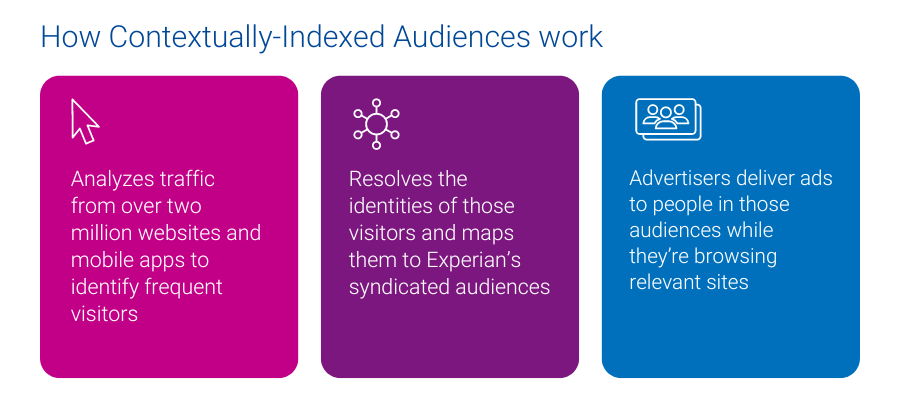
Contextually-Indexed Audiences harness advanced machine learning technology to move beyond traditional keyword-based strategies. The solution works in three steps:
- First, it analyzes traffic from over two million websites and mobile apps to identify the types of frequent visitors to those platforms.
- Next, using Experian’s Digital Graph, it resolves the identities of those visitors and maps them to more than 1,400 of Experian’s Syndicated Audiences, determining which audiences are most overrepresented on each site.
- Finally, the relevant audiences are assigned to those sites, allowing advertisers to deliver ads to people in those audiences while they are actively browsing the websites — without relying on user identifiers.
Customer success story
A leading auto manufacturer was among the first clients to activate this new solution while we were in beta. The goal was to identify new contextual targeting solutions that focus on privacy while maintaining scale and performance. The client identified two key target audiences: first-time vehicle buyers and experienced buyers. The initial campaigns using this new solution were highly successful. Even as the campaign scaled to twice the original volume, it continued to deliver three times the targeted click-through rate (CTR) goal.
“Partnering with industry leaders like Experian, we’re pushing the boundaries of contextual targeting with innovative data strategies that offer buyers greater flexibility and improved performance. These advanced contextual solutions are exciting as they not only drive results but also have the same privacy safeguards as traditional contextual targeting.”
Matt Griffith, CTO & Co-Founder, Audigent
Benefits of Contextually-Indexed Audiences
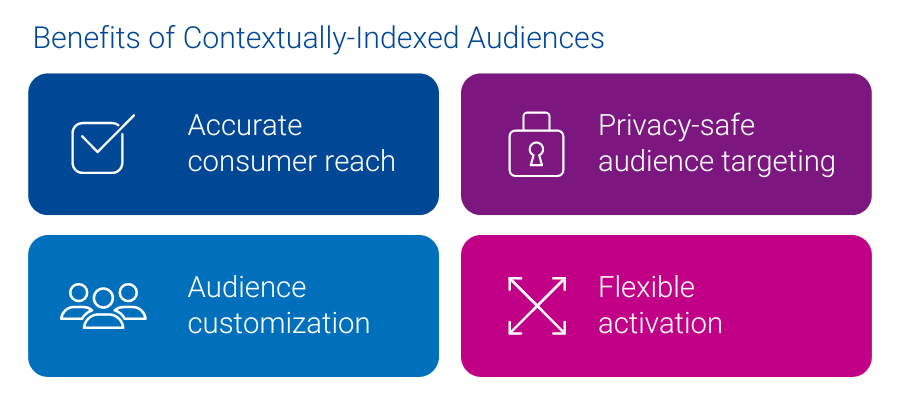
- Accurate consumer reach: Real-time integrations with over two million websites and apps coupled with machine-learning indexing technology ensure audience segments are constantly refreshed, which means advertisers reach consumers based on their latest habits.
- Privacy-safe audience targeting: These audiences are not reliant on cookies or any other user identifiers for targeting.
- Audience customization: Create the right audience segment for your campaign by using a combination of over 1,400 audiences across 12 data categories like demographics, politics, health, travel, finance, and TV.
- Flexible activation: Activate these audiences instantly in the top demand-side platform’s contextual marketplace or utilize our partnership with Audigent to create a custom private marketplace (PMP), where they can be activated across any media buying platform. When using a PMP, advertisers benefit from additional performance optimization capabilities.
Experian’s Contextually-Indexed Audiences offer advertisers a powerful solution that combines the precision of audience targeting with the flexibility of contextual targeting. With real-time analysis of over two million sites and access to 1,400 trusted audience segments, advertisers can reach consumers based on their exact behaviors and interests. This is done in a privacy-safe, yet scalable way since it’s not reliant on cookies or other user identifiers. Whether activating instantly through the top demand-side platform or customizing through Audigent PMPs, this is the future of audience targeting.
Ditch the cookie, not the data, and elevate your strategy today.
Latest posts
Scott Kozub, VP of Product Management, told the story of Experian Sanctuary, at the iAB Audience Connect event. Read the cliff notes on Marketing Forward.

The COVID variant is threatening holiday plans across the country. To protect many of the biggest campaigns of the year, Experian built Discovery Platform. Read the article to find out how you can brace your holiday campaigns for the holiday season.

Email hashing was originally intended to be used as an email security feature that has ended up being a very powerful marketing tool. A hashed email is a cryptographic function that changes an email address to a random code which can be used as an anonymous customer identifier. This code is privacy-safe and cannot be traced back to the customer’s email address. However, this hashed email can function like a digital passport that traces every behavior and action a customer takes when logged into an account that is authenticated with an email, making hashed emails a goldmine for customer data. Today emails are used across traditional publishers and within the CTV ecosystem; tying them to more consumer touch points than ever before. Why the emphasis now? Cookies are on their way out the door and have been the primary way that many marketers have tracked their existing and potential customers. In order to replace this granular level of data, marketers are likely going to need multiple solutions. With so many cookieless solutions and IDs appearing in the marketplace, the mapping of the customer journey is bound to be fragmented. Relying on first-party data, such as hashed email, is just one way to reduce that fragmentation; as it can serve as an authenticated starting point for cross-device identity resolution that can be leveraged for targeting, personalization and measurement. How can Tapad + Experian help? Tapad + Experian's Hashed Email Onboarding is a privacy-safe way to connect consumer email addresses to their related digital devices and other digital identifiers through high precision probabilistic identity. By onboarding hashed emails and incorporating them within your Tapad Graph file you can: Build a more holistic view of individuals and households and their relationship to email addresses in your first-party data set Leverage these relationships for increased cross-device scale for targeting Employ personalization tactics at the household or individual level across devices Create new audience segments and look-alike models for cross-channel activation Design more inclusive measurement and attribution for customer journey mapping Tapad, a part of Experian has built a hashed email onboarding product feature that works with the existing flexibility of The Tapad Graph to deliver the most holistic consumer view, combined with the attributes you need, in the structure that works best for your business objectives. Get started with The Tapad Graph For personalized consultation on the value and benefits of The Tapad Graph for your business, email Sales@tapad.com today!