
Ditch the cookie, not the data with the next evolution of contextual targeting
Today, we’re excited to announce Contextually-Indexed Audiences, a game-changer in contextual targeting. Experian’s new solution offers advertisers a powerful, privacy-safe solution that combines the precision of deterministic audience targeting with the flexibility of contextual targeting. Powered by real-time analysis from two million websites, access to 1,400 trusted audience segments, and easy activation through the top demand-side platform’s contextual marketplace or Audigent private marketplaces (PMPs), this solution offers advertisers a scalable way to reach their target consumers.
With this solution, advertisers can reach consumers on websites that over-index for visitors with the demographics, behaviors, or interests, they are looking to target. For example, an automotive brand can select Experian’s “Contextually-indexed in-market for a luxury electric car” audience segment and reach consumers when they are browsing websites that often attract that exact segment. Best of all, this is done in a privacy-safe way since it’s not reliant on cookies, mobile ad IDs (MAIDs) or other user identifiers.
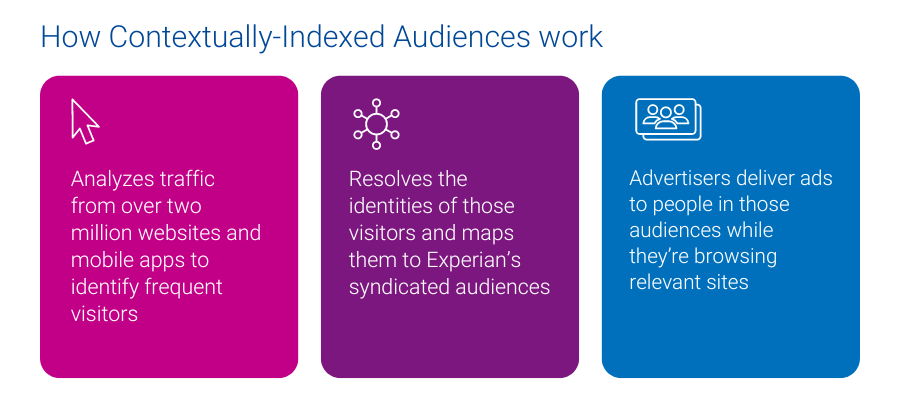
How Contextually-Indexed Audiences work
Contextually-Indexed Audiences harness advanced machine learning technology to move beyond traditional keyword-based strategies. The solution works in three steps:
- First, it analyzes traffic from over two million websites and mobile apps to identify the types of frequent visitors to those platforms.
- Next, using Experian’s Digital Graph, it resolves the identities of those visitors and maps them to more than 1,400 of Experian’s Syndicated Audiences, determining which audiences are most overrepresented on each site.
- Finally, the relevant audiences are assigned to those sites, allowing advertisers to deliver ads to people in those audiences while they are actively browsing the websites — without relying on user identifiers.
Customer success story
A leading auto manufacturer was among the first clients to activate this new solution while we were in beta. The goal was to identify new contextual targeting solutions that focus on privacy while maintaining scale and performance. The client identified two key target audiences: first-time vehicle buyers and experienced buyers. The initial campaigns using this new solution were highly successful. Even as the campaign scaled to twice the original volume, it continued to deliver three times the targeted click-through rate (CTR) goal.
“Partnering with industry leaders like Experian, we’re pushing the boundaries of contextual targeting with innovative data strategies that offer buyers greater flexibility and improved performance. These advanced contextual solutions are exciting as they not only drive results but also have the same privacy safeguards as traditional contextual targeting.”
Matt Griffith, CTO & Co-Founder, Audigent
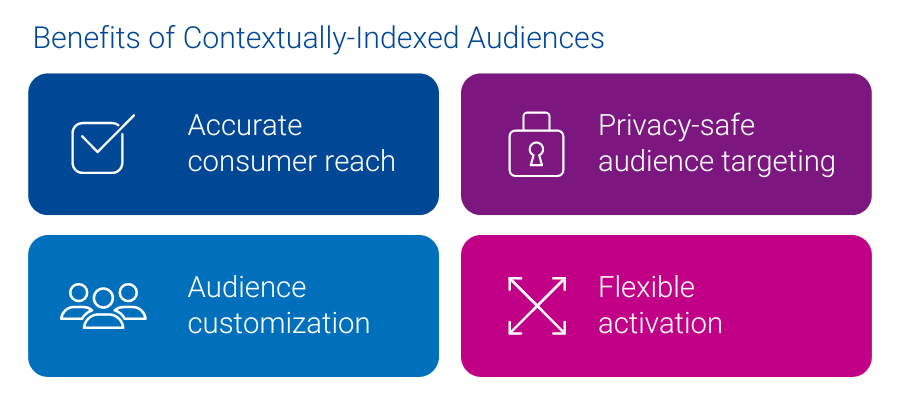
Benefits of Contextually-Indexed Audiences
- Accurate consumer reach: Real-time integrations with over two million websites and apps coupled with machine-learning indexing technology ensure audience segments are constantly refreshed, which means advertisers reach consumers based on their latest habits.
- Privacy-safe audience targeting: These audiences are not reliant on cookies or any other user identifiers for targeting.
- Audience customization: Create the right audience segment for your campaign by using a combination of over 1,400 audiences across 12 data categories like demographics, politics, health, travel, finance, and TV.
- Flexible activation: Activate these audiences instantly in the top demand-side platform’s contextual marketplace or utilize our partnership with Audigent to create a custom private marketplace (PMP), where they can be activated across any media buying platform. When using a PMP, advertisers benefit from additional performance optimization capabilities.
Experian’s Contextually-Indexed Audiences offer advertisers a powerful solution that combines the precision of audience targeting with the flexibility of contextual targeting. With real-time analysis of over two million sites and access to 1,400 trusted audience segments, advertisers can reach consumers based on their exact behaviors and interests. This is done in a privacy-safe, yet scalable way since it’s not reliant on cookies or other user identifiers. Whether activating instantly through the top demand-side platform or customizing through Audigent PMPs, this is the future of audience targeting.
Ditch the cookie, not the data, and elevate your strategy today.
Latest posts

![Price matters, but behind other factors in Deal Seeker analysis [VIDEO]](https://stg1.experian.com/blogs/marketing-forward/wp-content/uploads/default-post-image.png)
Watch our video chat with John Fetto as he shares insights from the Deal Seekers Report. This new report provides an analysis on the six deal-seeking consumer segments and information that savvy marketers need to know about them in order to more effectively target, reach and engage each group. Download the free report and watch John Fetto share some of the data:

As more consumers take pictures, make phone calls, read books and listen to music on smartphones and tablets, these devices replace the functions of the traditional gifts of years past. Read on to learn about this holiday’s hottest products and check out our recent Hot Holiday Products webcast to gain insight into how to capture more consumer visits during this busy season. Hot this week: Experian Marketing Services' analysis of online search trends this holiday season indicates that tech gifts are increasing in popularity this season. Smartphones and tablets rise to the top of the hot product list, as their functionality replaces that of traditional holiday gifts like cameras, books, clocks and stereos. New gaming consoles releasing this season, the Xbox One and PlayStation 4, are among the hottest products for 2013, with PlayStation currently in the lead. Tablets are also popular and the iPad is in the lead. Searches for iPad outperform those for Galaxy by a margin of more than 4:1. Hot holiday products With a scant 26 shopping days this holiday season, retailers need to identify hot products even faster than usual in order to run appropriate promotions and keep shoppers happy. Every year, Experian Marketing Services identifies the “hot products” that consumers want based on online searches driving traffic to the Hitwise® Retail 500, a grouping of the top online retail sites. This year, like last, the immediately recognizable footwear brand Ugg claims the top position on our list, as of November 9th. A new pair of cozy boots may sound nice as temperatures dip, but gadgets and electronics are what consumers are really hot for. Driving demand are two new major gaming consoles that hit the market this season. After several years without a major update, Microsoft will release the Xbox One and Sony will release the PlayStation 4. High consumer anticipation for both consoles won the PS4 and Xbox One a spot at number two and number three, respectively, on our hot products list. As of November 9th, variations on searches for PS4 were about 50 percent higher than search variations for Xbox One; however, the new PlayStation hits stores a week before the new Xbox, so this may change once both consoles have shipped. With smartphones and digital tablets performing the functions of traditional gifts of years past, such as cameras, stereos, books, watches, etc., it’s no surprise that the iPhone 5S, iPhone 5C and the new iPad Air are solid contenders on the hot product list. Likewise, the old-fashioned pedometer has been getting increasingly high-tech to the point where Fitbit, the wearable fitness tracker that links to your smartphone via Bluetooth, is the number four item on our list and searches this year are nearly three times what they were at this point in 2012. But not all of this season’s gadgets are high tech. In fact one of the hottest gadgets burning up the Web this season is about as old school as you can get: the loom, the Rainbow Loom, to be exact. We’ll cover this hot product in more detail in a bit, but it’s the number seven product on our list and one that every marketer targeting kids needs to have on their radar. Electronic spotlight With the tablet market heating up, iPads still enjoy a comfortable lead in terms of overall search. In fact, as of November 9th, search variations for iPad were more than four times higher than the nearest tablet competitor, the Samsung Galaxy. The Galaxy, however, overtook the Kindle Fire back in April of this year to become the second most searched for tablet. Tech Junkies, the segment comprised of online adults who visit technology review websites and technology content sites, are naturally more inclined to search for electronics and gadgets of all sorts, but they are even more disproportionately apt to be searching for Google and Microsoft products. For example, while Tech Junkies are 69 percent more likely than the average online adult to be searching for “iPad Air,” they are 2.7 times more likely to be searching for “Nexus 7” and 1.3 times more likely to be searching for “Galaxy Note 3,” two Android-powered tablets. Microsoft’s new tablet, the Surface 2, is also searched for by Tech Junkies at rates double that of the average online adult. Toys! Toys! Toys! When it comes to toys, it’s all about rubber band bracelets. In fact, four of the top 10 hot toy searches are tied to this trend. The Rainbow Loom and Crazy Loom (or Cra-Z-Loom, rather), are handheld looms that the young and the young-at-heart use to make rubber band bracelets (think: friendship bracelets) and other crafty creations. Since the start of the current school year, loom-related searches have taken off much to the ire of school administrators who have increasingly taken to banning the item from school premises. Video games aren’t just for grown-ups; they’re also for kids. The Skylanders SWAP Force and Disney Infinity are two sought after kid-friendly video games this year. Both allow players to bring physical action figures to digital life in video games. This is the third game in the Skylanders series and the first of its sort for Disney. Visit and bookmark http://ex.pn/hhp for up-to-date trends on hot products this holiday season, as well as a list of the top 20 online retailers capturing the greatest share of visits to the Hitwise Retail 500. We’ll update the data every Monday, so check back often!

If you are a mother, or if you know any mothers, you know that being a mom of an infant or toddler can be challenging. Not only is there an extreme amount of responsibility involved (and very little sleep!) but there is also a shift in social priorities. It’s no longer easy to ‘catch up with the ladies’ over drinks. Finding time to go on a date means finding a baby sitter and scheduling far in advance. And weekly poker nights at the neighbor’s house may no longer be feasible. It’s not a surprise, then, that moms with young kids (MYK’s) are very apt to become active on social media websites. In fact, according to a recent whitepaper by Experian Marketing Services, these moms are two times more likely than the average adult to use social media more than three times each day. And not only are they more likely to visit these sites, but they are also more likely to be active, posting and commenting two times more than the overall population. A possible explanation for this observation is that MYKs, especially those with infants, spend a lot of time at home with the kids and need an outlet that allows them to stay connected with family and friends. In that sense, social media—especially sites like Facebook (the top choice for MYK’s) where users can share photos, statuses and private messages—is ready-made for this segment. Beyond catching up with friends, these moms have a high propensity to follow brands and companies on social media platforms. Because they are so participatory as a segment, they offer a huge opportunity to marketers who may be looking to expand their target audience or narrow in on young mothers. Brands looking to target moms with young kids should consider offering deals through these social channels. They should also encourage moms to participate in their branded social media posts, both to interact with the brand directly and to support conversations between moms. Brands that offer time-saving ways to keep in touch and share ideas across platforms will do well with this segment. And marketers can get creative, too! Sponsoring “most beautiful baby” contests or starting discussions about the best way to calm a fussy child will not only give moms an entertaining break in their day, but will also help them associate the brand with positive, helpful experiences. For more information about moms with young kids, their online and mobile behaviors, and how to best reach them, download the whitepaper: From Diapers to Preschool: a window into the world of the Mom with Young Kids.