Experian is excited to introduce our new Geo-Indexed audiences. Our Geo-Indexed audiences use a new advanced indexing classification technology to identify and reach consumers based on their geo-regional attributes. These audiences can help you discover, segment, and craft messaging for consumers without the use of sensitive personal information, so you can confidently reach your target audience without sacrificing data privacy.
In this blog post, we’ll review how our new Geo-Indexed audiences can help you reach your audience while balancing data privacy and accuracy.
How we collect and use data is changing
The AdTech industry is undergoing a transformation as various forces shape its trajectory. One significant factor is legislation, with as many as 26 states currently considering data privacy laws. Consumer preferences also play a crucial role, as more individuals look to brands for responsible and ethical data handling practices. According to Forbes, 82% of people view brands positively when they consciously opt to refrain from using personal data for personalized ads. Major players in the field such as Apple and Google are actively pushing for a shift away from traditional methods like cookies and other identifiers in data collection and usage. These developments mark a considerable shift in how we use data.
Many brands are seeking a few solutions to continue to find and reach their target audience online, but at Experian, we see a great opportunity for innovation and impact within geo-based targeting solutions.
“We predict that over the next year, you will begin to see innovations in geo-based targeting methodologies that satisfy the industry’s need for audience targeting with responsible data strategies. By embracing innovations in geo-based targeting and adhering to responsible data strategies, you can not only comply with these laws but continue to reach your intended audiences effectively.”
jeremy meade, vp, marketing data & operations
Introducing Experian’s Geo-Indexed audiences
Geo-Indexed audiences from Experian allow brands to reach consumers and households based on geographic regions that over-index for a common set of attributes.
Our Geo-Indexed audiences give brands the ability to:
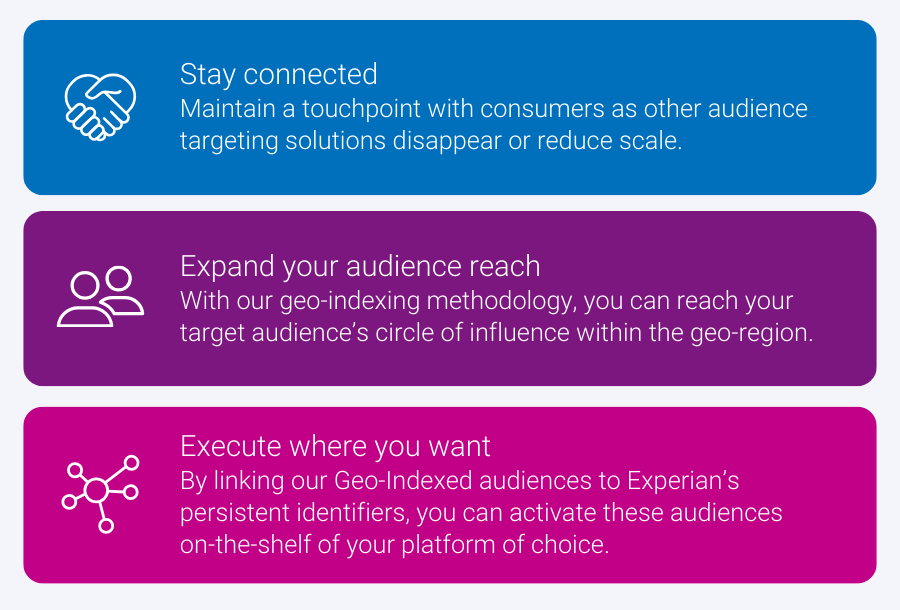
- Stay connected: Maintain a touchpoint with consumers as other audience targeting solutions disappear or reduce scale due to new legislation.
- Expand your audience reach: With our sophisticated geo-indexing methodology, you will be reaching your target audience’s circle of influence within the geo-region.
- Execute where you want: By linking our Geo-Indexed audiences to Experian’s persistent identifiers, you can activate these audiences on the shelf of your platform of choice.
As a part of the release of Geo-Indexed audiences, we will be rolling out three main categories:
- Language
- Ethnic Group
- Demographics which include:
- Education
- Household Income
- Marital Status
- Occupation
- Presence of Children
Over the next year, we will continue to release new audiences within Geo-Indexed audiences.
How you can use Geo-Indexed audiences
An Auto brand has a new corporate policy restricting the use of sensitive personal information in audience targeting but would like to reach high-income earners. To reach their target audience they use the Geo-Indexed audiences to reach households who are in geographic regions that index highly for income ranges ‘$175,000 – $199,999’ and ‘$200,000+.’
Prioritize privacy without sacrificing accuracy with Experian’s Geo-Indexed audiences
Our Geo-Indexed audiences are available in most major data and demand-side platforms. Visit our partner page for more information.
Don’t see our audiences on your platform of choice? We can help you build and activate an Experian audience on the platform of your choice.
Latest posts

Short-form video content is becoming more prevalent on video-sharing platforms. Keep up with trends and marketing strategies to stay relevant.
Experian received top ranks for hashed emails (HEMs) and demographic data from Truthset Data Collective Advertisers, technology partners, and agencies are all chasing accurate data to power their marketing strategies. Turns out, not all data is created equal and unless you’re working with the right partner, high-quality data can be hard to find. That’s because accuracy can vary widely across the industry and the partner you choose is important. A recent study conducted by data validation company Truthset showed that 51% of the data used for ad targeting and audience measurement is wrong, with average accuracy rates ranging between 32%-69% across data providers. The data quality challenge The lack of high-quality data poses multiple challenges in the advertising world: Wasted ad spend: without accurate data at the start, marketers can’t reach the right audiences, resulting in wasted impressions. Privacy and compliance: in an increasingly privacy-centric world, advertisers need to be especially mindful of accurate targeting to avoid putting their brand reputation at risk. Poor campaign performance: low-quality data skews metrics and attribution models, making it difficult to measure campaign success and optimize spend. Low-quality data can come in different forms like inconsistent or outdated information – think demographics (age, gender) and interests (dog versus cat lover) or simply the wrong relationship can be made between datasets. Data records can be incomplete or duplicative and data segments could be misclassified or inaccurate. For example, a kids snack food company may think they’re targeting a 35-year old man, who lives in the suburbs with his young family when in fact it’s a 65-year-old woman who moved to the city after her kids went to college. It’s wasted dollars!Build the data foundation Data quality needs to be addressed if advertisers and advertising technology partners want to fulfill consumers’ demand for personalized marketing. Per eMarketer, more than 75% of internet users worldwide said they were willing to share their email address, brand interest, and name in exchange for personalized experiences. Without accurate data, marketers won’t be able to provide the level of personalization that consumers desire. Validation can help advertisers evaluate third party data and help build trust across the ecosystem. Companies like Truthset review and provide an unbiased evaluation of data fidelity and quality on a regular basis. "As cookies and mobile ad identifiers continue to phase out, consented, durable identifiers (hashed email, postal addresses) are going to serve as the foundation for identity solutions of the future,” said Chip Russo, President at Truthset. “And the only way to ensure you are transacting on the highest quality identity and demography data is to actively validate the data you rely on with a third party.” Not all data is created equal: Experian leads the way In Q3 2023 Truthset reviewed Experian’s marketing data – as well as several other large data providers – and found: Experian is the #1 data provider in terms of largest volume of high-accuracy hashed e-mails (HEMs) with demographic data Experian ranks #1 in accuracy for 15 marketing data attributes, including but not limited to Age, Gender, Home Owner/Renter, Geography, Education, Presence of Children, and Pet Owner Experian consistently has the largest number of HEMs with demographic data that are 90% or more likely to be accurate “As a member of the Truthset Data Collective, Experian received top ranks across a variety of categories for its data,” continued Russo. “The entire digital advertising world runs on data, but focusing on data accuracy is going to drive the next phase of innovation for the industry, enhancing ROI for advertisers, CPMs for publishers, and relevant experiences for consumers.” As Truthset's recent study highlights, the data matched between hashed e-mails and postal addresses is crucial, underpinning everything from targeted ads to TV audience measurement. Highly accurate HEMs linked to high-quality demographic data should be the foundation of any marketing plan. Advertisers are able to overcome the complexities of identity resolution by tying online and offline touchpoints together to deliver a consistent message across channels. Companies are striving to eliminate marketing waste and provide consumers with personalized marketing and the advertising industry can have confidence that Experian’s marketing data has been externally validated as being highly accurate. The accuracy of our data will power smarter marketing initiatives, like insights, targeting, identity, and measurement. Let's start a conversation about how we can fully realize the potential of data-driven advertising together. Contact us today Latest posts

Programmatic TV can be an inexpensive option. Some platforms can offer a discounted path to prime-time ad spots on major networks.