Experian is excited to introduce our new Geo-Indexed audiences. Our Geo-Indexed audiences use a new advanced indexing classification technology to identify and reach consumers based on their geo-regional attributes. These audiences can help you discover, segment, and craft messaging for consumers without the use of sensitive personal information, so you can confidently reach your target audience without sacrificing data privacy.
In this blog post, we’ll review how our new Geo-Indexed audiences can help you reach your audience while balancing data privacy and accuracy.
How we collect and use data is changing
The AdTech industry is undergoing a transformation as various forces shape its trajectory. One significant factor is legislation, with as many as 26 states currently considering data privacy laws. Consumer preferences also play a crucial role, as more individuals look to brands for responsible and ethical data handling practices. According to Forbes, 82% of people view brands positively when they consciously opt to refrain from using personal data for personalized ads. Major players in the field such as Apple and Google are actively pushing for a shift away from traditional methods like cookies and other identifiers in data collection and usage. These developments mark a considerable shift in how we use data.
Many brands are seeking a few solutions to continue to find and reach their target audience online, but at Experian, we see a great opportunity for innovation and impact within geo-based targeting solutions.
“We predict that over the next year, you will begin to see innovations in geo-based targeting methodologies that satisfy the industry’s need for audience targeting with responsible data strategies. By embracing innovations in geo-based targeting and adhering to responsible data strategies, you can not only comply with these laws but continue to reach your intended audiences effectively.”
jeremy meade, vp, marketing data & operations
Introducing Experian’s Geo-Indexed audiences
Geo-Indexed audiences from Experian allow brands to reach consumers and households based on geographic regions that over-index for a common set of attributes.
Our Geo-Indexed audiences give brands the ability to:
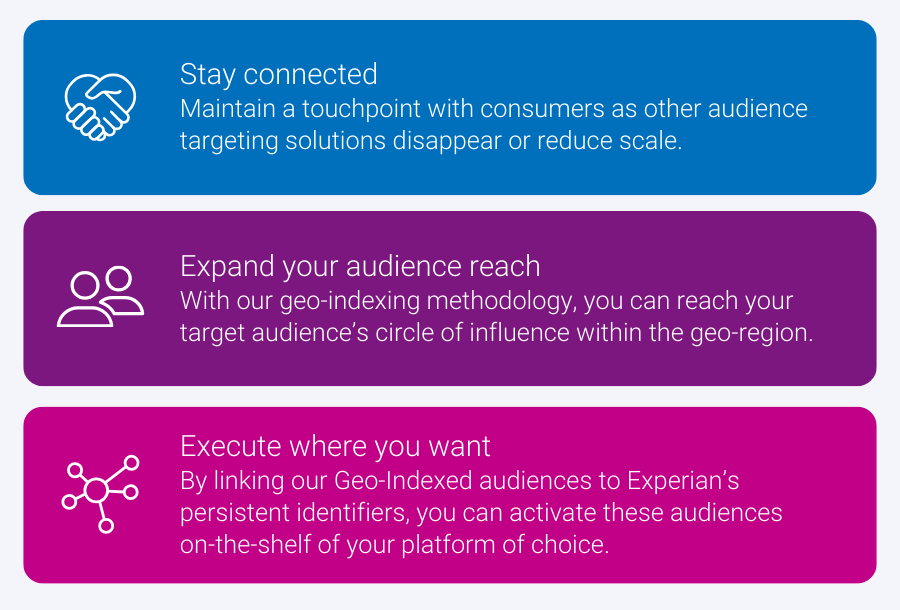
- Stay connected: Maintain a touchpoint with consumers as other audience targeting solutions disappear or reduce scale due to new legislation.
- Expand your audience reach: With our sophisticated geo-indexing methodology, you will be reaching your target audience’s circle of influence within the geo-region.
- Execute where you want: By linking our Geo-Indexed audiences to Experian’s persistent identifiers, you can activate these audiences on the shelf of your platform of choice.
As a part of the release of Geo-Indexed audiences, we will be rolling out three main categories:
- Language
- Ethnic Group
- Demographics which include:
- Education
- Household Income
- Marital Status
- Occupation
- Presence of Children
Over the next year, we will continue to release new audiences within Geo-Indexed audiences.
How you can use Geo-Indexed audiences
An Auto brand has a new corporate policy restricting the use of sensitive personal information in audience targeting but would like to reach high-income earners. To reach their target audience they use the Geo-Indexed audiences to reach households who are in geographic regions that index highly for income ranges ‘$175,000 – $199,999’ and ‘$200,000+.’
Prioritize privacy without sacrificing accuracy with Experian’s Geo-Indexed audiences
Our Geo-Indexed audiences are available in most major data and demand-side platforms. Visit our partner page for more information.
Don’t see our audiences on your platform of choice? We can help you build and activate an Experian audience on the platform of your choice.
Latest posts

Learn what deliverability really means in email marketing and how to ensure your customers actually receive your emails.

Top 5 marketing resolutions to improve your marketing programs. Learn the most effective way for better customer engagement.

Dextro clients to achieve increased accuracy in cross-device consumer measurement and engagement NEW YORK, Feb. 6, 2017 /PRNewswire/ — Dextro Analytics, a pure play analytics company that harnesses the power of human learning and artificial reasoning to drive more informed and effective consumer marketing, is partnering with Tapad, the leading provider of unified, cross-screen marketing technology solutions and now a part of Experian. The deal is effective immediately and the scope of the partnership covers North America. Additional terms were not disclosed. Leveraging Tapad's privacy-safe Device Graph™, Dextro Analytics will be able to significantly bolster its insight engine to decode complex customer journeys. Armed with more relevant, actionable insights, marketers can use Dextro's cross-screen, closed-loop measurement systems to reach and engage the right customer at the right time through the right channel. "Being able to accurately map consumer preferences, behaviors and journeys in a privacy-safe and unified way across devices is still one of the biggest pain points for marketers," said Ajith Govind, co-founder of Dextro Analytics. "At the same time, this partnership engages customers with the right message at the right time." "Detecting latent patterns and signals, and tracing backward- and forward-looking behavioral characteristics, are keys to sustaining a competitive advantage in a crowded space," said Manmit Shrimali, co-founder of Dextro Analytics. "With the proliferation of data and devices, connecting the dots is of paramount importance." "Dextro is solving some of the biggest challenges in analytics today," said Pierre Martensson, GM of Tapad's data division. "Our partners consistently see notable improvements in both budget allocation and device optimizations after integrating with the Tapad Device Graph, and I have every confidence that Dextro will be among them." For more information about Dextro Analytics' revolutionary approach to using human learning and artificial intelligence algorithms to solve business and analytical problems, please visit http://dextroanalytics.com/. For more information about Tapad's cross-platform advertising solutions, please visit https://www.experian.com/marketing/consumer-sync Contact us today!