The stakes are high when it comes to advertising during football’s biggest games as the cost of advertising continues to rise, with the average 30-second TV ad during the 2023-24 Sunday Night Football season priced at $882K. With record viewership at the College Football Playoff and the Super Bowl drawing in 123.7 million average viewers, the largest TV audience on record, it’s no surprise that brands are willing to pay those prices since football games are prime time for reaching engaged audiences. In fact, an estimated 51% of viewers search for an ad they saw during the game, underscoring the potential of second-screen engagement to amplify campaign impact. Whether you advertise on TV during these games or not, brands are exploring how they can use football season to drive a deeper connection to their audience. To do this, brands need data driven strategies.
In this blog post, we’ll reveal audience segments designed for you to craft tailored marketing strategies that resonate with football fans in the stands and on the couch. You can find the complete audience segment name in the appendix.
Make a game-winning play with Experian Audiences
With playoff season fast approaching, it’s the perfect time to go on the offensive and target football fans. Utilize Experian’s syndicated audiences to ensure your marketing messages resonate with fans when they’re the most engaged.
- Experian’s 2,400+ syndicated audiences are available directly on over 30 leading television, social, and programmatic advertising platforms.
- Reach consumers based on who they are, where they live, and what they do using data ranked #1 in accuracy by Truthset.
- Run omnichannel campaigns based on a reliable understanding of households, people, digital identifiers, and marketing attributes.
Four football audience categories to add to your advertising lineup
Football fans come in all shapes, sizes, and viewing habits. From dedicated supporters to casual viewers, targeting the right audience can make or break your campaign.
Here are four football audience categories you can target:
- Sports enthusiasts
- College football fans
- 21+ audiences
- TV viewers
Let’s huddle up and break down the audience segments within each category. Whether it’s tailgating, tuning in, or cheering from the stands, these insights will get your campaign into the end zone.
Sports enthusiasts

Whether they’re following their favorite teams, attending games in person, or watching professional sports events on TV, football fans are deeply engaged, making them an ideal target for advertisers looking to score big.
Here are five audiences to target:
- NFL Enthusiasts
- Football (FLA/Fair Lending Friendly)1
- Sports Enthusiasts
- NFL Stadium Visitors
- Professionals Sports Event
College football fans
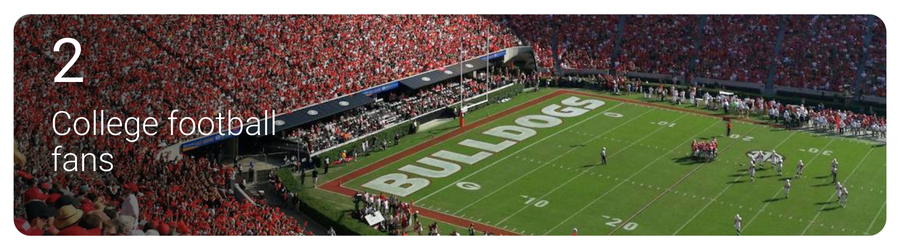
College football fans bring unmatched passion and loyalty, with bowl games during the 2023 season drawing on average of 4.6 million viewers across 40 total games—a 5% increase year-over-year. From students to alumni, these fans represent an invaluable opportunity for advertisers to connect with a deeply invested audience.
Here are four audiences to target to connect with passionate college football fans:
- College Football Stadium Visitors
- College Football Bowls
- College Students
- College Sports Venues
21+ audiences
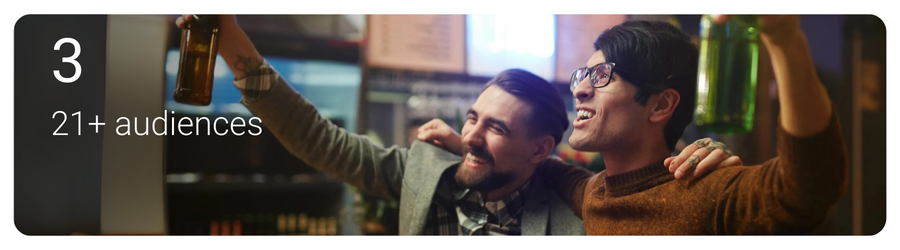
With 84% of U.S adults reporting that they drink alcohol while watching football on TV, targeting 21+ audiences during game season is a winning play. Whether they’re cracking open a cold one at a tailgate, hosting a game-day party, or relaxing on the couch, these audiences represent a key audience for brands looking to tap into football culture.
Here are four audiences that you can target this post season:
- Imported Light Beer Enthusiasts
- Domestic/Imported Beer
- High-end Spirit Drinkers
- Discretionary spend: Alcohol and wine $331 – $726
These audiences can help you serve up campaigns that pour directly into the heart of football fandom.
TV viewers

Football games attract some of the most engaged and diverse TV audiences, with 85% of sports fans preferring to watch live sports on TV rather than in-person. Notably, for the first time, viewers aged 18 to 49 spent the majority of their sports viewing time (54%) via streaming. This shift highlights the immense opportunity for advertisers to connect with highly attentive viewers tuned into every play.
Here are seven audiences that you can use to create a game-winning strategy to reach engaged TV watching football fans:
- Cable Satellite or Streaming Network Subscribers
- Streaming Video: High Spenders
- Cord Cutters
- Cable and Streaming TV Service Subscribers
- Paid TV High Spenders
- Screen Size – Large
- Co-Watchers
Whether they’re catching the action on a large TV screen or streaming from their phone, these audiences will help you craft campaigns that deliver results with highly engaged viewers.
Score big with Experian this postseason
As some of football’s biggest games approach, it’s time to huddle up and connect with consumers who live for the thrill of the game.Whether they’re tuning in to cheer for their favorite teams, tailgating with friends, or enjoying the game-day experience from home, Experian Marketing Data provides the playbook to score big with targeting, enrichment, and activation. With Experian’s data-driven insights, you can turn every opportunity into a game-winning play!
You can activate our syndicated audiences on-the-shelf of most major platforms. For a full list of Experian’s syndicated audiences and activation destinations, download our syndicated audiences guide.
Explore our other seasonal audiences that you can activate today.
1 “Fair Lending Friendly” indicates data fields that Experian has made available without use of certain demographic attributes that may increase the likelihood of discriminatory practices prohibited by the Fair Housing Act (“FHA”) and Equal Credit Opportunity Act (“ECOA”). These excluded attributes include, but may not be limited to, race, color, religion, national origin, sex, marital status, age, disability, handicap, family status, ancestry, sexual orientation, unfavorable military discharge, and gender. Experian’s provision of Fair Lending Friendly indicators does not constitute legal advice or otherwise assures your compliance with the FHA, ECOA, or any other applicable laws. Clients should seek legal advice with respect to your use of data in connection with lending decisions or application and compliance with applicable laws.
Appendix
Sports enthusiasts
- Lifestyle and Interests (Affinity) > Activities and Entertainment > NFL Enthusiasts
- Lifestyle and Interests (Affinity) > Sports and Recreation > Sports Enthusiast
- Mobile Location Models > Visits > NFL Stadium Visitors
- Lifestyle and Interests (Affinity) > Sports > Football (FLA / Fair Lending Friendly)2 Travel Intent > Activities > Professional Sports Event
College sports fans
- Mobile Location Models > Visits > University Stadium College Football Visitor
- Lifestyle and Interests (Affinity) > Sports > College Football Bowls
- Mobile Location Models > Visits > College Students
- Mobile Location Models > Visits > College Sport Venues
21+ audiences
- Lifestyle and Interests (Affinity) > Activities and Entertainment > Imported Light Beer Enthusiasts
- Lifestyle and Interests (Affinity) > In-Market > Domestic/Imported Beer
- Lifestyle and Interests (Affinity) > Retail > High-end Spirit Drinkers
- Financial – Analytics IQ > Discretionary Spend > Alcohol and Wine: $331-$726
TV viewers
- Television (TV) > Household/Family Viewing > Cable Satellite or Streaming Network Subscribers
- Retail Shoppers: Purchase Based > Entertainment > Streaming/Video/Audio/CTV/Cable TV: Streaming Video: High Spenders
- Television (TV) > Household/Family Viewing > Cord Cutters
- Television (TV) > Household/Family Viewing > Cable and Streaming Service Subscribers
- Television (TV) > TV Enthusiasts > Paid TV High Spenders
- Television (TV) > Viewing Device Type > Screen Size – Large
- Television (TV) > Household/Family Viewing > Co-Watchers
Latest posts

As sure as the sun rises and sets, Tax Day comes around every year, whether it falls on April 15th or a day or two thereafter. As part of the Simmons National Consumer Study, Experian Simmons collects information on the various ways Americans file their taxes. In the following post, we will explore a few tax trends in the Land of the Free as well as some deductions available to many. Software for the Hard Stuff Long gone are the days of preparing our taxes the old-fashioned way using pen and paper (and hopefully a calculator). Last year, just 8.7% of U.S. tax filers prepared their taxes manually, down from 16.4% of filers who prepared their taxes this way in 2006. Software (including both online and offline versions, such as Turbo Tax or H&R Block At Home) have risen to replace their graphite-powered ancestors. In 2005, 21.5% of tax filers said they used software to prepare their taxes. Specifically, 6.8% used offline software and another 14.7% used online software. Today, 21.5% of filers use online tax software and 7.4% use offline software, bringing the total share of software preparers to 28.9%. But tax software isn’t just replacing at-home pencil pushers. The share of filers using a CPA, a private accountant or a notary public to prepare their taxes has also declined slightly in recent years as has the share of filers that use a professional on-site service, like H&R Block of Jackson Hewitt. In 2011, 30.8% of filers had their taxes prepared by a CPA, private accountant or notary, down from 32.9% who employed this type of professional in 2006. Likewise, 17.7% of last year’s filers used a professional on-site service to prepare their taxes, compared with 19% who used such a service in 2006. Filing Trends of Business Owners Much attention in Washington has been paid to small business owners, especially when the topic of tax policy is concerned. Rest assured, we’re not going to explore the political implications of proposed tax code changes on business owners, but we will examine the way these Americans prepare their personal taxes. A business owner’s tax prep work depends a lot on how many employees they have working for them. Those who own very small companies with between 2 and 9 employees, including the owner, are the most likely to have a CPA, private accountant or notary prepare their taxes. In fact, 65% of these small business owners do their taxes this way, compared with 52% of those who own companies with between 10 and 99 employees. Interestingly, only 35% of tax filers who own companies with 100 employees or more use a CPA, a private accountant or a notary to prepare their taxes, a rate equal to that of the national average. Larger business owners are actually more likely than average to have their taxes done by an on-site professional. While few business owners do their taxed by hand, the self-employed who have no employees are actually among the few that still do their taxes the old-fashioned way. In fact, 11% of business owners who list only themselves as employees say they did their taxes manually last year, a rate 30% above than the U.S. average. Most of those who don’t to their taxes themselves have them done by a CPA, a private accountant or a notary. Fifty-two percent of the self-employed with no other employees chose this method to prepare their taxes last year, which is a rate 45% higher than the average filer. Deduction Time Deductions are a common way for reducing one’s tax liability. Here we’ll explore how many Americans could benefit from several common deductions allowed by the Internal Revenue Service. For more information about consumer trends, visit www.experian.com/simmons.

Yesterday, Facebook announced the acquisition of Instagram, a popular photo sharing network with over 30 million users, for $1 billion. Visits to the Instagram website have steadily increased over the past 24 weeks and reached 3.8 million last week, up from 68,800 visits for the week ending October 22, 2012. While the majority of activity takes place within the Instagram application, the website provides links to the Apple App Store and Google Play as well as some account management tools, so the growth marks increased consumer interest. The audience for Instagram is relatively young, with over half of the visitors to the Instagram website are under the age of 35. This is an interesting contrast to the visitors of Facebook’s website, which reflects a more mainstream audience with a higher share of older users. These differences can certainly offer opportunities to promote and grow usage of each of the networks across age groups. Many users of Instagram share their photos across a number of social networks since within the Instagram application, you can link to your share photos with Twitter, Facebook, Flickr, Tumblr, Posterous (recently acquired by Twitter) and Foursquare accounts. As a result of this integration and heavy use of social networks in general, social networks refer the majority of traffic to the Instagram website. Last week, 25% of the traffic to Instagram from social networks was from new visitors, most likely interested in learning more about Instagram after seeing photos within the feeds of their friends. Last week, there was considerable excitement around the launch of Instagram app for Android phones, which became available on Google’s recently relaunched digital media store, Google Play. The app reached over 1 million downloads on the first day of availability. Visits to the Instagram website increased 59% over the previous week and Google Play ranked 6th among the downstream websites visited immediately after the Instagram website. Please note this data does not include mobile traffic.

According to Epsilon Targeting’s latest Consumer Channel Preference Study of 5,000 consumers in North America, 60% of consumers report an "emotional boost" from receiving direct mail, agreeing that they enjoying checking their mailbox. This report showed that across all categories, direct mail continues to be a trusted source of information. It's always good to reach out to consumers via email, but the disadvantage to this is that the consumer has the ability to receive emails from you on their own terms, which may be infrequent or not at all. The use of direct mail has shown to be a pleasing emotional hook. Even with the ever growing digital world, consumers are still responding to your direct mail pieces. Don't let your businesses address contact data fall to the wayside – this is still just as important as ever to have. To ensure as timely delivery, make sure you're using address validation tools to make sure you're saving money and getting the most out of your direct mail campaigns.

As sure as the sun rises and sets, Tax Day comes around every year, whether it falls on April 15th or a day or two thereafter. As part of the Simmons National Consumer Study, Experian Simmons collects information on the various ways Americans file their taxes. In the following post, we will explore a few tax trends in the Land of the Free as well as some deductions available to many. Software for the Hard Stuff Long gone are the days of preparing our taxes the old-fashioned way using pen and paper (and hopefully a calculator). Last year, just 8.7% of U.S. tax filers prepared their taxes manually, down from 16.4% of filers who prepared their taxes this way in 2006. Software (including both online and offline versions, such as Turbo Tax or H&R Block At Home) have risen to replace their graphite-powered ancestors. In 2005, 21.5% of tax filers said they used software to prepare their taxes. Specifically, 6.8% used offline software and another 14.7% used online software. Today, 21.5% of filers use online tax software and 7.4% use offline software, bringing the total share of software preparers to 28.9%. But tax software isn’t just replacing at-home pencil pushers. The share of filers using a CPA, a private accountant or a notary public to prepare their taxes has also declined slightly in recent years as has the share of filers that use a professional on-site service, like H&R Block of Jackson Hewitt. In 2011, 30.8% of filers had their taxes prepared by a CPA, private accountant or notary, down from 32.9% who employed this type of professional in 2006. Likewise, 17.7% of last year’s filers used a professional on-site service to prepare their taxes, compared with 19% who used such a service in 2006. Filing Trends of Business Owners Much attention in Washington has been paid to small business owners, especially when the topic of tax policy is concerned. Rest assured, we’re not going to explore the political implications of proposed tax code changes on business owners, but we will examine the way these Americans prepare their personal taxes. A business owner’s tax prep work depends a lot on how many employees they have working for them. Those who own very small companies with between 2 and 9 employees, including the owner, are the most likely to have a CPA, private accountant or notary prepare their taxes. In fact, 65% of these small business owners do their taxes this way, compared with 52% of those who own companies with between 10 and 99 employees. Interestingly, only 35% of tax filers who own companies with 100 employees or more use a CPA, a private accountant or a notary to prepare their taxes, a rate equal to that of the national average. Larger business owners are actually more likely than average to have their taxes done by an on-site professional. While few business owners do their taxed by hand, the self-employed who have no employees are actually among the few that still do their taxes the old-fashioned way. In fact, 11% of business owners who list only themselves as employees say they did their taxes manually last year, a rate 30% above than the U.S. average. Most of those who don’t to their taxes themselves have them done by a CPA, a private accountant or a notary. Fifty-two percent of the self-employed with no other employees chose this method to prepare their taxes last year, which is a rate 45% higher than the average filer. Deduction Time Deductions are a common way for reducing one’s tax liability. Here we’ll explore how many Americans could benefit from several common deductions allowed by the Internal Revenue Service. For more information about consumer trends, visit www.experian.com/simmons.

Yesterday, Facebook announced the acquisition of Instagram, a popular photo sharing network with over 30 million users, for $1 billion. Visits to the Instagram website have steadily increased over the past 24 weeks and reached 3.8 million last week, up from 68,800 visits for the week ending October 22, 2012. While the majority of activity takes place within the Instagram application, the website provides links to the Apple App Store and Google Play as well as some account management tools, so the growth marks increased consumer interest. The audience for Instagram is relatively young, with over half of the visitors to the Instagram website are under the age of 35. This is an interesting contrast to the visitors of Facebook’s website, which reflects a more mainstream audience with a higher share of older users. These differences can certainly offer opportunities to promote and grow usage of each of the networks across age groups. Many users of Instagram share their photos across a number of social networks since within the Instagram application, you can link to your share photos with Twitter, Facebook, Flickr, Tumblr, Posterous (recently acquired by Twitter) and Foursquare accounts. As a result of this integration and heavy use of social networks in general, social networks refer the majority of traffic to the Instagram website. Last week, 25% of the traffic to Instagram from social networks was from new visitors, most likely interested in learning more about Instagram after seeing photos within the feeds of their friends. Last week, there was considerable excitement around the launch of Instagram app for Android phones, which became available on Google’s recently relaunched digital media store, Google Play. The app reached over 1 million downloads on the first day of availability. Visits to the Instagram website increased 59% over the previous week and Google Play ranked 6th among the downstream websites visited immediately after the Instagram website. Please note this data does not include mobile traffic.

According to Epsilon Targeting’s latest Consumer Channel Preference Study of 5,000 consumers in North America, 60% of consumers report an "emotional boost" from receiving direct mail, agreeing that they enjoying checking their mailbox. This report showed that across all categories, direct mail continues to be a trusted source of information. It's always good to reach out to consumers via email, but the disadvantage to this is that the consumer has the ability to receive emails from you on their own terms, which may be infrequent or not at all. The use of direct mail has shown to be a pleasing emotional hook. Even with the ever growing digital world, consumers are still responding to your direct mail pieces. Don't let your businesses address contact data fall to the wayside – this is still just as important as ever to have. To ensure as timely delivery, make sure you're using address validation tools to make sure you're saving money and getting the most out of your direct mail campaigns.