The stakes are high when it comes to advertising during football’s biggest games as the cost of advertising continues to rise, with the average 30-second TV ad during the 2023-24 Sunday Night Football season priced at $882K. With record viewership at the College Football Playoff and the Super Bowl drawing in 123.7 million average viewers, the largest TV audience on record, it’s no surprise that brands are willing to pay those prices since football games are prime time for reaching engaged audiences. In fact, an estimated 51% of viewers search for an ad they saw during the game, underscoring the potential of second-screen engagement to amplify campaign impact. Whether you advertise on TV during these games or not, brands are exploring how they can use football season to drive a deeper connection to their audience. To do this, brands need data driven strategies.
In this blog post, we’ll reveal audience segments designed for you to craft tailored marketing strategies that resonate with football fans in the stands and on the couch. You can find the complete audience segment name in the appendix.
Make a game-winning play with Experian Audiences
With playoff season fast approaching, it’s the perfect time to go on the offensive and target football fans. Utilize Experian’s syndicated audiences to ensure your marketing messages resonate with fans when they’re the most engaged.
- Experian’s 2,400+ syndicated audiences are available directly on over 30 leading television, social, and programmatic advertising platforms.
- Reach consumers based on who they are, where they live, and what they do using data ranked #1 in accuracy by Truthset.
- Run omnichannel campaigns based on a reliable understanding of households, people, digital identifiers, and marketing attributes.
Four football audience categories to add to your advertising lineup
Football fans come in all shapes, sizes, and viewing habits. From dedicated supporters to casual viewers, targeting the right audience can make or break your campaign.
Here are four football audience categories you can target:
- Sports enthusiasts
- College football fans
- 21+ audiences
- TV viewers
Let’s huddle up and break down the audience segments within each category. Whether it’s tailgating, tuning in, or cheering from the stands, these insights will get your campaign into the end zone.
Sports enthusiasts

Whether they’re following their favorite teams, attending games in person, or watching professional sports events on TV, football fans are deeply engaged, making them an ideal target for advertisers looking to score big.
Here are five audiences to target:
- NFL Enthusiasts
- Football (FLA/Fair Lending Friendly)1
- Sports Enthusiasts
- NFL Stadium Visitors
- Professionals Sports Event
College football fans
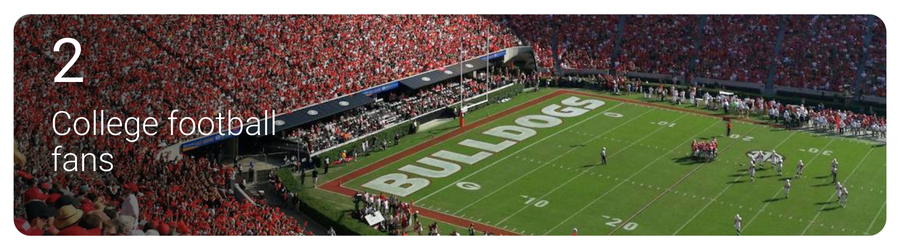
College football fans bring unmatched passion and loyalty, with bowl games during the 2023 season drawing on average of 4.6 million viewers across 40 total games—a 5% increase year-over-year. From students to alumni, these fans represent an invaluable opportunity for advertisers to connect with a deeply invested audience.
Here are four audiences to target to connect with passionate college football fans:
- College Football Stadium Visitors
- College Football Bowls
- College Students
- College Sports Venues
21+ audiences

With 84% of U.S adults reporting that they drink alcohol while watching football on TV, targeting 21+ audiences during game season is a winning play. Whether they’re cracking open a cold one at a tailgate, hosting a game-day party, or relaxing on the couch, these audiences represent a key audience for brands looking to tap into football culture.
Here are four audiences that you can target this post season:
- Imported Light Beer Enthusiasts
- Domestic/Imported Beer
- High-end Spirit Drinkers
- Discretionary spend: Alcohol and wine $331 – $726
These audiences can help you serve up campaigns that pour directly into the heart of football fandom.
TV viewers

Football games attract some of the most engaged and diverse TV audiences, with 85% of sports fans preferring to watch live sports on TV rather than in-person. Notably, for the first time, viewers aged 18 to 49 spent the majority of their sports viewing time (54%) via streaming. This shift highlights the immense opportunity for advertisers to connect with highly attentive viewers tuned into every play.
Here are seven audiences that you can use to create a game-winning strategy to reach engaged TV watching football fans:
- Cable Satellite or Streaming Network Subscribers
- Streaming Video: High Spenders
- Cord Cutters
- Cable and Streaming TV Service Subscribers
- Paid TV High Spenders
- Screen Size – Large
- Co-Watchers
Whether they’re catching the action on a large TV screen or streaming from their phone, these audiences will help you craft campaigns that deliver results with highly engaged viewers.
Score big with Experian this postseason
As some of football’s biggest games approach, it’s time to huddle up and connect with consumers who live for the thrill of the game.Whether they’re tuning in to cheer for their favorite teams, tailgating with friends, or enjoying the game-day experience from home, Experian Marketing Data provides the playbook to score big with targeting, enrichment, and activation. With Experian’s data-driven insights, you can turn every opportunity into a game-winning play!
You can activate our syndicated audiences on-the-shelf of most major platforms. For a full list of Experian’s syndicated audiences and activation destinations, download our syndicated audiences guide.
Explore our other seasonal audiences that you can activate today.
1 “Fair Lending Friendly” indicates data fields that Experian has made available without use of certain demographic attributes that may increase the likelihood of discriminatory practices prohibited by the Fair Housing Act (“FHA”) and Equal Credit Opportunity Act (“ECOA”). These excluded attributes include, but may not be limited to, race, color, religion, national origin, sex, marital status, age, disability, handicap, family status, ancestry, sexual orientation, unfavorable military discharge, and gender. Experian’s provision of Fair Lending Friendly indicators does not constitute legal advice or otherwise assures your compliance with the FHA, ECOA, or any other applicable laws. Clients should seek legal advice with respect to your use of data in connection with lending decisions or application and compliance with applicable laws.
Appendix
Sports enthusiasts
- Lifestyle and Interests (Affinity) > Activities and Entertainment > NFL Enthusiasts
- Lifestyle and Interests (Affinity) > Sports and Recreation > Sports Enthusiast
- Mobile Location Models > Visits > NFL Stadium Visitors
- Lifestyle and Interests (Affinity) > Sports > Football (FLA / Fair Lending Friendly)2 Travel Intent > Activities > Professional Sports Event
College sports fans
- Mobile Location Models > Visits > University Stadium College Football Visitor
- Lifestyle and Interests (Affinity) > Sports > College Football Bowls
- Mobile Location Models > Visits > College Students
- Mobile Location Models > Visits > College Sport Venues
21+ audiences
- Lifestyle and Interests (Affinity) > Activities and Entertainment > Imported Light Beer Enthusiasts
- Lifestyle and Interests (Affinity) > In-Market > Domestic/Imported Beer
- Lifestyle and Interests (Affinity) > Retail > High-end Spirit Drinkers
- Financial – Analytics IQ > Discretionary Spend > Alcohol and Wine: $331-$726
TV viewers
- Television (TV) > Household/Family Viewing > Cable Satellite or Streaming Network Subscribers
- Retail Shoppers: Purchase Based > Entertainment > Streaming/Video/Audio/CTV/Cable TV: Streaming Video: High Spenders
- Television (TV) > Household/Family Viewing > Cord Cutters
- Television (TV) > Household/Family Viewing > Cable and Streaming Service Subscribers
- Television (TV) > TV Enthusiasts > Paid TV High Spenders
- Television (TV) > Viewing Device Type > Screen Size – Large
- Television (TV) > Household/Family Viewing > Co-Watchers
Latest posts
It’s been over a year since Google announced they’d be deprecating the third-party cookie and in that time there’s been a major focus on two types of cookieless identity solutions. Identity vendors and marketers are strategizing which of these two future solutions best fits their needs so they can achieve privacy-safe scale once third-party cookies are no longer available for use on Chrome. Let’s break down these solutions and the considerations marketers need to take into account when deciding what partners to move forward with in the future of identity resolution. Authenticated Traffic Solutions Authenticated traffic solutions (ATS) are a type of digital identification that asks the end-user to identify themselves via personal information, most commonly email address. Often, you’ll see self-authentication at the point of entry to a website that asks you to create an account or login immediately to access the content you are seeking. E-commerce sites use authentication to keep track of consumer purchases and inform advertising decisions for that customer; and publishers use it to tailor featured content, or, more importantly for this discussion, leverage it within the ad ecosystem for targeting. While authentication can provide very valuable user data for audience segmenting and targeting, it can be limited in scale for a single publisher to leverage and monetize on their own. That’s why some identity vendors have worked to integrate themselves within as many publisher authentication modules as possible, so that they can create an aggregate of scale for the ad ecosystem to tap into. But, even this isn’t going to deliver the reach marketers truly thirst for. Alternatively, Facebook has the scale for authenticated traffic, but they keep their data inside a walled garden, so the utility of those authenticated users is only valuable within the Facebook ecosystem. So how can authenticated traffic solutions increase scale to broaden the scope of identifiers they can collect and leverage? Hint: a few of the biggest players have already figured it out. It’s the single sign-on. Google is probably the largest purveyor of a single-sign on solution that can directly impact advertising capabilities. Can you think of a site you visit that doesn’t offer a sign-in with your existing Google account? It’s a short list. Google has integrated themselves into so many applications and publishers that “Login with Gmail” is just second nature (you pictured the Gmail logo when you read that, didn’t you?). Now, if you’re about to purchase something you found off an Instagram ad, or perhaps a retailer you buy from regularly, you’ve probably noticed options to proceed with your checkout via “Amazon pay” or “Apple pay”. These are also single-sign ons. You’re authenticating yourself through Amazon or Apple to that retailer in exchange for A- the safety and security that Amazon or Apple provide for your financial information and B- skipping the annoying process of manually entering personal information over and over again at point of sale. It’s starting to sound like there’s a lot of authenticated data out there isn’t it? Well, that’s true, but again, Amazon and Apple are walled gardens. Amazon is working diligently to build out their own ecosystem to leverage their content and retail channel data for a holistic offering. And Apple keeps user data very close to the chest, constantly limiting its utility for themselves and advertisers. So what is identity resolution doing about it? The Trade Desk announced their solution; Unified ID 2.0, which promises to leverage email authenticated identity for a truly scaled solution for publishers via Javascript through Prebid. By handing over UID2.0 to an independent unbiased organization like Prebid, The Trade Desk is creating instant scale and trust in their solution. Unauthenticated Traffic Solutions Unlike ATS, unauthenticated traffic solutions do not rely on a log-in to identify a user, but they also don’t rely on third-party cookies. Instead, unauthenticated solutions (UATS) leverage their existing streams of real-time data through Javascript on publisher sites or an SDK (software development kit used by apps). The type of information UATS solutions can collect via Javascript or SDK vary, but it can include IP address, user agent and device level info. But being able to read this information at the point of entry to a website does not make a quality identifier. The best unauthenticated solutions will have the ability to set or ingest this information into a unique ID through an infrastructure with incredibly fast speed that can process trillions of anonymous data signals across multiple channels and devices. And even more so, be able to interpret those signals into a profile using machine learning– all at the moment a user enters a domain. It sounds complicated because it is, but it also has a lot of potential. The identity space cannot rest solely on authenticated traffic solutions, because, as you can see, it could limit ownership and operability to just a few power players/walled gardens. This doesn’t help the larger ecosystem monetize and personalize ad inventory. The right unauthenticated solution, however, can unify cross-device individuals and households at scale, because they’re integrated on the broadest number of publishers/SDKs across platforms, have the best algorithms to build confident connections between identifiers, and are universally transactable across the most common sell and demand side platforms. Think of it as the perfect partner- speaking a common language that everyone in the ecosystem understands and acts on. Today more than twenty cookieless identifiers are available in market for the ad ecosystem, and Google hasn’t even announced a date of deprecation. It’s important to be on the lookout for differentiators like scale and precision. Most importantly, choosing a truly cross-device partner will be key, especially as more digital devices and IDs grow in adoption, like CTV has this past year. Taking advantage of both What we will come to find, once the third-party cookie is obsolete, is that choosing just one of these solution types, or partners, will be a disadvantage. The more the industry comes together to collaborate on solutions, the more apparent it is that both of them have value, and thus employing both solutions will give marketers the best opportunities. Tapad, now part of Experian, recently announced the launch of Switchboard; a module within our identity solution; The Tapad Graph, to create this agnostic interoperability for identifiers of all types, and choice and control for the ad tech vendors and marketers who want them. By instantly creating the ability to partner with multiple solutions, Tapad + Experian is ensuring that all use cases for the third-party cookie live on in our cookieless future. Get started with The Tapad Graph For personalized consultation on the value and benefits of The Tapad Graph for your business, email Sales@tapad.com today!
Tapad launches global privacy-safe solution to provide continuity in the absence of third-party cookies Switchboard, a module within The Tapad Graph, will connect emerging cookieless identifiers to traditional IDs, creating a more holistic view of the consumer and driving value exchange within the advertising ecosystem Tapad, part of Experian, a global leader in cross-device digital identity resolution, and a part of Experian, announced today the launch of Switchboard, a first-of-its-kind solution to help navigate the evolving cookieless landscape. Switchboard, a module within The Tapad Graph, will operate as a global, privacy-safe solution to provide continuity in the absence of third-party cookies by connecting new cookieless identifiers to traditional digital IDs for a comprehensive view of consumers and their digital touchpoints. Switchboard will enable interoperability across the growing number of these digital identifiers and the value exchange between publishers, content creators and consumers. Leading digital identity solutions partnering with Tapad, part of Experian at the launch of Switchboard include Unified ID 2.0, ID5, Lotame Panorama ID, BritePool, Retargetly IDx and Audigent Halo ID. Tapad, part of Experian plans to expand support to additional identity solutions on an ongoing basis. In addition to these identity solutions, early partners across the ecosystem include The Trade Desk, Amobee, Martin, ShareThis, Eyeota and Catalina. “This diverse group of launch partners and testing customers will prove that Switchboard is an important tenet for the future of identity resolution. We’re excited to be proactive in our approach to give marketers time to adapt new solutions and test their function in tandem with the third-party cookie, while continuing to give our customers flexibility and control,” said Mark Connon, General Manager of Tapad, part of Experian. “Facilitating access and usage of 1st party identifiers is crucial to help marketers prepare for the cookieless future. Thanks to Switchboard, ID5's cookieless IDs will be available to a wider audience of brands and agencies and enable them to run effective, data-driven campaigns beyond the third-party cookie,” said Mathieu Roche Co-founder & CEO of ID5. Switchboard provides value across the marketing and advertising ecosystem as the need for the ability to support multiple cookieless ID’s across ad tech increases throughout 2021. With a decade of expertise creating digital identity resolution products, Tapad, part of Experian is poised to solve this challenge through innovation and quality, privacy-safe data-driven solutions. “Interoperability is paramount for brand marketers, agencies, publishers and platforms if we want to support an open and free Internet and break free of the stranglehold of walled gardens,” said Pierre Diennet, Global Partnerships at Lotame. ”Lotame Panorama ID’s participation in Switchboard reflects our steadfast commitment to collaborating across and within the industry and providing value to all of its players.” “As advertisers continue to contemplate the future of identity, Amobee is proud to partner with Tapad, part of Experian on this next-generation solution to provide a comprehensive view of consumers,” says Bryan Everett, Senior Vice President of Global Business Development at Amobee. “With the imminent loss of cookies, advertisers must think creatively in order to respectfully engage consumers in a privacy-compliant way and Switchboard can play an important role in addressing their respective identity needs.” Tapad, part of Experian is welcoming identity solutions and Tapad Graph customer participation in Switchboard throughout 2021. Stayed tuned for more updates and information on Switchboard in the coming months. Get started with The Tapad Graph For personalized consultation on the value and benefits of The Tapad Graph for your business, email Sales@tapad.com today!
Adapt with Tapad, a part of Experian Leading browsers have made public announcements and technical deployments to reduce the digital advertising accessibility of third-party cookies for data collection, storage, and sharing due to growing privacy concerns. As a result, there has been growing momentum to find an alternative via cookieless IDs, with the intent to create a replacement that helps ensure continuity across the ecosystem. At Tapad we’ve chosen to approach the market with a solution that provides agnostic interoperability for these cookieless identifiers, so that marketers can continue to work with the identity providers of their choice while maintaining the most holistic view of consumers across digital touchpoints. Introducing switchboard Switchboard is a module within The Tapad Graph that leverages our core capabilities across machine learning and identity management to provide a connection between traditional digital identifiers and the new wave of cookieless IDs that will be utilized in the future. Customers of Tapad can take advantage of its broad ecosystem of identifiers to drive targeting and frequency capping strategies and enable detailed measurement and attribution post-deprecation of the third-party cookie. Our goal is to accelerate the adoption, scale, and utility of cookieless IDs with the release of the Switchboard module within The Tapad Graph, while maintaining an agnostic approach to the market. Switchboard for identity solutions In the evolving landscape agencies and marketers will need to invest, test, and analyze the best combination of cookieless ID partners to meet their objectives. The Switchboard module will increase the utility and value of the cookieless ID space in conjunction with other addressable IDs, by providing a layer of connectivity that will be natively missing with the deprecation of third-party cookies. Identity solutions at launch: Switchboard for graph customers For existing Tapad customers who leverage the Switchboard module in The Tapad Graph, it will provide a seamless way to facilitate interoperability while resolving identity back to a Household or Individual. By providing this translation layer, Tapad will take on the responsibility of encryption and decryption protocols where applicable, which will deliver added functionality to our customers. Tapad + Experian partners at launch: Use cases Resolve existing first-party data with new cookieless solutions through The Tapad Graph to minimize data loss Frequency cap at the Individual and Household level via Cookieless and traditional ID Reach consumers at scale across all touchpoints and IDs Build a more inclusive and holistic view of the consumer journey Run accurate and scalable measurement before and after the formal deprecation of third-party cookies in Chrome Map online data into offline activities Hear why industry leaders are adapting with Tapad + Experian As advertisers continue to contemplate the future of identity, Amobee is proud to partner with Tapad, a part of Experian, on this next-generation solution to provide a comprehensive view of consumers. With the imminent loss of cookies, advertisers must think creatively in order to respectfully engage consumers in a privacy-compliant way and Switchboard can play an important role in addressing their respective identity needs. — Bryan Everett | Senior Vice President of Global Business Development | Amobee Connecting offline and online shopper activity in a privacy-compliant way is fundamental to marketing effectiveness and determining return on ad-spend. That’s why we’re excited to be a launch partner for Tapad + Experian's Switchboard offering; it provides a unified solution for supporting the variety of proprietary and anonymous user ID standards required by advertising demand-side platforms today. — Brian Dunphy | SVP Digital Business and Strategic Partnerships | Catalina As the industry evolves, Tapad + Experian's Switchboard presents a privacy-safe solution that allows for the continued activation of data and an alternative to advertising within walled garden environments. We look forward to collaborating with Tapad and the industry as we collectively transition to support cookieless identity. — Don Lee |SVP of Global Platform Partnerships | Eyeota We are excited to participate in this proactive solution to the sunset of third-party cookies. Switchboard’s agnostic interoperability, with BritePool and other ID providers, will create high-value for marketers as they transition to the era of cookieless web advertising. — David J. Moore | CEO | BritePool Interoperability is paramount for brand marketers, agencies, publishers and platforms if we want to support an open and free Internet and break free of the stranglehold of walled gardens. Lotame Panorama ID’s participation in Switchboard reflects our steadfast commitment to collaborating across and within the industry and providing value to all of its players. — Pierre Diennet | Global Partnerships | Lotame At this pivotal moment in the industry, we are excited to be partnering with Tapad, a part of Experian on their cookieless initiative and making Retargetly IDx available into the Switchboard solution, providing global brands, platforms and publishers with a compliant, cookieless ID solution for the Latin American market; enabling them to target, reach and measure users at scale through the region. — Daniel Czaplinski | CEO and Co-Founder | Retargetly With Audigent’s Halo ID, we’re architecting a cookieless future where clients and partners have confidence in the actionability and interoperability of exclusive 1st party audiences, originated from some of the world’s leading publishers and creators. We see collaboration as being critical to a collective understanding of identity and Tapad, a part of Experian as a trusted partner with solutions such as Switchboard to support continuity for marketers’ addressability. — Drew Stein | CEO and Founder | Audigent Facilitating access and usage of 1st party identifiers is crucial to help marketers prepare for the cookieless future. Thanks to Switchboard, ID5’s cookie-less IDs will be available to a wider audience of brands and agencies and enable them to run effective, data-driven campaigns beyond the third-party cookie. — Mathieu Roche | CEO and Co-Founder | ID5 Addressing the current identity challenge requires transparency and collaboration. We are pleased to align ShareThis data with Tapad + Experian’s growing ecosystem. ShareThis data helps marketers evolve beyond the cookie to complete the picture. Tapad + Experian’s Switchboard offering will support ShareThis’s deep connections to clients and technology platforms, preserving and growing the accessibility of our data. — Michael Gorman | SVP Product and Business Development | ShareThis Get started with The Tapad Graph For personalized consultation on the value and benefits of The Tapad Graph for your business, email Sales@tapad.com today!
It’s been over a year since Google announced they’d be deprecating the third-party cookie and in that time there’s been a major focus on two types of cookieless identity solutions. Identity vendors and marketers are strategizing which of these two future solutions best fits their needs so they can achieve privacy-safe scale once third-party cookies are no longer available for use on Chrome. Let’s break down these solutions and the considerations marketers need to take into account when deciding what partners to move forward with in the future of identity resolution. Authenticated Traffic Solutions Authenticated traffic solutions (ATS) are a type of digital identification that asks the end-user to identify themselves via personal information, most commonly email address. Often, you’ll see self-authentication at the point of entry to a website that asks you to create an account or login immediately to access the content you are seeking. E-commerce sites use authentication to keep track of consumer purchases and inform advertising decisions for that customer; and publishers use it to tailor featured content, or, more importantly for this discussion, leverage it within the ad ecosystem for targeting. While authentication can provide very valuable user data for audience segmenting and targeting, it can be limited in scale for a single publisher to leverage and monetize on their own. That’s why some identity vendors have worked to integrate themselves within as many publisher authentication modules as possible, so that they can create an aggregate of scale for the ad ecosystem to tap into. But, even this isn’t going to deliver the reach marketers truly thirst for. Alternatively, Facebook has the scale for authenticated traffic, but they keep their data inside a walled garden, so the utility of those authenticated users is only valuable within the Facebook ecosystem. So how can authenticated traffic solutions increase scale to broaden the scope of identifiers they can collect and leverage? Hint: a few of the biggest players have already figured it out. It’s the single sign-on. Google is probably the largest purveyor of a single-sign on solution that can directly impact advertising capabilities. Can you think of a site you visit that doesn’t offer a sign-in with your existing Google account? It’s a short list. Google has integrated themselves into so many applications and publishers that “Login with Gmail” is just second nature (you pictured the Gmail logo when you read that, didn’t you?). Now, if you’re about to purchase something you found off an Instagram ad, or perhaps a retailer you buy from regularly, you’ve probably noticed options to proceed with your checkout via “Amazon pay” or “Apple pay”. These are also single-sign ons. You’re authenticating yourself through Amazon or Apple to that retailer in exchange for A- the safety and security that Amazon or Apple provide for your financial information and B- skipping the annoying process of manually entering personal information over and over again at point of sale. It’s starting to sound like there’s a lot of authenticated data out there isn’t it? Well, that’s true, but again, Amazon and Apple are walled gardens. Amazon is working diligently to build out their own ecosystem to leverage their content and retail channel data for a holistic offering. And Apple keeps user data very close to the chest, constantly limiting its utility for themselves and advertisers. So what is identity resolution doing about it? The Trade Desk announced their solution; Unified ID 2.0, which promises to leverage email authenticated identity for a truly scaled solution for publishers via Javascript through Prebid. By handing over UID2.0 to an independent unbiased organization like Prebid, The Trade Desk is creating instant scale and trust in their solution. Unauthenticated Traffic Solutions Unlike ATS, unauthenticated traffic solutions do not rely on a log-in to identify a user, but they also don’t rely on third-party cookies. Instead, unauthenticated solutions (UATS) leverage their existing streams of real-time data through Javascript on publisher sites or an SDK (software development kit used by apps). The type of information UATS solutions can collect via Javascript or SDK vary, but it can include IP address, user agent and device level info. But being able to read this information at the point of entry to a website does not make a quality identifier. The best unauthenticated solutions will have the ability to set or ingest this information into a unique ID through an infrastructure with incredibly fast speed that can process trillions of anonymous data signals across multiple channels and devices. And even more so, be able to interpret those signals into a profile using machine learning– all at the moment a user enters a domain. It sounds complicated because it is, but it also has a lot of potential. The identity space cannot rest solely on authenticated traffic solutions, because, as you can see, it could limit ownership and operability to just a few power players/walled gardens. This doesn’t help the larger ecosystem monetize and personalize ad inventory. The right unauthenticated solution, however, can unify cross-device individuals and households at scale, because they’re integrated on the broadest number of publishers/SDKs across platforms, have the best algorithms to build confident connections between identifiers, and are universally transactable across the most common sell and demand side platforms. Think of it as the perfect partner- speaking a common language that everyone in the ecosystem understands and acts on. Today more than twenty cookieless identifiers are available in market for the ad ecosystem, and Google hasn’t even announced a date of deprecation. It’s important to be on the lookout for differentiators like scale and precision. Most importantly, choosing a truly cross-device partner will be key, especially as more digital devices and IDs grow in adoption, like CTV has this past year. Taking advantage of both What we will come to find, once the third-party cookie is obsolete, is that choosing just one of these solution types, or partners, will be a disadvantage. The more the industry comes together to collaborate on solutions, the more apparent it is that both of them have value, and thus employing both solutions will give marketers the best opportunities. Tapad, now part of Experian, recently announced the launch of Switchboard; a module within our identity solution; The Tapad Graph, to create this agnostic interoperability for identifiers of all types, and choice and control for the ad tech vendors and marketers who want them. By instantly creating the ability to partner with multiple solutions, Tapad + Experian is ensuring that all use cases for the third-party cookie live on in our cookieless future. Get started with The Tapad Graph For personalized consultation on the value and benefits of The Tapad Graph for your business, email Sales@tapad.com today!
Tapad launches global privacy-safe solution to provide continuity in the absence of third-party cookies Switchboard, a module within The Tapad Graph, will connect emerging cookieless identifiers to traditional IDs, creating a more holistic view of the consumer and driving value exchange within the advertising ecosystem Tapad, part of Experian, a global leader in cross-device digital identity resolution, and a part of Experian, announced today the launch of Switchboard, a first-of-its-kind solution to help navigate the evolving cookieless landscape. Switchboard, a module within The Tapad Graph, will operate as a global, privacy-safe solution to provide continuity in the absence of third-party cookies by connecting new cookieless identifiers to traditional digital IDs for a comprehensive view of consumers and their digital touchpoints. Switchboard will enable interoperability across the growing number of these digital identifiers and the value exchange between publishers, content creators and consumers. Leading digital identity solutions partnering with Tapad, part of Experian at the launch of Switchboard include Unified ID 2.0, ID5, Lotame Panorama ID, BritePool, Retargetly IDx and Audigent Halo ID. Tapad, part of Experian plans to expand support to additional identity solutions on an ongoing basis. In addition to these identity solutions, early partners across the ecosystem include The Trade Desk, Amobee, Martin, ShareThis, Eyeota and Catalina. “This diverse group of launch partners and testing customers will prove that Switchboard is an important tenet for the future of identity resolution. We’re excited to be proactive in our approach to give marketers time to adapt new solutions and test their function in tandem with the third-party cookie, while continuing to give our customers flexibility and control,” said Mark Connon, General Manager of Tapad, part of Experian. “Facilitating access and usage of 1st party identifiers is crucial to help marketers prepare for the cookieless future. Thanks to Switchboard, ID5's cookieless IDs will be available to a wider audience of brands and agencies and enable them to run effective, data-driven campaigns beyond the third-party cookie,” said Mathieu Roche Co-founder & CEO of ID5. Switchboard provides value across the marketing and advertising ecosystem as the need for the ability to support multiple cookieless ID’s across ad tech increases throughout 2021. With a decade of expertise creating digital identity resolution products, Tapad, part of Experian is poised to solve this challenge through innovation and quality, privacy-safe data-driven solutions. “Interoperability is paramount for brand marketers, agencies, publishers and platforms if we want to support an open and free Internet and break free of the stranglehold of walled gardens,” said Pierre Diennet, Global Partnerships at Lotame. ”Lotame Panorama ID’s participation in Switchboard reflects our steadfast commitment to collaborating across and within the industry and providing value to all of its players.” “As advertisers continue to contemplate the future of identity, Amobee is proud to partner with Tapad, part of Experian on this next-generation solution to provide a comprehensive view of consumers,” says Bryan Everett, Senior Vice President of Global Business Development at Amobee. “With the imminent loss of cookies, advertisers must think creatively in order to respectfully engage consumers in a privacy-compliant way and Switchboard can play an important role in addressing their respective identity needs.” Tapad, part of Experian is welcoming identity solutions and Tapad Graph customer participation in Switchboard throughout 2021. Stayed tuned for more updates and information on Switchboard in the coming months. Get started with The Tapad Graph For personalized consultation on the value and benefits of The Tapad Graph for your business, email Sales@tapad.com today!
Adapt with Tapad, a part of Experian Leading browsers have made public announcements and technical deployments to reduce the digital advertising accessibility of third-party cookies for data collection, storage, and sharing due to growing privacy concerns. As a result, there has been growing momentum to find an alternative via cookieless IDs, with the intent to create a replacement that helps ensure continuity across the ecosystem. At Tapad we’ve chosen to approach the market with a solution that provides agnostic interoperability for these cookieless identifiers, so that marketers can continue to work with the identity providers of their choice while maintaining the most holistic view of consumers across digital touchpoints. Introducing switchboard Switchboard is a module within The Tapad Graph that leverages our core capabilities across machine learning and identity management to provide a connection between traditional digital identifiers and the new wave of cookieless IDs that will be utilized in the future. Customers of Tapad can take advantage of its broad ecosystem of identifiers to drive targeting and frequency capping strategies and enable detailed measurement and attribution post-deprecation of the third-party cookie. Our goal is to accelerate the adoption, scale, and utility of cookieless IDs with the release of the Switchboard module within The Tapad Graph, while maintaining an agnostic approach to the market. Switchboard for identity solutions In the evolving landscape agencies and marketers will need to invest, test, and analyze the best combination of cookieless ID partners to meet their objectives. The Switchboard module will increase the utility and value of the cookieless ID space in conjunction with other addressable IDs, by providing a layer of connectivity that will be natively missing with the deprecation of third-party cookies. Identity solutions at launch: Switchboard for graph customers For existing Tapad customers who leverage the Switchboard module in The Tapad Graph, it will provide a seamless way to facilitate interoperability while resolving identity back to a Household or Individual. By providing this translation layer, Tapad will take on the responsibility of encryption and decryption protocols where applicable, which will deliver added functionality to our customers. Tapad + Experian partners at launch: Use cases Resolve existing first-party data with new cookieless solutions through The Tapad Graph to minimize data loss Frequency cap at the Individual and Household level via Cookieless and traditional ID Reach consumers at scale across all touchpoints and IDs Build a more inclusive and holistic view of the consumer journey Run accurate and scalable measurement before and after the formal deprecation of third-party cookies in Chrome Map online data into offline activities Hear why industry leaders are adapting with Tapad + Experian As advertisers continue to contemplate the future of identity, Amobee is proud to partner with Tapad, a part of Experian, on this next-generation solution to provide a comprehensive view of consumers. With the imminent loss of cookies, advertisers must think creatively in order to respectfully engage consumers in a privacy-compliant way and Switchboard can play an important role in addressing their respective identity needs. — Bryan Everett | Senior Vice President of Global Business Development | Amobee Connecting offline and online shopper activity in a privacy-compliant way is fundamental to marketing effectiveness and determining return on ad-spend. That’s why we’re excited to be a launch partner for Tapad + Experian's Switchboard offering; it provides a unified solution for supporting the variety of proprietary and anonymous user ID standards required by advertising demand-side platforms today. — Brian Dunphy | SVP Digital Business and Strategic Partnerships | Catalina As the industry evolves, Tapad + Experian's Switchboard presents a privacy-safe solution that allows for the continued activation of data and an alternative to advertising within walled garden environments. We look forward to collaborating with Tapad and the industry as we collectively transition to support cookieless identity. — Don Lee |SVP of Global Platform Partnerships | Eyeota We are excited to participate in this proactive solution to the sunset of third-party cookies. Switchboard’s agnostic interoperability, with BritePool and other ID providers, will create high-value for marketers as they transition to the era of cookieless web advertising. — David J. Moore | CEO | BritePool Interoperability is paramount for brand marketers, agencies, publishers and platforms if we want to support an open and free Internet and break free of the stranglehold of walled gardens. Lotame Panorama ID’s participation in Switchboard reflects our steadfast commitment to collaborating across and within the industry and providing value to all of its players. — Pierre Diennet | Global Partnerships | Lotame At this pivotal moment in the industry, we are excited to be partnering with Tapad, a part of Experian on their cookieless initiative and making Retargetly IDx available into the Switchboard solution, providing global brands, platforms and publishers with a compliant, cookieless ID solution for the Latin American market; enabling them to target, reach and measure users at scale through the region. — Daniel Czaplinski | CEO and Co-Founder | Retargetly With Audigent’s Halo ID, we’re architecting a cookieless future where clients and partners have confidence in the actionability and interoperability of exclusive 1st party audiences, originated from some of the world’s leading publishers and creators. We see collaboration as being critical to a collective understanding of identity and Tapad, a part of Experian as a trusted partner with solutions such as Switchboard to support continuity for marketers’ addressability. — Drew Stein | CEO and Founder | Audigent Facilitating access and usage of 1st party identifiers is crucial to help marketers prepare for the cookieless future. Thanks to Switchboard, ID5’s cookie-less IDs will be available to a wider audience of brands and agencies and enable them to run effective, data-driven campaigns beyond the third-party cookie. — Mathieu Roche | CEO and Co-Founder | ID5 Addressing the current identity challenge requires transparency and collaboration. We are pleased to align ShareThis data with Tapad + Experian’s growing ecosystem. ShareThis data helps marketers evolve beyond the cookie to complete the picture. Tapad + Experian’s Switchboard offering will support ShareThis’s deep connections to clients and technology platforms, preserving and growing the accessibility of our data. — Michael Gorman | SVP Product and Business Development | ShareThis Get started with The Tapad Graph For personalized consultation on the value and benefits of The Tapad Graph for your business, email Sales@tapad.com today!