Loading...

Score a touchdown with Experian’s football audience playbook

Published: January 7, 2025 by Lucy Simmonds

Huddle up: Target football's biggest fans with Experian Audiences

The stakes are high when it comes to advertising during football’s biggest games as the cost of advertising continues to rise, with the average 30-second TV ad during the 2023-24 Sunday Night Football season priced at $882K. With record viewership at the College Football Playoff and the Super Bowl drawing in 123.7 million average viewers, the largest TV audience on record, it’s no surprise that brands are willing to pay those prices since football games are prime time for reaching engaged audiences. In fact, an estimated 51% of viewers search for an ad they saw during the game, underscoring the potential of second-screen engagement to amplify campaign impact. Whether you advertise on TV during these games or not, brands are exploring how they can use football season to drive a deeper connection to their audience. To do this, brands need data driven strategies.

In this blog post, we’ll reveal audience segments designed for you to craft tailored marketing strategies that resonate with football fans in the stands and on the couch. You can find the complete audience segment name in the appendix.

Make a game-winning play with Experian Audiences

With playoff season fast approaching, it’s the perfect time to go on the offensive and target football fans. Utilize Experian’s syndicated audiences to ensure your marketing messages resonate with fans when they’re the most engaged.

  • Experian’s 2,400+ syndicated audiences are available directly on over 30 leading television, social, and programmatic advertising platforms.
  • Reach consumers based on who they are, where they live, and what they do using data ranked #1 in accuracy by Truthset.
  • Run omnichannel campaigns based on a reliable understanding of households, people, digital identifiers, and marketing attributes.

Four football audience categories to add to your advertising lineup

Football fans come in all shapes, sizes, and viewing habits. From dedicated supporters to casual viewers, targeting the right audience can make or break your campaign.

Here are four football audience categories you can target:

  • Sports enthusiasts
  • College football fans
  • 21+ audiences
  • TV viewers

Let’s huddle up and break down the audience segments within each category. Whether it’s tailgating, tuning in, or cheering from the stands, these insights will get your campaign into the end zone.

Sports enthusiasts

Sports enthusiasts

Whether they’re following their favorite teams, attending games in person, or watching professional sports events on TV, football fans are deeply engaged, making them an ideal target for advertisers looking to score big.

Here are five audiences to target:

  1. NFL Enthusiasts
  2. Football (FLA/Fair Lending Friendly)1
  3. Sports Enthusiasts
  4. NFL Stadium Visitors
  5. Professionals Sports Event

College football fans
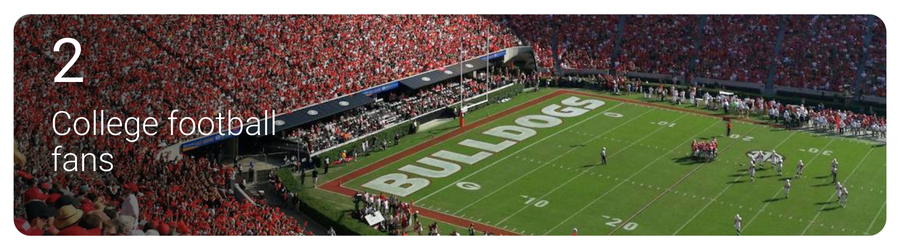
College football fans

College football fans bring unmatched passion and loyalty, with bowl games during the 2023 season drawing on average of 4.6 million viewers across 40 total games—a 5% increase year-over-year. From students to alumni, these fans represent an invaluable opportunity for advertisers to connect with a deeply invested audience.

Here are four audiences to target to connect with passionate college football fans:

  1. College Football Stadium Visitors
  2. College Football Bowls
  3. College Students
  4. College Sports Venues

21+ audiences

21+ audiences

With 84% of U.S adults reporting that they drink alcohol while watching football on TV, targeting 21+ audiences during game season is a winning play. Whether they’re cracking open a cold one at a tailgate, hosting a game-day party, or relaxing on the couch, these audiences represent a key audience for brands looking to tap into football culture.

Here are four audiences that you can target this post season:

  1. Imported Light Beer Enthusiasts
  2. Domestic/Imported Beer
  3. High-end Spirit Drinkers
  4. Discretionary spend: Alcohol and wine $331 – $726

These audiences can help you serve up campaigns that pour directly into the heart of football fandom.

TV viewers

TV viewers

Football games attract some of the most engaged and diverse TV audiences, with 85% of sports fans preferring to watch live sports on TV rather than in-person. Notably, for the first time, viewers aged 18 to 49 spent the majority of their sports viewing time (54%) via streaming. This shift highlights the immense opportunity for advertisers to connect with highly attentive viewers tuned into every play.

Here are seven audiences that you can use to create a game-winning strategy to reach engaged TV watching football fans:

  1. Cable Satellite or Streaming Network Subscribers
  2. Streaming Video: High Spenders
  3. Cord Cutters
  4. Cable and Streaming TV Service Subscribers
  5. Paid TV High Spenders
  6. Screen Size – Large
  7. Co-Watchers

Whether they’re catching the action on a large TV screen or streaming from their phone, these audiences will help you craft campaigns that deliver results with highly engaged viewers.

Score big with Experian this postseason

As some of football’s biggest games approach, it’s time to huddle up and connect with consumers who live for the thrill of the game.Whether they’re tuning in to cheer for their favorite teams, tailgating with friends, or enjoying the game-day experience from home, Experian Marketing Data provides the playbook to score big with targeting, enrichment, and activation. With Experian’s data-driven insights, you can turn every opportunity into a game-winning play!

You can activate our syndicated audiences on-the-shelf of most major platforms. For a full list of Experian’s syndicated audiences and activation destinations, download our syndicated audiences guide.

Explore our other seasonal audiences that you can activate today.

1Fair Lending Friendly” indicates data fields that Experian has made available without use of certain demographic attributes that may increase the likelihood of discriminatory practices prohibited by the Fair Housing Act (“FHA”) and Equal Credit Opportunity Act (“ECOA”). These excluded attributes include, but may not be limited to, race, color, religion, national origin, sex, marital status, age, disability, handicap, family status, ancestry, sexual orientation, unfavorable military discharge, and gender. Experian’s provision of Fair Lending Friendly indicators does not constitute legal advice or otherwise assures your compliance with the FHA, ECOA, or any other applicable laws. Clients should seek legal advice with respect to your use of data in connection with lending decisions or application and compliance with applicable laws.


Appendix

Sports enthusiasts

  • Lifestyle and Interests (Affinity) > Activities and Entertainment > NFL Enthusiasts
  • Lifestyle and Interests (Affinity) > Sports and Recreation > Sports Enthusiast
  • Mobile Location Models > Visits > NFL Stadium Visitors
  • Lifestyle and Interests (Affinity) > Sports > Football (FLA / Fair Lending Friendly)2 Travel Intent > Activities > Professional Sports Event

College sports fans

  • Mobile Location Models > Visits > University Stadium College Football Visitor
  • Lifestyle and Interests (Affinity) > Sports > College Football Bowls
  • Mobile Location Models > Visits > College Students
  • Mobile Location Models > Visits > College Sport Venues

21+ audiences

  • Lifestyle and Interests (Affinity) > Activities and Entertainment > Imported Light Beer Enthusiasts
  • Lifestyle and Interests (Affinity) > In-Market > Domestic/Imported Beer
  • Lifestyle and Interests (Affinity) > Retail > High-end Spirit Drinkers
  • Financial – Analytics IQ > Discretionary Spend > Alcohol and Wine: $331-$726

TV viewers

  • Television (TV) > Household/Family Viewing > Cable Satellite or Streaming Network Subscribers
  • Retail Shoppers: Purchase Based > Entertainment > Streaming/Video/Audio/CTV/Cable TV: Streaming Video: High Spenders
  • Television (TV) > Household/Family Viewing > Cord Cutters
  • Television (TV) > Household/Family Viewing > Cable and Streaming Service Subscribers
  • Television (TV) > TV Enthusiasts > Paid TV High Spenders
  • Television (TV) > Viewing Device Type > Screen Size – Large
  • Television (TV) > Household/Family Viewing > Co-Watchers

Latest posts

Loading…
Scruff is in as men shave less

Whether it’s a result of the sky rocketing costs of razor blades, the increasing popularity of Movember or a general trend among Hollywood’s leading men to sport some scruff, it seems that facial hair hasn’t been this en vogue since the mid-70s. Whether you love it or hate it, shaving is big business and any rise in beardedness can shave significant revenue from the bottom lines of companies catering to men’s grooming products. As proof, CPG giant Proctor & Gamble recently announced that its second-quarter earnings were negatively impacted due to the growing preference among men for mustaches and beards. For years, Experian Marketing Services has been measuring the grooming habits of men for marketers via our trusted Simmons National Consumer Study and a recent analysis of the data shows a slight, yet clear, decline in the use of shaving products and an increase in the percent of men sporting facial hair in recent years, especially among the younger demographic. According to our estimates, 17 percent of all men and 35 percent of young men ages 18 to 24 have facial hair today, up from 14 percent and 31 percent, respectively, since 2009. That said, most men with facial hair at least occasionally use shaving products, like shaving cream, disposable razors, razor blades or electric shavers. In fact, the vast majority of all guys (94 percent) still use at least some shaving products, and that number has remained virtually unchanged in recent years. There is, however, a sizable and growing share of young men who are going all wooly mammoth and steering clear of shaving products all together. Specifically, 15 percent of men ages 18 to 24 today say they don’t use any shaving products up from 13 percent in 2009. As younger men’s beards fill in and they move into more professional occupations, most are likely to throw in the (hot) towel and pick up a razor, as evidenced by the fact that only 5 percent of men in the next-oldest age bracket (25 to 34) don’t shave. But the growing bearded trend among young men is hair raising nonetheless. Another trend worth monitoring is the declining frequency of use of shaving products overall, which clearly reflects the increasing popularity of the two-, three- or five-day beard. Among the 67 percent of all men who use shaving cream, for instance, less than a third (29 percent) say they use it seven times a week or more often (the equivalent of a daily shave). On average, men today use shaving cream only 4.3 times per week down from 4.5 times per week in 2009. Young men use shaving cream only 3.3 times a week on average, down from 3.6 times in 2009. Frequency of use is also down among the 36 percent of men who use an electric razor, a popular grooming tool for bearded men who wish to keep things a bit more tame. In fact, just 27 percent of men in the electric razor set say they use it seven or more times a week. On average men use an electric razor 3.7 times per week, down from 4.0 times per week in 2009. On the bright side, Proctor & Gamble, in their latest earnings report, said that despite bad news for their facial hair business, they see potential to offset losses with the increasing popularity of body-shaving by men. And they may have a point. Based on 52-week trend data from our Hitwise online search intelligence tool, searches for “manscaping,” a modern term used to refer to the shaving or trimming of excess body hair, are up a relative 14 percent in the past year.  

Mar 11,2014 by

The ever-evolving job description of the CMO

Once upon a time, the Chief Marketing Officer (CMO) was primarily focused on their company’s branding efforts. They spent a lot of time thinking about things like look and feel, messaging, ad buys and what their competitors were up to. Of course, those are all still important components of a CMO’s job description, but the role has changed – expanded, really – over the last five or so years. The ongoing proliferation of devices in the hands of empowered consumers requires that CMOs understand things like consumer behavior, channel and device preference, triggered messaging and much more. They must have expertise in various technologies, real-time analytics and, oftentimes, be change agents who move their organizations toward a more customer-centric business model. Today’s CMO must know how their customers want to interact with their brand, then build messaging and execute campaigns that create engagement and ensure ongoing brand advocacy. In a newly published predictions piece: “#7for14: Seven ways digital marketing will change in 2014” several of Experian Marketing Services’ leaders weigh in on the changing role of today’s marketing heads. Check out prediction #1 – Challenges of the CMO and prediction #6 – The CMO as technologist to see more.  

Feb 04,2014 by

Canadian Anti-Spam Law update

CASL will come into force in phases starting July 1, 2014 The information below should not be considered legal advice. Please consult with appropriate legal counsel before relying upon the compliance information provided below. As of December 2013 both regulators responsible for implementing Canada’s Anti-Spam Law have finalized their regulations. Industry Canada’s guidelines confirm all but one of the expected exemptions, provide needed clarifications to key requirements and delay implementation of the more controversial aspects of the law. Over the past two years we have been updating you on CASL’s developments and efforts by industry groups to address unclear or onerous aspects of its proposed regulations. With Industry Canada confirming all but one expected exemptions and providing detailed guidance in its Regulatory Impact Analysis Statement, marketers should now have an easier time preparing. Here is a summary of key points for Industry Canada’s final regulations: i. CASL will be implemented in three phases:       a. The majority of CASL comes into force July 1, 2014;       b. The rules that apply to computer programs will come into force January 15, 2015; and       c. The private right of action takes effect on July 1, 2017. ii. Industry Canada has provided interpretive guidance on several issues under CASL, including:       a. The definition of a "CEM";       b. The application of CASL to express consent obtained before CASL comes into force;       c. The application of CASL to IP addresses and cookies; and       d. The interaction between the unsubscribe requirement and implied consent. iii. New exceptions have been added for:       a. Closed platforms, which would appear to apply to platforms such as BlackBerry Messenger and social medial networks;       b. Limited-access accounts, where organizations communicate directly with recipients (e.g., online banking);       c. Messages targeted at foreign persons; and       d. Fundraising by charities and political parties. A surprising exclusion of the ‘Reasonable Knowledge’ exemption In its draft regulations, Industry Canada sought to exempt foreign senders in instances where the sender could not reasonably know that the message would be received in Canada, particularly when the recipient does not typically access email within Canada or through Canadian systems.[1] However, in its final rulemaking the Department chose to nix this exemption as “unnecessary,” choosing instead to exempt messages routed through Canada into a foreign state. [2] This omission may create challenges for marketers in situations where it’s not possible or practical to collect country of origin information.[3]  We expect further clarification on this concern from Canadian regulators in the coming months. For detailed information please visit the Canadian Government’s informational website. For summary information please see the following links: http://news.gc.ca/web/article-eng.do?nid=798829 http://blog.deliverability.com/2013/12/canadas-anti-spam-law-casl-is-now-a-done-deal.html http://www.cauce.org/2013/12/canadas-anti-spam-law-coming-into-force-june-2014.html If you would like to discuss CASL’s email-related issues, please email us at digitalprivacy@experian.com or reach out to us through your account teams.   [1] Archived http://www.gazette.gc.ca/rp-pr/p1/2013/2013-01-05/html/reg1-eng.html [2] See Limited Exclusions section of Industry Canada’s Regulatory Risk Impact Assessment, http://fightspam.gc.ca/eic/site/030.nsf/eng/00271.html [3] If a consumer uses a global inbox provider like Google a sender will be challenged to determine where the email is accessed. And since reverse IP geo-location records may be outdated or inaccurate, new technologies and customer self-identification processes may be needed.

Jan 08,2014 by Experian Marketing Services

Loading…
Scruff is in as men shave less

Whether it’s a result of the sky rocketing costs of razor blades, the increasing popularity of Movember or a general trend among Hollywood’s leading men to sport some scruff, it seems that facial hair hasn’t been this en vogue since the mid-70s. Whether you love it or hate it, shaving is big business and any rise in beardedness can shave significant revenue from the bottom lines of companies catering to men’s grooming products. As proof, CPG giant Proctor & Gamble recently announced that its second-quarter earnings were negatively impacted due to the growing preference among men for mustaches and beards. For years, Experian Marketing Services has been measuring the grooming habits of men for marketers via our trusted Simmons National Consumer Study and a recent analysis of the data shows a slight, yet clear, decline in the use of shaving products and an increase in the percent of men sporting facial hair in recent years, especially among the younger demographic. According to our estimates, 17 percent of all men and 35 percent of young men ages 18 to 24 have facial hair today, up from 14 percent and 31 percent, respectively, since 2009. That said, most men with facial hair at least occasionally use shaving products, like shaving cream, disposable razors, razor blades or electric shavers. In fact, the vast majority of all guys (94 percent) still use at least some shaving products, and that number has remained virtually unchanged in recent years. There is, however, a sizable and growing share of young men who are going all wooly mammoth and steering clear of shaving products all together. Specifically, 15 percent of men ages 18 to 24 today say they don’t use any shaving products up from 13 percent in 2009. As younger men’s beards fill in and they move into more professional occupations, most are likely to throw in the (hot) towel and pick up a razor, as evidenced by the fact that only 5 percent of men in the next-oldest age bracket (25 to 34) don’t shave. But the growing bearded trend among young men is hair raising nonetheless. Another trend worth monitoring is the declining frequency of use of shaving products overall, which clearly reflects the increasing popularity of the two-, three- or five-day beard. Among the 67 percent of all men who use shaving cream, for instance, less than a third (29 percent) say they use it seven times a week or more often (the equivalent of a daily shave). On average, men today use shaving cream only 4.3 times per week down from 4.5 times per week in 2009. Young men use shaving cream only 3.3 times a week on average, down from 3.6 times in 2009. Frequency of use is also down among the 36 percent of men who use an electric razor, a popular grooming tool for bearded men who wish to keep things a bit more tame. In fact, just 27 percent of men in the electric razor set say they use it seven or more times a week. On average men use an electric razor 3.7 times per week, down from 4.0 times per week in 2009. On the bright side, Proctor & Gamble, in their latest earnings report, said that despite bad news for their facial hair business, they see potential to offset losses with the increasing popularity of body-shaving by men. And they may have a point. Based on 52-week trend data from our Hitwise online search intelligence tool, searches for “manscaping,” a modern term used to refer to the shaving or trimming of excess body hair, are up a relative 14 percent in the past year.  

Mar 11,2014 by

The ever-evolving job description of the CMO

Once upon a time, the Chief Marketing Officer (CMO) was primarily focused on their company’s branding efforts. They spent a lot of time thinking about things like look and feel, messaging, ad buys and what their competitors were up to. Of course, those are all still important components of a CMO’s job description, but the role has changed – expanded, really – over the last five or so years. The ongoing proliferation of devices in the hands of empowered consumers requires that CMOs understand things like consumer behavior, channel and device preference, triggered messaging and much more. They must have expertise in various technologies, real-time analytics and, oftentimes, be change agents who move their organizations toward a more customer-centric business model. Today’s CMO must know how their customers want to interact with their brand, then build messaging and execute campaigns that create engagement and ensure ongoing brand advocacy. In a newly published predictions piece: “#7for14: Seven ways digital marketing will change in 2014” several of Experian Marketing Services’ leaders weigh in on the changing role of today’s marketing heads. Check out prediction #1 – Challenges of the CMO and prediction #6 – The CMO as technologist to see more.  

Feb 04,2014 by

Canadian Anti-Spam Law update

CASL will come into force in phases starting July 1, 2014 The information below should not be considered legal advice. Please consult with appropriate legal counsel before relying upon the compliance information provided below. As of December 2013 both regulators responsible for implementing Canada’s Anti-Spam Law have finalized their regulations. Industry Canada’s guidelines confirm all but one of the expected exemptions, provide needed clarifications to key requirements and delay implementation of the more controversial aspects of the law. Over the past two years we have been updating you on CASL’s developments and efforts by industry groups to address unclear or onerous aspects of its proposed regulations. With Industry Canada confirming all but one expected exemptions and providing detailed guidance in its Regulatory Impact Analysis Statement, marketers should now have an easier time preparing. Here is a summary of key points for Industry Canada’s final regulations: i. CASL will be implemented in three phases:       a. The majority of CASL comes into force July 1, 2014;       b. The rules that apply to computer programs will come into force January 15, 2015; and       c. The private right of action takes effect on July 1, 2017. ii. Industry Canada has provided interpretive guidance on several issues under CASL, including:       a. The definition of a "CEM";       b. The application of CASL to express consent obtained before CASL comes into force;       c. The application of CASL to IP addresses and cookies; and       d. The interaction between the unsubscribe requirement and implied consent. iii. New exceptions have been added for:       a. Closed platforms, which would appear to apply to platforms such as BlackBerry Messenger and social medial networks;       b. Limited-access accounts, where organizations communicate directly with recipients (e.g., online banking);       c. Messages targeted at foreign persons; and       d. Fundraising by charities and political parties. A surprising exclusion of the ‘Reasonable Knowledge’ exemption In its draft regulations, Industry Canada sought to exempt foreign senders in instances where the sender could not reasonably know that the message would be received in Canada, particularly when the recipient does not typically access email within Canada or through Canadian systems.[1] However, in its final rulemaking the Department chose to nix this exemption as “unnecessary,” choosing instead to exempt messages routed through Canada into a foreign state. [2] This omission may create challenges for marketers in situations where it’s not possible or practical to collect country of origin information.[3]  We expect further clarification on this concern from Canadian regulators in the coming months. For detailed information please visit the Canadian Government’s informational website. For summary information please see the following links: http://news.gc.ca/web/article-eng.do?nid=798829 http://blog.deliverability.com/2013/12/canadas-anti-spam-law-casl-is-now-a-done-deal.html http://www.cauce.org/2013/12/canadas-anti-spam-law-coming-into-force-june-2014.html If you would like to discuss CASL’s email-related issues, please email us at digitalprivacy@experian.com or reach out to us through your account teams.   [1] Archived http://www.gazette.gc.ca/rp-pr/p1/2013/2013-01-05/html/reg1-eng.html [2] See Limited Exclusions section of Industry Canada’s Regulatory Risk Impact Assessment, http://fightspam.gc.ca/eic/site/030.nsf/eng/00271.html [3] If a consumer uses a global inbox provider like Google a sender will be challenged to determine where the email is accessed. And since reverse IP geo-location records may be outdated or inaccurate, new technologies and customer self-identification processes may be needed.

Jan 08,2014 by Experian Marketing Services

Subscribe to our newsletter

Enter your name and email for the latest updates

This site is protected by reCAPTCHA and the Google Privacy Policy and Terms of Service apply.

About Experian Marketing Services

At Experian Marketing Services, we use data and insights to help brands have more meaningful interactions with people. As leaders in the evolution of the advertising landscape, Experian Marketing Services can help you identify your customers and the right potential customers, uncover the most appropriate communication channels, develop messages that resonate, and measure the effectiveness of marketing activities and campaigns.

Visit our website

Subscribe to our newsletter

Stay up to date on the latest industry news and receive expert tips from our marketing experts.
Subscribe now!