This holiday shopping season, marketers will look to take advantage of the surge in spending across channels like connected TV (CTV), programmatic, and mobile. Despite challenges such as privacy regulations and Google’s new cookie deprecation plan, this moment presents a unique opportunity for marketers to reshape their traditional approaches to consumer engagement and capitalize on these changes.
As we approach the holiday season, understanding how consumers spend, where they shop, and how their shopping habits are changing are key components to consider when crafting your holiday advertising campaigns. Our 2024 Holiday spending trends and insights report utilizes our expertise in data and insights to highlight emerging consumer behaviors and spending patterns. In our report, we share what these trends mean for marketers and how Experian can help, so you can refine your messaging and target the right audience through the best channels.
In this blog post, we cover three insights from our report. Watch our video for a recap below.
1. Consumers are shopping evenly throughout the holiday season
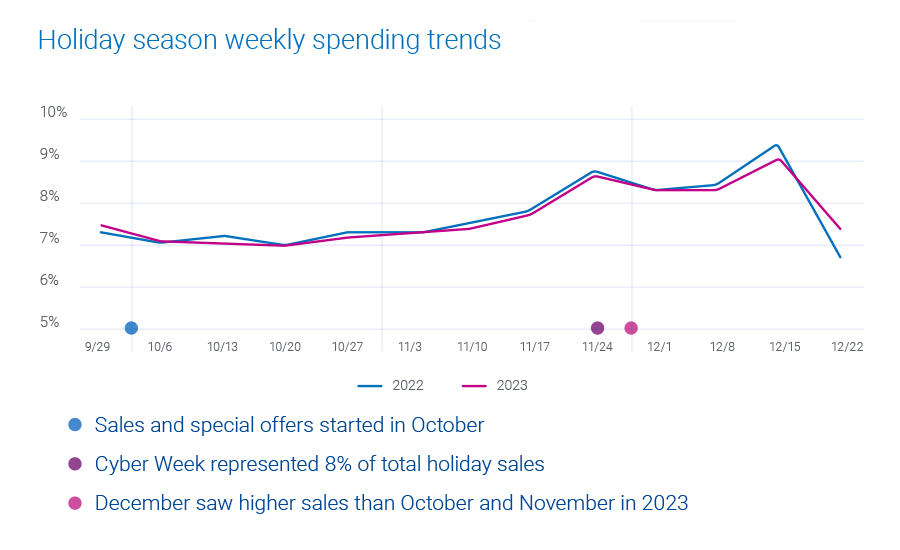
35% of holiday shopping was done in December, peaking at 9% of total holiday sales the week before Christmas. Cyber Week, the five-day period between Thanksgiving and Cyber Monday, and the week before Christmas brought the highest weekly sales for the past two holiday seasons.
What this means for marketers
Prepare for an extended promotional period. Schedule your marketing campaigns and sales initiatives to maximize impact during the extended season, focusing on the peaks of Cyber Week and the week before Christmas.
How Experian can help you target these shoppers
Experian’s data, ranked #1 in accuracy by Truthset, offers advertisers the ability to reach people based on demographic, geographic, and behavioral attributes (e.g. websites visited and purchase history). Our audiences are available on-the-shelf of most major platforms, making it easy for you to activate and target holiday shoppers.
We recently released 19 new holiday-focused audience segments. Here are a few you can activate:
- Black Friday Shoppers
- Cyber Monday Shoppers
- Big Box/Club Store Shoppers
- Luxury Gift Shoppers
- Discount Holiday Shoppers
- Holiday Airline Travel
2. Online shopping is leveling out
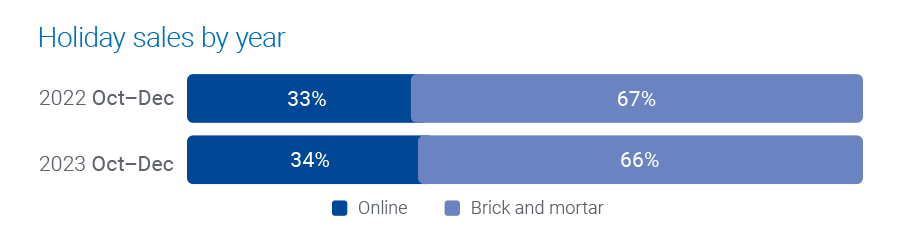
Online holiday spending continues to remain around a third of all holiday shopping spending.
We are starting to see online shopping slow and level out – people are going back in-store. The high amount of online shopping we saw during the pandemic is starting to return to pre-pandemic behaviors.
Consumers are spending more in-store at department and discount stores but are shopping online for office/electronics/games, mass retailers, and apparel.
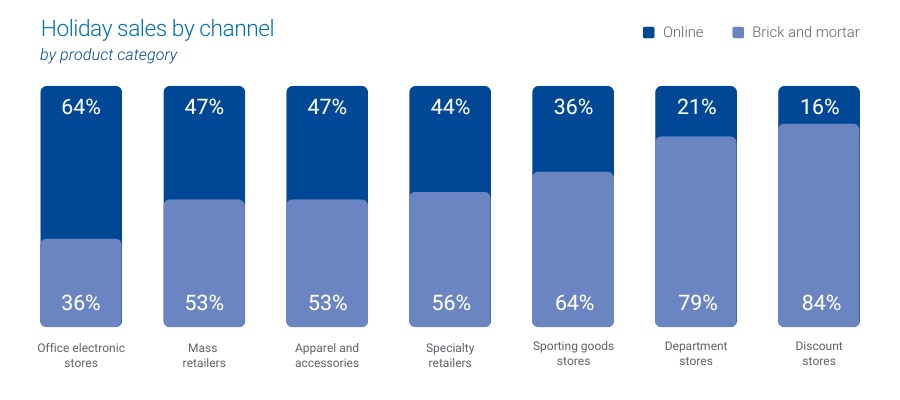
- 84% of holiday shopping was done in-store for discount stores.
- 79% of holiday shopping was done in-store for department stores.
- 64% of holiday shopping was done online for office, electronics, and games stores.
What this means for marketers
Digital and physical experiences work together. Retailers should have a multi-channel plan to reach consumers, tailoring their approach to their target audience and product and creating engaging in-store experiences to drive visitors.
How Experian can help you target and measure across channels
We connect online and offline data to enable precise targeting and measurement of marketing efforts across multiple channels. Read our case study with Cuebiq to learn how they used our Activity Feed solution to deliver in-store lift analyses to their clients.
3. CTV is the top channel to reach consumers
Over two-thirds of the U.S. population now use CTV, and the average time spent among adults is expected to surpass two hours per day in 2024. CTV offers a creative ad experience similar to its linear counterpart but provides more sophisticated targeting and analytics capabilities.
What this means for marketers
As CTV viewing continues to dominate, the importance of cross-device targeting and measurement increases.
How Experian can help you reach shoppers across devices
Later this year, we’ll add support for IPv6 in our Digital Graph as well as phone-based UID2s. This is in addition to our current coverage of IPv4 and email-based UID2s. As a result, all IP signals and UID2s will be resolved back to Experian’s household and individual profiles and their associated devices, which means marketers and platforms can better understand the full customer journey and reach people across their devices.
Download our 2024 Holiday spending trends and insights report
This holiday season is about more than just transactions – it’s about cultivating meaningful connections with your audience. Download our 2024 Holiday spending trends and insights report to access all of our predictions for this year’s holiday season.
When you work with Experian for your holiday shopping campaigns, you’re getting:
- Accurate consumer insights: Better understand your customers’ behavioral and demographic attributes with our #1 ranked data covering the full U.S. population.
- Signal-agnostic identity solutions: Our deep understanding of people in the offline and digital worlds provides you a persistent linkage of personally identifiable information (PII) data and digital IDs, ensuring you accurate cross-device targeting, addressability and measurement.
- Secure connectivity: Bring data and identity to life in a way that meets your needs by securely sharing data between partners, utilizing the integrations we have across the ecosystem, and using our marketing data in flexible ways.
Make the most of this holiday shopping season with Experian. Contact us today to get started.
Latest posts

To our valued customers and partners,It’s been an exciting week here at Tapad! As announced in a press release this morning, Tapad is now a member of the Experian family. We’re thrilled to continue to grow as a leader in identity resolution under the umbrella of a global expert in data, analytics and technology. Tapad and Experian are deeply connected by our commitment to serving the needs of our customers; and with a focus on quality of the data we provide, we have a common goal for the future of identity in the advertising ecosystem. As part of this announcement, we wanted to assure you, our valued customer, that we remain deeply committed to serving you today just as we always have. Nothing will change in your daily operations with Tapad. Experian immediately recognized that the success and growth of Tapad was directly tied to the strength and depth of its team members. As such, the acquisition will not result in any changes to day-to-day contacts at Tapad, or processes with weekly graph deliveries and other product support. Experian’s faith and investment in Tapad’s future and the future of identity resolution underscores what we’ve always believed our products could achieve and that we will be able to continue serving brands, advertisers, publishers, and the advertising and marketing ecosystem for years to come. On a personal note, I am excited to be transitioning my role as Chief Operating Officer of Tapad to the General Manager position of a global business that’s achieved exponential growth over the past several years; culminating in this strategic acquisition that will no doubt bring even more value to our customers in the future. We remain committed to open communication and welcome any questions you may have. Thank you, Mark Connon | General Manager, Tapad

Addressable TV has been through a transformation in the past year. Streaming content has become the most coveted space for creators and advertisers with the rise of new apps and platforms; but the influx of stay-at-home orders around the country have shifted television viewership as we know it, and streaming apps are popping up in droves to take advantage. So, how can you? With no shortage of opportunities to advertise on addressable TV and CTV, how does it fit into the media mix? And furthermore, how can you attribute this household-level device into your overall strategy? Tying it all together Layering addressable TV within digital ad campaigns couldn’t be easier today — but applying the right targeting and cadence between all of your digital efforts; and tying them together in attribution takes the right kind of data. Marketers can use CTV identifiers coupled with other device identifiers available in The Tapad Graph to not only target impressions but also map addressable TVs within the consumer journey; and unify strategies between household decision makers to better personalize messaging. Let's get to work, together At Tapad, we provide actionable insights for marketers to deliver better ad experiences to their consumers through identity resolution. Interested in learning more? Contact us today at sales@tapad.com for a more personal conversation about your identity strategy. 1 The Trade Desk Q2 2020 Earnings Call Transcript, August 2020; 2 iSpot Report, via Deadline, July 2020; 3 Flixed.io, January 2020

For the past several years ad-tech defined the value of identity at the individual level; made possible by the evolution of data, technology and machine-learning. But, earlier this year COVID-19 set in motion many shifts in consumer digital behavior. The more we’ve been working and learning from home, using devices that are shared amongst an entire household, the more apparent it is that marketers need to shift their strategies to align with these changes. Did you know the average household owns eleven or more connected devices? And the longer we’ve been at home, the more these devices are shared by multiple individuals. If you’re looking for a few simple ways to evolve from an individual focused strategy to a household strategy, here’s a good place to start: Audience segmentation Traditionally, audiences are built with a narrow focus on a single user, and what known attributes about that individual or their brand engagement can be leveraged for a targeting strategy. Now that screens are being shared between multiple users in a home, how can you be sure you’re identifying them correctly, and thus, segmenting them in the right buckets for targeting? The key lies in the ability to connect those points through identity resolution. Using ad exposure from household level devices, followed by a second engagement from an individual within that household can indicate a user is a better candidate for purchase or conversion than others. So before you build audiences for targeting, you can qualify them at the household level for segmentation with more confidence. Example: An auto advertiser uses audience segments from a third party provider such as ‘auto intenders’ to target individuals with new pricing offers. They would continue retargeting these users, unaware that some are connected in the same household, and thus are probably not all in the market to actually get a new car. By bucketing users that share a common household device within this third party segment, they can hone in on which individuals are actually in-market for a car and evolve their strategy to be more effective. Targeting Retargeting, frequency capping and sequential messaging have always been meant for an individual user — the more they’re exposed to your brand in a personalized way, the more likely they are to take the desired action. But, have you considered that multiple users could have a shared initial exposure to your brand? Today, you can target a household of potential consumers on a shared device like a CTV, and employ those retargeting strategies based on that common initial exposure. Starting at the household level, means you can compare movement through the funnel between different individuals in that household, and tailor your targeting accordingly. Perhaps you realize only one person in that household will convert and you tailor messaging to them more frequently, while confidently suppressing the other individuals. Example: a CPG brand uses OTT advertising, but doesn’t incorporate it within their sequential strategy, because they consider it just a ‘brand awareness’ opportunity. By using OTT more strategically as a household level engagement, it can reveal which individuals within a household are more favorable towards a brand further down the funnel. So, you can spend impressions targeting those users, rather than wasting impressions on multiple individuals within the household. Measurement Measurement and attribution are imperative to understanding the path to purchase and making strategies more efficient over time. Often that efficiency involves adding or removing devices and channels from a targeting strategy based on their contribution to an action or conversion by an individual. This year we’re seeing addressable TV devices explode in use, which are shared at the household level. Even desktop computers are being used by more people in the home due to COVID-19. So, assuming a linear path of attribution by an individual is missing the full picture. Identity resolution can help you understand where messaging was more effective for some users in the household than others, and leverage that insight to continue more effective strategies in the future. Example: Without a household view, a direct-to-consumer brand would assume all interactions from one device would be coming from a single individual, and that could create a higher cost-per analysis. By incorporating the household level devices into attribution models, they can find efficiencies between touch points of multiple users, and learn how those split off into individual paths to conversion. Not only can this DTC create a more effective model, but they can use that model to create cost efficiencies in the future. Get started with The Tapad Graph For personalized consultation on the value and benefits of The Tapad Graph for your business, email Sales@tapad.com today!