The holiday season is just around the corner, and retailers and marketers are gearing up for the busiest shopping period of the year. It’s crucial to understand how consumer behavior is evolving and what emerging trends to expect. Experian’s 2023 Holiday spending trends and insights report analyzes recent trends, consumer spending habits, and anticipates what’s to come in 2023 to help you deliver a top-notch shopping experience this holiday season.
In this blog post, we’ll cover three key insights from our report.
1. Consumers are shopping earlier
It’s no secret that December has always been the go-to month for consumers when it comes to holiday spending. However, holiday shopping now starts earlier, particularly with online sales.
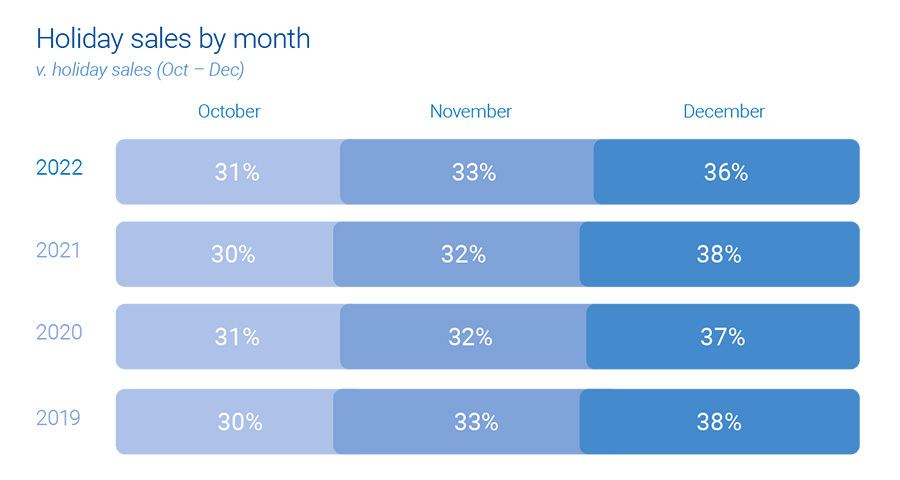
This can be attributed to a surge in promotions and deals, enticing shoppers to open their wallets ahead of time, giving a significant boost to holiday sales. Notably, Cyber Week sales have proven to be an influential factor, accounting for 8% of total consumer holiday spending.
Experian tip
Reach the right shoppers with your promotions with sell-side targeting. This powerful approach gives you control over where your ads are placed while ensuring maximum visibility through direct connections with publishers. Whether on mobile, web, or CTV, this seamless ad experience will engage your audience effectively.
2. Online sales are on the rise
The popularity of online holiday sales is continuously growing, surpassing in-store shopping. There has been a consistent 1% year-over-year increase in online sales, while in-store sales have seen a 1% decrease.
“It’s easier for consumers to comparison shop for large ticket items online that they might find at a mass retailer or office supply store. Consumers prefer to have larger, bulkier items shipped directly to their home for minimal cost. By shopping online, consumers can save time since they don’t need to wait in checkout lines.”
Anna Liparoto, Sr. Account Executive, Retail & CPG
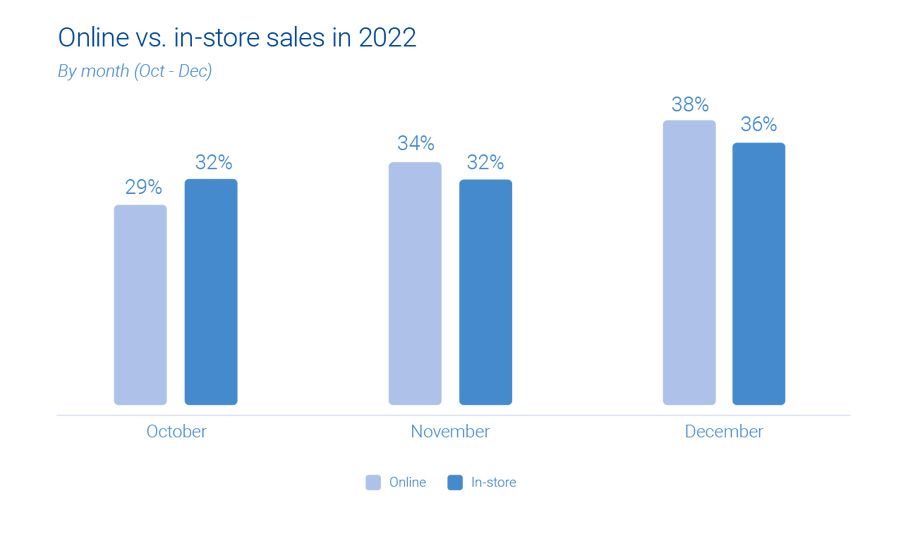
Although online sales currently make up only one-third of all holiday shopping, there is immense potential for further expansion. Mass retailers and office, electronics, and games industries particularly excel in online holiday sales. While in-store purchases remain the primary choice for holiday shoppers, consumer online and offline activities intersect before the final purchase.
Experian tip
Take advantage of the surge in online shopping by diversifying your marketing channels. An agnostic identity graph can bring together device and media data, capturing valuable user insights. By gaining a holistic view of your target audience, you’ll be able to optimize your ad spend and allocate resources effectively, ultimately boosting your return on investment.
“Omnichannel targeting during the upcoming holiday season will continue to prove to be the best way to reach scale and maximize ROI across all marketing channels.”
Joe LigÉ, Head of Enterprise Demand Partnerships
3. 2023 holiday spending will be on par with 2022
During the holiday season in 2022, consumer spending showed an anticipated increase, although the growth rate was slightly lower compared to previous years. October saw a surge in average consumer spending, indicating a swift response to early discounts and promotions offered by retailers.
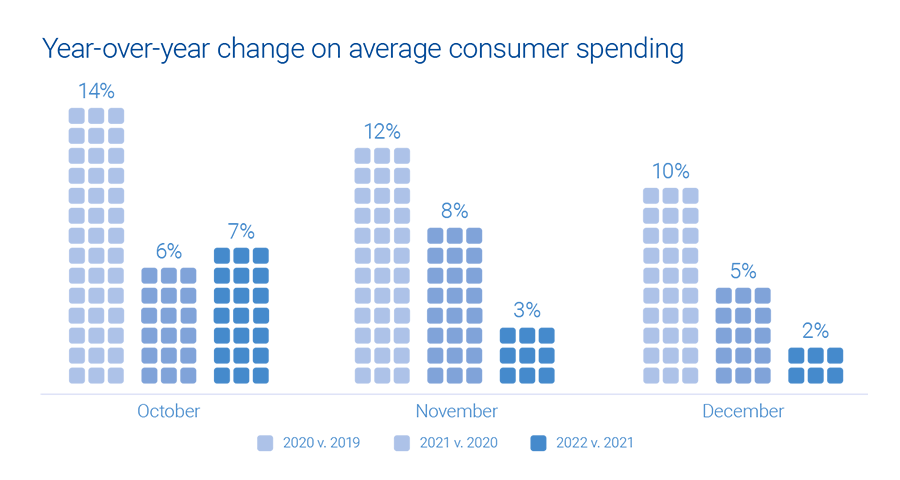
As the holiday season progressed, holiday spending gradually slowed down and reached a level similar to that of the previous year. Overall, there was a modest 2% growth. Looking into the future, if economic conditions remain stable in the second half of 2023, we can expect holiday spending to align with the figures from last year.
Experian tip
To truly maximize impact, consider data enrichment. By diving deeper into your target audience’s preferences and behaviors, you can better tailor your strategies and seamlessly integrate the enriched data across various channels. This allows you to unlock the true potential of your ad inventory, creating more meaningful connections with your audience.
Download our 2024 report
Get ready for the holiday shopping season with Experian’s 2024 Holiday spending trends and insights report. Inside you’ll find:
- Analysis of past trends and what they mean for 2024
- Exclusive predictions for the upcoming holiday season
- The top audiences to activate this holiday season
To access to all of our predictions for this year’s holiday shopping season, download our 2024 Holiday spending trends and insights report today.
Latest posts
Today, we are excited to announce our acquisition of Audigent—a leading data and activation platform in the advertising industry.

Commerce media has recently established itself as a significant player in the AdTech industry. What is it and why should you care?

Originally appeared on MarTech Series Marketing’s understanding of identity has evolved rapidly over the past decade, much like the shifting media landscape itself. From the early days of basic direct mail targeting to today's complex omnichannel environment, identity has become both more powerful and more fragmented. Each era has brought new tools, challenges, and opportunities, shaping how brands interact with their customers. We’ve moved from traditional media like mail, newspapers, and linear/network TV, to cable TV, the internet, mobile devices, and apps. Now, multiple streaming platforms dominate, creating a far more complex media landscape. As a result, understanding the customer journey and reaching consumers across these various touchpoints has become increasingly difficult. Managing frequency and ensuring effective communication across channels is now more challenging than ever. This development has led to a fragmented view of the consumer, making it harder for marketers to ensure that they are reaching the right audience at the right time while also avoiding oversaturation. Marketers must now navigate a fragmented customer journey across multiple channels, each with its own identity signals, to stitch together a cohesive view of the customer. Let’s break down this evolution, era by era, to understand how identity has progressed—and where it’s headed. 2010-2015: The rise of digital identity – Cookies and MAIDs Between 2010 and 2015, the digital era fundamentally changed how marketers approached identity. Mobile usage surged during this time, and programmatic advertising emerged as the dominant method for reaching consumers across the internet. The introduction of cookies and mobile advertising IDs (MAIDs) became the foundation for tracking users across the web and mobile apps. With these identifiers, marketers gained new capabilities to deliver targeted, personalized messages and drive efficiency through programmatic advertising. This era gave birth to powerful tools for targeting. Marketers could now follow users’ digital footprints, regardless of whether they were browsing on desktop or mobile. This leap in precision allowed brands to optimize spend and performance at scale, but it came with its limitations. Identity was still tied to specific browsers or devices, leaving gaps when users switched platforms. The fragmentation across different devices and the reliance on cookies and MAIDs meant that a seamless, unified view of the customer was still out of reach. 2015-2020: The age of walled gardens From 2015 to 2020, the identity landscape grew more complex with the rise of walled gardens. Platforms like Facebook, Google, and Amazon created closed ecosystems of first-party data, offering rich, self-declared insights about consumers. These platforms built massive advertising businesses on the strength of their user data, giving marketers unprecedented targeting precision within their environments. However, the rise of walled gardens also marked the start of new challenges. While these platforms provided detailed identity solutions within their walls, they didn’t communicate with one another. Marketers could target users with pinpoint accuracy inside Facebook or Google, but they couldn’t connect those identities across different ecosystems. This siloed approach to identity left marketers with an incomplete picture of the customer journey, and brands struggled to piece together a cohesive understanding of their audience across platforms. The promise of detailed targeting was tempered by the fragmentation of the landscape. Marketers were dealing with disparate identity solutions, making it difficult to track users as they moved between these closed environments and the open web. 2020-2025: The multi-ID landscape – CTV, retail media, signal loss, and privacy By 2020, the identity landscape had splintered further, with the rise of connected TV (CTV) and retail media adding even more complexity to the mix. Consumers now engaged with brands across an increasing number of channels—CTV, mobile, desktop, and even in-store—and each of these channels had its own identifiers and systems for tracking. Simultaneously, privacy regulations are tightening the rules around data collection and usage. This, coupled with the planned deprecation of third-party cookies and MAIDs has thrown marketers into a state of flux. The tools they had relied on for years were disappearing, and new solutions had yet to fully emerge. The multi-ID landscape was born, where brands had to navigate multiple identity systems across different platforms, devices, and environments. Retail media networks became another significant player in the identity game. As large retailers like Amazon and Walmart built their own advertising ecosystems, they added yet another layer of first-party data to the mix. While these platforms offer robust insights into consumer behavior, they also operate within their own walled gardens, further fragmenting the identity landscape. With cookies and MAIDs being phased out, the industry began to experiment with alternatives like first-party data, contextual targeting, and new universal identity solutions. The challenge and opportunity for marketers lies in unifying these fragmented identity signals to create a consistent and actionable view of the customer. 2025: The omnichannel imperative Looking ahead to 2025 and beyond, the identity landscape will continue to evolve, but the focus remains the same: activating and measuring across an increasingly fragmented and complex media environment. Consumers now expect seamless, personalized experiences across every channel—from CTV to digital to mobile—and marketers need to keep up. The future of identity lies in interoperability, scale, and availability. Marketers need solutions that can connect the dots across different platforms and devices, allowing them to follow their customers through every stage of the journey. Identity must be actionable in real-time, allowing for personalization and relevance across every touchpoint, so that media can be measurable and attributable. Brands that succeed in 2025 and beyond will be those that invest in scalable, omnichannel identity solutions. They’ll need to embrace privacy-friendly approaches like first-party data, while also ensuring their systems can adapt to an ever-changing landscape. Adapting to the future of identity The evolution of identity has been marked by increasing complexity, but also by growing opportunity. As marketers adapt to a world without third-party cookies and MAIDs, the need for unified identity solutions has never been more urgent. Brands that can navigate the multi-ID landscape will unlock new levels of efficiency and personalization, while those that fail to adapt risk falling behind. The path forward is clear: invest in identity solutions that bridge the gaps between devices, platforms, and channels, providing a full view of the customer. The future of marketing belongs to those who can manage identity in a fragmented world—and those who can’t will struggle to stay relevant. Explore our identity solutions Latest posts