Lorem Ipsumis simply dummy text of the printing and typesetting industry. Lorem Ipsum has been the industry’s standard dummy text ever since the 1500s, when an unknown printer took a galley of type and scrambled it to make a type specimen book. It has survived not only five centuries, but also the leap into electronic typesetting, remaining essentially unchanged.


How we shop, how we bank and how we access healthcare — it’s all racing to digital and being mostly consumed at home. It’s the evolution of the “anytime, anywhere, anyone, anything” promise that the Internet made available to us in the 1990s. However, in order to deliver on that promise, we need to be able to reduce the chances of fraud by identifying people no matter where they are or what device they are using. The rise of digital has made being able to identify an individual even more critical. According to a recent Global Insights Report from Experian, there has been a 20 percent increase overall in consumer online transaction activities and 60 percent of consumers have higher expectations of their digital experience than before Covid-19. The challenge companies are currently facing is how to digitally identify individuals while maintaining a positive consumer experience. They need to rely on new technologies including data, biometrics, identity graphs and AI. When it works right, our experiences are more convenient, safer and it creates time for us to focus on other aspects of our lives. At Experian, we are committed to leading the race to digital identity. We use our more than 40 years of experience with success in matching, managing, and protecting identities and personal data combined with today’s most advanced technologies, including AI and machine learning to confirm the identity of an individual. Specifically, Experian is an identity leader in the following areas that impact our society on a daily basis: Fraud Prevention Being able to spot the good guys from the fraudsters is strictly dependent on establishing identity. At the most basic level, we need to be able to verify an individual as a real person and authenticate that they are who they say are. Businesses also need to ensure that the extra secure measures added in order to prove someone’s identity don’t cause too much friction. Today’s consumers are looking for both a convenient and safe experience. In fact, according to our 2020 Global Identity & Fraud Report, 74 percent of consumers said security was their top priority in their online experience, with convenience following closely behind. Most recently, Experian has focused on allowing businesses to reduce both fraud and friction as the world migrates towards a touchless society. Connecting with Consumers Identity is the foundation of the marketing ecosystem. It enables marketers to deliver relevant messages to customers across their most preferred digital channels. But with consumers jumping from device-to-device throughout the day, hundreds of digital touchpoints are created, and connecting these together to build a digital identity can prove challenging. Add to that, the deprecation of third-party cookies, disparate data sources and walled gardens, digital identity can feel like an uphill battle. Experian is committed to helping marketers address the digital identity challenge, connecting offline and digital identifiers into one single customer view. This will help marketers gain a clearer view of their customers across the buying journey and seamlessly deliver relevant content across all digital devices. Healthcare More than half of all deaths that are attributed to medical errors are due to identification mistakes. Despite some giant technological advances in recent years in patient management, achieving accurate and complete patient records remains a major challenge for the U.S. healthcare industry. It’s estimated that around 70 percent of patient data held in electronic health records is incomplete or inaccurate, and up to half of all patient records may not be linked correctly. Unreliable patient data presents some huge problems for health systems, from flawed diagnoses and treatment errors to unreliable analytics and billing mistakes. As patient portals become the new “digital front door” to access care services and manage things like scheduling and payments, and telehealth gains traction as a preferred care modality, fraudulent activity in healthcare will accelerate to an all-time high. Experian helps with healthcare’s largest challenges, including duplicate medical records, mistaken patient identities, pharmaceutical abuse and associated rising costs for patients and providers. We are committed to the industry-wide adoption of Universal Patient Identifiers on the part of providers, pharmacies, payers and other stakeholders in order to improve patient safety and improve industry standards. Combating Synthetic Identities Synthetic identity fraud, where criminals combine real and fake information to create fake identities, is the fastest growing financial crime in the United States. A critical step for lenders to protect their portfolios and manage risk is confirming whether a consumer who is applying for credit is real or not. The earlier in the process this is done, the better. Experian’s fraud prevention solutions, such as Sure Profile, help lenders differentiate between real people and potentially risky applicants, so lenders can confidently increase application approvals with less risk. Businesses are faced with more competition than ever before and consumer behavior is shifting at an unprecedent pace. Being able to identify an individual whether online or offline is critical in today’s environment. Businesses that don’t embrace technology in order to keep up with the changing needs of consumers will be left behind in the race to digital identity.

There hasn’t been many world events that have occurred during my 25+ year career that have had such an impact on cybersecurity as the pandemic. As I reflect on the approximate one year mark since we first heard about COVID-19, it’s truly been one for the record books. This is not relative to numbers such as the amount of data breaches that have been caused by the pandemic, but more so because of the long term ramifications. The pandemic opened up many new cyber scams and threat vectors as well as more vulnerable targets due to rapid and – at times – rushed changes organizations had to undertake in order to respond. A good cyber review of 2020 can be found here. Now we are at a tipping point with societal and operational changes companies and cybersecurity professionals will need to grapple with for a long time. I addressed how some of these will affect 2021 in my annual Data Breach Industry Forecast. As we forge ahead, there are two key areas I see as major security concerns with long-term impact: Remote working is here to stay There is no turning back in how, and more importantly, where we do business. What that means is a larger workforce working from home, which spurs a number of concerns and vulnerabilities from a security standpoint. Businesses now have a much broader threat landscape to protect. Not only that, but families need to tighten their security hygiene as well for their personal devices since criminals know we are spending more time at home using these tools. I predict that operationally there will be new strategies to protect systems and a rethinking of best practices in addition to a flurry of new protection software and other technologies to better protect this at-home frontier. Companies will also need to create new trainings for its employees and find better defenses for social networking attacks like spear phishing. Healthcare will never be the same That line is an understatement. Unfortunately, cybercriminals will not take pity and leave the embattled industry alone. Medical information is very lucrative and thieves will continue to take advantage of healthcare organizations’ focus on the pandemic. But they must address security, especially with advancements here to stay such as telehealth. In fact, I envision that operationally we’ll see more third party data breaches as more providers engage outside suppliers for their digital offerings. Also, with increased digital visits there could be more patients visiting smaller clinics or diagnostic testing centers for further evaluations or tests, which opens up more roads where patients’ information is flowing back and forth. Organizations will need to shore up third party security protocols and expectations to try to prevent this type of data breach. We are only at the beginning of this journey to overcome unexpected challenges and manage new ways of conducting business. For more commentary and updates on the cyber-demic, follow my LinkedIn monthly digest.

Given the many challenges presented over the last 12 months, it’s extremely satisfying to have retained our status and I couldn’t be prouder of this achievement. Being certified as a Top Employer showcases our dedication to a better world of work, which has been exhibited through our excellent HR policies and people practices. It’s been a year like no other, and the COVID-19 pandemic, in particular, has been a real test of our business resilience. Hugely challenging for many individuals. I’m really proud of the support we have put in place, helping our people to reach their full potential and remaining true to our values and purpose. We have been determined to ensure that the diverse needs within our workforce are accommodated. Our ability to exercise progressive policies, such as greater flexibility and enhanced wellbeing offerings, has been essential for our people to adapt to a very different way of working successfully. We’ve provided a wide range of resources, including employee assistance programmes, mindfulness training and collaborative technology tooling, to ensure that our people have the relevant support to stay mentally well. But it is our people that have made this recognition possible. Despite our new working environments, they have been instrumental in ensuring our culture continues to thrive. I have heard so many great examples of how teams stay connected and support each other – from video walks and online games to competitions and virtual cocktail hours. This award demonstrates that we are clearly on the right path, but we won’t stop here. We’re always looking for new ways to do things and to improve as a business. By listening to our people and actively encouraging new ideas, we can continue to develop Experian as a great place to work. To find out more about the Top Employer certification, click here.
Related Posts
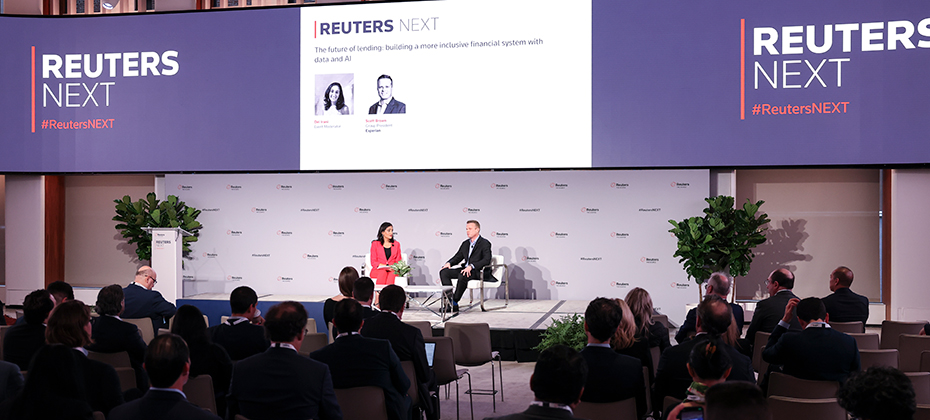
Today, we stand at the forefront of a digital revolution that is reshaping the financial services industry. And, against this backdrop, financial institutions are at vastly different levels of maturity; the world’s biggest banks are managing large-scale infrastructure migrations and making significant investments in AI while regional banks and credit unions are putting plans in place for modernization strategies, and fintechs are purpose-built and cloud native. To explore this more, I recently had the privilege of attending the annual Reuters NEXT live event in New York City. The event gathers globally recognized leaders across business, finance, technology, and government to tackle some of today’s most pressing issues. On the World Stage, I joined Del Irani, a talented anchor and broadcast journalist, to discuss the future of lending and the pivotal role of data and AI in building a more inclusive financial system. Improving financial access Our discussion highlighted the lack of access to traditional financial systems, and the impact it has on nearly 100 million people in North America alone. Globally, the problem affects over one billion people. These people, who are credit invisible, unscoreable, or have subprime credit scores, are unable to secure everyday financial products that many of us take for granted. What many don’t realize is, this is not a fringe subset of the population. Most of us, myself included, know someone who has faced the challenges of financial exclusion. Everyday Americans, including young people who are just starting out, new immigrants and people from diverse communities, often lack access to mainstream financial products. We discussed how traditional lending has a limited view of a consumer. Like looking through a keyhole, the lender’s understanding of the person in view is often incomplete and obstructed. However, with expanded data, technology, and advanced analytics, there is an opportunity to better understand the whole person, and as a result have a more inclusive financial system. At Experian, we have a unique ability to connect the power of traditional credit with alternative data, bringing a more holistic understanding of consumers and their behaviors. We are dedicated to leveraging our rich history in data and our expertise in technology to create the future of credit and ultimately bring financial power to everyone. The future of lending After spending two days with over 700 industry leaders from around the world, one thing is abundantly clear: much like the early days of the internet, today, we are at the cutting-edge of a technical revolution. Reflecting on my time at Reuters NEXT, I am particularly excited by the collective commitment to drive innovative, and smarter ways of working. We are only beginning to scratch the surface of how data and technology can transform financial services, and Experian is positioned to play a significant role. As we look to the future, I am excited about the ways we will create new opportunities for businesses and consumers alike.

We believe that financial literacy leads to empowerment. That is why Experian supports initiatives and partners with community organizations to deliver financial education. We also develop products and services that give more control to consumers over their credit profile and financial health. As part of advancing our mission of Financial Power to All®, we are proud to announce we are helping more than 5,000 Hispanic individuals nationwide by relieving $10 million dollars of consumer debt. To provide families with this boost, we joined forces with ForgiveCo, a Public Benefit Corporation (PBC), to administer the acquisition and cancellation of qualifying consumer debt for the selected recipients. Beneficiaries will also receive a one-year premium Experian membership for free that offers access to their Experian credit report in English and Spanish[i], FICO® Score[ii], bilingual educational content, and other financial resources. We hope this effort helps raise awareness of the importance of financial literacy for everyone, and that Experian has resources to help individuals reach their financial dreams. To amplify the message, we collaborated with multi-platinum, award-winning singer and songwriter Prince Royce and you can see his video here. In fact, we have been making a concerted effort the last several years to evolve our educational resources and products to better support all underserved communities. Some of our other activities include the creation of the B.A.L.L. for Life initiative that connects African American and Hispanic youth with financial education, supporting scholarships for Asian Americans through the Ascend organization, providing custom resources for Out & Equal and Born This Way Foundation for the LGBTQ+ community, supporting the NextGen Innovation Lab for Disability:IN, and sponsoring credit counseling for the military community with Operation HOPE. For resources in Spanish, Experian offers a credit e-book and consumers can access a full suite of articles at the Ask Experian blog here. [i] Only Experian credit reports are available in Spanish. All other services associated with an Experian membership are available in English only. English fluency is required for full access to Experian’s products. [ii] Credit score calculated based on FICO® Score 8 model. Your lender or insurer may use a different FICO® Score than FICO® Score 8, or another type of credit score altogether. Learn more.

Amid some of the financial challenges that underserved communities experience, members across the financial services community remain committed to championing initiatives and programs that drive greater financial inclusion. In fact, collaboration has led to the inclusion of non-debt related payment information on consumers’ credit profiles, as well as digital services that make it easier to manage money. These efforts have helped to broaden access to fair and affordable financial resources for more individuals. While significant progress has been made, there is still more work to do. However, some of the misconceptions and myths about the financial services community are hindering further advancement. Debunking these myths will accelerate progress by building trust between the financial services community and consumers. Person withdrawing money from ATM contactless Myth #1: “Financial institutions have no interest in underserved consumers or credit invisibles.” The truth is, banks and credit unions want to say “yes” to more prospective borrowers, including individuals and families from underserved communities. Beyond being the right thing to do, it’s an opportunity to potentially build lifelong relationships with a relatively untapped market. A show of good faith to communities who have largely been ignored by the financial system could lead to customer loyalty that may extend to their family and friends. That’s why participants across the financial ecosystem have been proponents of including expanded data sources—such as on-time telecom, utility and video streaming service payments—on to consumer credit reports, as well as exploring other Fair Credit Reporting Act (FCRA)-regulated data sources, including payment data on short-term small dollar loans and expanded public records data. Making this data more accessible to lenders provides a more comprehensive view of a consumer’s ability and willingness to repay outstanding debt—an actionable solution to extending credit to consumers without lenders taking on additional risk. Myth #2: “There is a lack of trustworthy financial education resources.” The financial services community and affiliated organizations recognize that empowering people with financial knowledge and skillset are critical to consumers’ financial success. In fact, banks and credit unions are partnering with nonprofits and non-governmental organizations to better understand the unique challenges and opportunities within specific communities and provide relevant tools and resources. For example, Experian’s B.A.L.L. for Life (Be A Legacy Leader) program, launched in partnership with the National Urban League, serves as a catalyst for engaging with Black communities and low-income youth through live events and digital financial education. Subject matter experts, professional athletes, celebrities, and other influencers share their experiences and expertise, covering topics such as banking, credit, financial management and investing. In addition, to help people improve their financial management, Experian partners with the National Foundation for Credit Counseling (NFCC). The NFCC connects consumers with certified financial counselors to help them address various pain points, including debt management, homeownership, student loans or small business cash flow issues. Myth #3: “Underserved communities have few opportunities to build credit and enter the mainstream financial system.” People from underserved communities, as well as younger consumers and recent immigrants are often excluded from the mainstream financial system because they lack an extensive credit history. Historically, it’s created a vicious cycle; in order to get credit, you have to have credit. Fortunately, there has been a sea change in innovative solutions to address the specific needs of these populations. These include new credit scoring models and microfinancing which provide financial services to individuals who may have been excluded from traditional banking systems. In addition, by incorporating expanded data sources, such as telecom, utility and residential rental payments onto credit reports, lenders have more visibility into consumers who may have been excluded by traditional credit scoring methods.These programs help individuals and families from underserved communities establish and build a credit history that could enable loans, or the ability to rent an apartment or open their dream business. An example is Experian Boost®, a free feature that allows Experian members to contribute their history of making utility, cellphone, insurance, residential rent and video streaming service payments directly into their Experian credit profile. By incorporating nontraditional credit data like paying utility bills on time, online banking transactions, rental payments and verified income data, more people can establish a credit profile that can potentially qualify them for a loan. More Inclusion, Fewer Myths It’s encouraging that community organizations and banks are beginning to see the economic and social benefits of aligning on financial literacy and inclusion. As more initiatives come online, underserved populations will be able to establish a better financial foundation. Then, we can declare the myths to be history.