

Greater transparency in buy now, pay later activity is key to helping consumers build their credit histories and supporting responsible lending.
Experian North AmericaScott Brown, Group President, Financial Services

Affirm plans to report all pay-over-time loan products issued from April 1, 2025, and beyond, including Pay-in-4. The move will help drive greater transparency into the buy now, pay later market while helping consumers build their credit histories over time.
Related Posts

Read Moreio55 Button 2- Learn more Primary button Secondary button Related Posts
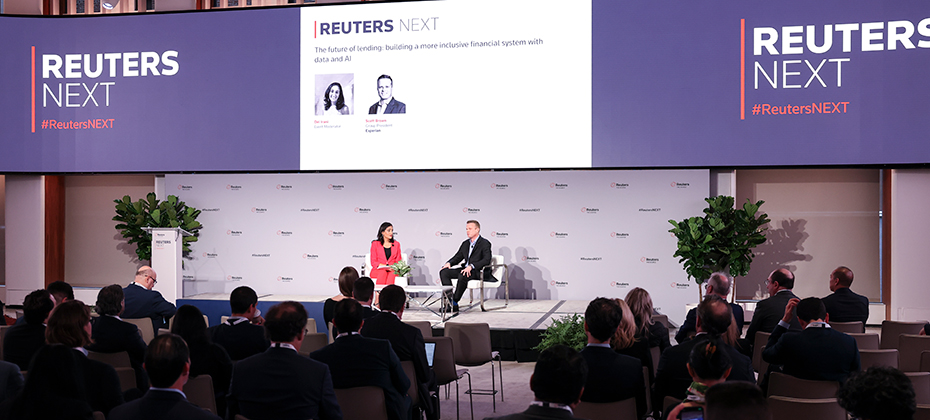
Insights from Reuters Next: Building a More Inclusive Financial System with Data and AI
Data & AnalyticsToday, we stand at the forefront of a digital revolution that is reshaping the financial services industry. And, against this backdrop, financial institutions are at vastly different levels of maturity; the world’s biggest banks are managing large-scale infrastructure migrations and making significant investments in AI while regional banks and credit unions are putting plans in place for modernization strategies, and fintechs are purpose-built and cloud native. To explore this more, I recently had the privilege of attending the annual Reuters NEXT live event in New York City. The event gathers globally recognized leaders across business, finance, technology, and government to tackle some of today’s most pressing issues. On the World Stage, I joined Del Irani, a talented anchor and broadcast journalist, to discuss the future of lending and the pivotal role of data and AI in building a more inclusive financial system. Improving financial access Our discussion highlighted the lack of access to traditional financial systems, and the impact it has on nearly 100 million people in North America alone. Globally, the problem affects over one billion people. These people, who are credit invisible, unscoreable, or have subprime credit scores, are unable to secure everyday financial products that many of us take for granted. What many don’t realize is, this is not a fringe subset of the population. Most of us, myself included, know someone who has faced the challenges of financial exclusion. Everyday Americans, including young people who are just starting out, new immigrants and people from diverse communities, often lack access to mainstream financial products. We discussed how traditional lending has a limited view of a consumer. Like looking through a keyhole, the lender’s understanding of the person in view is often incomplete and obstructed. However, with expanded data, technology, and advanced analytics, there is an opportunity to better understand the whole person, and as a result have a more inclusive financial system. At Experian, we have a unique ability to connect the power of traditional credit with alternative data, bringing a more holistic understanding of consumers and their behaviors. We are dedicated to leveraging our rich history in data and our expertise in technology to create the future of credit and ultimately bring financial power to everyone. The future of lending After spending two days with over 700 industry leaders from around the world, one thing is abundantly clear: much like the early days of the internet, today, we are at the cutting-edge of a technical revolution. Reflecting on my time at Reuters NEXT, I am particularly excited by the collective commitment to drive innovative, and smarter ways of working. We are only beginning to scratch the surface of how data and technology can transform financial services, and Experian is positioned to play a significant role. As we look to the future, I am excited about the ways we will create new opportunities for businesses and consumers alike.
The advertising ecosystem has seen significant transformation over the past few years, with increased privacy regulation, changes in available signals, and the rise of channels like connected TV and retail media. These changes are impacting the way that consumers interact with brands and how brands understand and continue to deliver relevant messages to consumers with precision. Experian has been helping marketers navigate these changes, and as a result, our marketing data and identity solutions underpin much of today’s advertising industry. We’re committed to empowering marketers and agencies to understand and reach their target audiences, across all channels. Today, we are excited to announce our acquisition of Audigent—a leading data and activation platform in the advertising industry. With Audigent’s combination of first-party publisher data, inventory and deep supply-side distribution relationships, publishers, big and small, can empower marketers to better understand their customers, expand the reach of their target audiences and activate those audiences across the most impactful inventory. I am excited to bring together Audigent’s supply-side network as a natural extension to our existing demand-side capabilities. Audigent’s ability to combine inventory with targeted audiences using first-party, third-party and contextual signals provides the best of all worlds, allowing marketers to deliver campaigns centered on consumer choices, preferences, and behaviors. The addition of Audigent further strengthens our strategy to be the premier independent provider of marketing data and identity, ultimately creating more relevant experiences for consumers. To learn more about Experian and Audigent, visit https://www.experian.com/marketing/ and https://audigent.com/.

Experian 11th Annual Data Breach Industry Forecast Details Emerging Cyber Threats in 2024
Data & AnalyticsIn its 11th year, Experian’s Data Breach Resolution group today released its annual Data Breach Industry Forecast for 2024. The report’s global outlook identifies potential moves cybercriminals near and far may take to penetrate organizations and cause chaos. The six predictions included offer commentary into the evolving landscape including the vulnerabilities in expansive data supply chains, what may be new targets, and the sophistication of cyber crews globally. A key reminder is that cybercriminals are working smarter not harder. Like many, they too are potentially leveraging modern tools like artificial intelligence. There may be sophisticated cybergangs operating like organized crime families. Also, hackers today could be backed by growing resources from nation-state sponsors. Their MO is not only stealing data to possibly sell on the dark web or deploy ransomware anymore. They can potentially reap benefits by disrupting economies or industries as we mention in our prediction, “No, not Mother Earth!” or use intellectual property as collateral or for personal gain outlined in the “Winning from the Inside” prediction, for example. There are always new ways of conducting “business” for cybercriminals. In the face of emerging cyber threats, organizations are urged to prioritize cybersecurity as a fundamental aspect of their operations. They should regularly update and reinforce security protocols, conduct thorough risk assessments, and invest in cutting-edge cybersecurity technologies. By staying vigilant and adopting a proactive cybersecurity stance, organizations can significantly mitigate the risks posed by the evolving tactics of cybercriminals in 2024 and beyond. Experian Global Data Breach Resolution offers international resources for companies impacted by a security incident and services include IdentityWorks℠ Global, multilingual call centers, and notifications covering more than 100 countries. Experian has also recently expanded capabilities to Japan, Taiwan and Thailand. To access the complimentary report, visit https://ex.pn/2024databreachindustryforecast.

In the chronicles of business evolution, one often recalls Amazon’s humble beginnings as an online book seller before transforming into the e-commerce giant we know today. Reminiscent of that journey, Experian has undergone its own transformation. It has long since ceased to be simply a “credit bureau” and has instead embraced a story that is far more dynamic and which defies this caricature. The Real Experian: When people associate Experian with being a credit bureau, our response is a resounding, “Yes, but that is only a part of our story.” It is the beginning chapter—as data evolved to ‘Big Data’, we layered in technology to understand that data, catapulting our company into a different realm. Today, Experian is a global force with a presence in over 30 countries, boasting a team of 22,000 professionals dedicated to harnessing the power of data and analytics for the betterment of businesses, societies, and consumers worldwide. Embracing Data and Analytics: At the core of our story lies a commitment to embrace data and analytics in a way that only Experian can. We collaborate across our operations to deploy advanced technologies, artificial intelligence, and to tap into rich data. The result? A powerful impact on businesses, societies, and consumers alike. Only Experian can: We are proud to share our story of how we power opportunities in a way that only Experian can. Experian leaders worldwide provide a glimpse into what sets Experian apart in the modern landscape of advanced technologies and powerful analytics. You can read the 5-minute story here. Continual Evolution: Experian’s evolution from the world’s leading credit bureau to a global data and analytics powerhouse is an ongoing journey. Our vision propels us forward, driving us to continually redefine our role in an ever-changing landscape. As Experian continues to evolve, our commitment to making a powerful difference remains unwavering. Our story is one of transformation, innovation, and a relentless pursuit of excellence. Join us on this journey, as we redefine what it means to be a global leader in data and analytics.

HRC Awards Experian Highest Score on the Corporate Equality Index for the 5th Year in a Row
Diversity & InclusionExperian celebrates its fifth consecutive year of achieving the highest score in the Human Rights Campaign’s Corporate Equality Index (CEI), solidifying our position as a leader in LGBTQ+ workplace inclusion. Our enduring commitment to LGBTQ+ equality and inclusion has not only earned us this prestigious recognition, but also underscores our dedication to fostering a diverse and inclusive workplace where everyone can thrive. Michele Bodda, Executive Sponsor of Experian’s PRIDE ERG said, “I am incredibly proud to see our company achieve this milestone recognition again. It’s a testament to the dedication of our entire Experian family in fostering an inclusive and accepting workplace where everyone can be their authentic selves.” LGBTQ+ Workplace Inclusion in ActionOur score of 100 in the 2023 CEI is a testament to our continued efforts in promoting LGBTQ+ workplace inclusion. Here are some of the initiatives that exemplify our commitment: Progressive Benefit Programs: Experian offers comprehensive benefit programs that encompass transgender services and provide equal coverage to same and different-sex domestic partners and spouses. These benefits support the diverse needs of all our employees. Non-Discrimination and Equal Employment Policies: Our non-discrimination and equal employment policies are committed to fairness and respect for all employees, transcending federal requirements and embracing inclusivity without regard to gender identity or sexual orientation. Transgender and Nonbinary Identity Support: We’ve created a process for transgender and non-binary individuals to update their identity documentation without emotional and financial strain. We also suppress their former names (deadnames) from Experian credit reports. The Power of YOU Initiative: To foster an inclusive work culture, Experian actively supports LGBTQ+ employees through initiatives like the Power of YOU campaign and the PRIDE Employee Resource Group. Check out the 2023 Power of You DEI Report to learn more. Celebrating five consecutive years of earning the highest possible score on the CEI is a milestone that underscores our continued dedication to creating an inclusive work environment where every employee, feels supported, valued, and empowered. For more information on our HRC Award and the 2023 Corporate Equality Index, check out the full report here. You can also learn more about Experian’s awards for our work supporting consumers, businesses, and our employees here.
In this article…