Loading...

10 political personas to use in political digital marketing campaigns

Published: April 23, 2024 by Experian Marketing Services

Political audiences to include in your political campaign strategy

In the American political landscape, understanding the intricacies of voters’ attitudes and behaviors has never been more crucial. With the 2024 election season on the horizon, the challenge lies in moving beyond broad categorizations like “Democrat,” “Republican,” or “Independent.” Voters seek candidates who resonate with their beliefs and values.

To meet this challenge, Experian has created political personas that offer a nuanced understanding of American voters. In this blog post, we’ll explore how these Experian audiences can help you tailor your engagement strategies for the upcoming election cycle.

Before we dive into our political personas, let’s break down what political campaign marketing is and six benefits of using digital marketing in political campaigns.

What is political campaign marketing?

Political campaign marketing is the strategic engine that drives candidates toward electoral success. It involves crafting and sending out tailored messages to effectively reach constituents to inform them about candidates’ stances on key issues. Think of it as the art of narrative construction, using various communication channels—from traditional media to digital platforms—to engage and mobilize supporters. In an era marked by information saturation, effective campaign marketing serves to cut through the noise to deliver compelling messages that inform, inspire, and spur action.

Benefits of digital marketing in political campaigns

As the 2024 election approaches, using digital marketing in political campaigns becomes paramount to effectively reach and influence voters where they spend a significant portion of their time—online.

Kamala Harris’s entry into the race has shifted spending priorities, particularly in critical states such as Ohio, where the Senate race has already attracted $300 million in ad spending. Political ad spend on connected TV (CTV) is expected to rise significantly, from 2.7% in 2020 to 12.8% this year. The Harris campaign is spearheading this trend, dedicating $200 million to digital ads, with a substantial portion directed toward streaming platforms.

Embracing digital marketing can help campaigns effectively shape opinions and mobilize support. Here are five key benefits of integrating digital marketing strategies into political campaigns:

  1. Unparalleled reach with targeted advertising: A well-connected digital platform partner can help you reach your target audiences across the ecosystem – from social to the open web.
  2. Optimization flexibility: Digital marketing allows for quick adjustments in response to real-time data and evolving circumstances.
  3. Interactive engagement: The interactive nature of digital channels creates meaningful engagement and dialogue between candidates and voters, building connections and community.
  4. Insights: Robust analytics provide valuable insights into audience behavior and preferences, facilitating continuous optimization and refinement of outreach efforts.
  5. Amplified messaging: Through digital marketing, political campaigns can amplify their message, mobilize support, and forge deeper connections with voters.

Data serves as the foundation for these benefits. Interactivity hinges on data to deliver the right message and creative for engagement. Insights are gained through pre-campaign research, analyzing audience attributes to grasp their interests and behaviors. Flexibility relies on real-time campaign data, a unique advantage in digital marketing.

In an era where audiences are available readily on most major activation platforms, advertisers need to understand how audiences are built to be privacy conscious and consistent in a cookieless environment.

Experian’s political personas

Digital marketing in political campaigns is crucial to reach and influence voters online. Integrating Experian’s political personas into your political campaign strategy can help you grasp the complexities of today’s American voter landscape and craft tailored engagement strategies. These personas offer invaluable insights into voter viewpoints on key political issues, enriching digital marketing efforts and empowering campaigns to connect with constituents more effectively.

Experian has created 10 political personas to help you better understand today’s American voter so you can reach consumers based on their viewpoints into key political issues.

Our political personas group voters along the political spectrum from most “committed” on the ends of the spectrum.
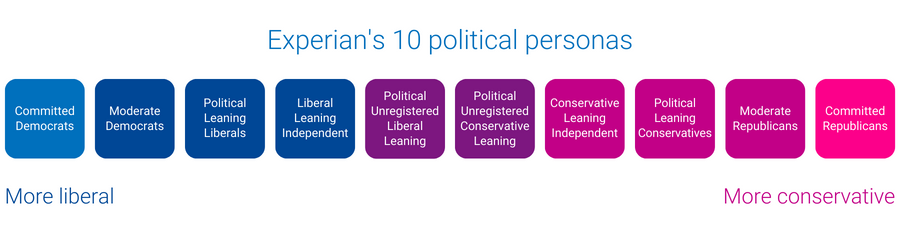
The spectrum of Experian's 10 political personas

Let’s walk through how we define each persona starting from the most “committed” personas on the ends of the spectrum.

Committed Democrats

This audience contains consumers who are likely to have a “very liberal” outlook on political issues. They have strong liberal opinions on various topics including key issues and the economy and are very involved in their communities.

Committed Republicans

This audience contains consumers who are likely to have a “very conservative” outlook on political issues. They are well-informed, community-minded individuals with strong opinions that reflect their conservatism. They have very conservative attitudes regarding key social issues.

Moderate Democrats

This audience contains consumers who are likely to have a “somewhat liberal” outlook on political issues.

Moderate Republicans

This audience contains consumers who are likely to have a “somewhat conservative” outlook on political issues.

Political Leaning Liberals

This audience contains consumers who are likely to have strong opinions on key issues that may not align with the traditional Democrat point of view.

Political Leaning Conservatives

This audience contains consumers who are likely on-the-fence on traditional Republican points of view on key issues.

Liberal Leaning Independents

This audience contains consumers who are registered independents and who are likely to have a “middle of the road” outlook on political issues while tending to lean more liberal.

Conservative Leaning Independents

This audience contains consumers who are likely registered independents and likely have a “middle-of-the-road” outlook on political issues while tending to lean more conservative.

Political Unregistered Liberal Leaning

This audience contains consumers who are not likely to have aligned with a specific party, but have a more liberal attitude. They are well-informed and are aware of important political issues. They frequently align with but are not necessarily completely aligned with liberal points of view.

Political Unregistered Conservative Leaning

This audience contains consumers who are not likely to have aligned with a specific party, but have a more conservative attitude. They are well-informed and are aware of important political issues. They frequently align with but are not necessarily completely aligned with conservative points of view.

These 10 personas can help you better understand who the American voter is, but when combined with our 200 politically relevant audiences, such as watches political TV, donations to charitable causes, engagement channel preferences, hobbies, and more, the ability to study and improve engagement for each persona is considerably magnified.

How to combine our political personas with other audiences

If you’re a political candidate looking to reach an important population, Experian audiences are available on-the-shelf of major platforms. For example, if you want to reach unregistered voters and independent voters to influence green initiatives within your community, you can focus on unregistered and moderate personas in the area and combine that with audiences interested in green initiatives, like our GreenAware segments – which predict a consumer’s attitude and point of view on environmental issues.

You can use our “Political Unregistered Liberal Leaning”, “Liberal Leaning Independents,” and GreenAware “Think Greens” audience segments to reach constituents who are likely to be most interested in your message.

To reach voters based on their regional voting patterns, you can use our new battleground counties and district audiences:

  • Affiliation Switcher Counties
  • Battleground Counties
  • House Battleground Districts
  • Democrat Counties
  • Republican Counties
  • Independent Counties

Add Experian’s audiences to your 2024 election strategy

Political advertising spend is projected to surpass $12 billlion in the 2024 election cycle, generating the largest amount of voter outreach in the history of American elections. Experian’s audiences are available on major activation platforms allowing you to strategically reach constituents who would be most impacted and interested in your initiatives.

As we approach a cookieless future, Experian’s political personas are cookie resilient. Our data is rooted in both offline and online data that doesn’t rely on third-party cookies. The personas do not rely on an individual’s browsing behavior. Experian can help our partners understand and engage with these political audiences.

Over 200 politically relevant Experian audiences are available for activation on-the-shelf of the leading TV, demand, and supply platforms. Here are the platforms where you can find our political audiences:

  • ArcSpan
  • Audigent
  • Cadent
  • Eyeota
  • Magnite
  • Microsoft
  • Nexxen
  • Pandora
  • Permutive
  • Samsung Ads
  • The Trade Desk
  • Verizon Media
  • Viant
  • Videoamp
  • Yieldmo

Can’t find the audience you’re looking for or need a custom audience? Connect with our audience team for more information.


Latest posts
Loading…
Experian’s Graph adds support for Unified I.D. 2.0 (UID2)

Cookies are leaving us, but that doesn’t have to mean performance has to. That’s why Experian is taking the steps needed to future-proof identity in our Graph, including adding Unified ID 2.0 (UID2) from The Trade Desk. Experian currently supports UID2 in our Graph outputs for demand-side platforms (DSPs). UID2 support in our Graph outputs will be available to all approved partners by December 2023. In this blog post, we talk about why cookieless IDs, like UID2, that are coming to market because of cookie deprecation, are important, and how incorporating cookieless IDs into an identity graph can help you prepare for a cookieless future. What are cookieless IDs? Like cookies, cookieless IDs provide you with a comprehensive view of a consumer’s digital activity. Unlike cookies, identity providers produce cookieless IDs, using user-consented data and deterministic and probabilistic data signals (like hashed emails or mobile ad IDs). Cookieless IDs are a newer identifier that allows the advertising industry to maintain our understanding of consumers’ digital actions, helping to ensure we continue to generate smart, data-driven insights, targets, activation strategies, personalized experiences, and measurement and attribution. Why should you incorporate cookieless IDs into an identity graph? Adding cookieless IDs to an identity graph allows for licensees of the graph to: Resolve the universal ID to a consolidated consumer profile and know which other digital IDs tie to the cookieless ID Establish a unified view of the consumer with a privacy-compliant ID Produce data-driven and informed advertising strategies that still drive results, without the use of cookies Experian’s Graph Experian’s Graph is one of the most robust and signal agnostic identity graphs in the market. Experian’s Graph supports most digital IDs, including cookieless IDs, such as ID5, UID2, and Hadron ID. When you license Experian’s Graph, you increase your ability to better understand the different digital IDs that tie to a household or individual. Additionally, with our cookieless ID support, you can continue to understand your consumer and their digital IDs in the cookieless world. Why is it crucial to include UID2 support in Experian's Graph outputs? The Trade Desk is the largest, independent demand-side platform. They’ve created a cookieless ID, UID2, that they hope can power the advertising world to come across the open web. UID2 is an alternative solution to third-party cookies that when utilized in an identity graph, can offer a clearer picture of your consumer, enabling frequency controls and better management, across both digital and connected TV (CTV). Approved DSPs can add UID2s to their Experian Graph, giving them access to one of the more trusted and prominent cookieless IDs in the market today. Additionally, DSPs can use this identifier to decide whether to bid on certain inventory or not, on behalf of their advertiser partner. And, if we hedge our bets, it will only grow in prominence and use. While only available to approved DSPs today for use in the Experian Graph, the forthcoming encrypted UID2 token will provide this capability to the entire ecosystem, which allows us all to speak the same language and operate as efficiently as possible. "We are excited to support UID2, one of the premier IDs to support the future of addressability across the open internet, in the Experian Graph. We continue to see the adoption of UID2 across the demand-side ecosystem, increasing addressability across growing channels like CTV and beyond. I am personally excited to see how this momentum continues to increase over the remainder of 2023 and into 2024."chris feo, svp, sales & partnerships, experian Future-proof your identity strategy with Experian Graph and UID2 We’ve seen the impact that cookies have had on digital advertising and marketing. With the impending third-party cookie deprecation, you will need to adopt alternative cookieless ID solutions such as Unified ID 2.0. Experian is well-positioned to help you navigate this change, offering UID2 support in our Graph outputs for all approved partners by December 2023. Take the right steps now to future-proof your identity strategy and discover lasting success even without cookies. Alongside Experian’s Graph solution, you can achieve resilience in an ever-changing world of digital marketing and advertising. Now is the time to get ready for a cookieless future. Connect with an Experian team member to learn more about our Graph capabilities today. Learn more about Experian's Graph today Latest posts

Nov 09,2023 by Dylan Rothenberg

Three steps to maximize your data collaboration strategies for 2023 and 2024

In this article…How data collaboration is evolving from 2023 to 2024How to create efficient data collaboration strategies We live in a data-driven world, and businesses need effective data collaboration strategies to remain successful. Before you determine your 2023 and 2024 data collaboration options, it’s essential to understand what data collaboration is. In short, it involves sharing and combining data from multiple sources to better understand a customer base and make informed marketing decisions. Read on to learn more about our three-step plan to create new data collaboration strategies, how it’s evolving, and what we do to ensure our solutions help maintain your company’s data privacy. How data collaboration is evolving from 2023 to 2024 Data collaboration strategies continually evolve thanks to changing industry dynamics and new technologies. As we move from 2023 to 2024, we’ll likely see collaboration extending outside businesses, meaning data can be shared with external partnerships in the form of a data ecosystem. A data ecosystem is a platform that combines numerous information points, including packages, algorithms, and cloud-computing services, to allow businesses to store, analyze, and use the data they’ve collected. To ensure you’re ready for 2024 data collaboration, you’ll need to take a forward-thinking approach toward new data strategies. How to create efficient data collaboration strategies Here are our three steps for efficient collaboration to make the most of 2023 data collaboration and prepare for 2024. Identify your collaboration goal What are you hoping to gain from data collaboration? Do you understand the audience you’re trying to target and what you want regarding outcomes? To measure your success, you should set short- and long-term goals surrounding data collaboration in 2023 and 2024. Maximize the value of your data One of the most important reasons to gather data is to discover in-depth insights into your audience and the effectiveness of your marketing efforts. You’ll be able to identify hidden patterns and pinpoint trends you may not have noticed before. With this information, you can make more strategic marketing decisions to stay competitive in your industry. Resolve digital identities Collaborating on data with trusted partners can help you gain a more complete view of your customers by building comprehensive digital profiles. Resolving digital identities can provide greater insight into online and offline behavior of individual consumers, allowing you to better connect with your target audience and boost brand loyalty. Find an alternative to third-party cookies Digital privacy regulations are getting more strict, which is why it’s so important to find more secure alternatives to third-party cookies. By collaborating on data, you can gather essential insights without relying on cookies. This means you’ll still get the information you want while complying with privacy regulations. Choose the right collaboration partner Before you choose a data collaboration partner, it’s essential to ensure their privacy standards align with yours. How do they collect data and use it ethically and responsibly? At Experian, we are dedicated to protecting consumers and delivering responsible and transparent data practices. We focus on five Global Data Principles — security, accuracy, fairness, transparency, and inclusion — to ensure we treat data carefully and respectfully while boosting economic growth and resilience in the marketing environment. When you partner with us for data collaboration, you can trust that your data is protected in a system built for 2023 data collaboration needs — both known and unknown — while still evolving for 2024 and beyond. Choose a secure environment for collaboration Data collaboration security is vital to safeguard your business and consumers’ information. You can make sure your new data collaboration options are protected in several ways. We’ve outlined three options below. Collaboration in clean rooms Clean rooms are secure, private environments where data is shared and analyzed without exposing the underlying raw data. This ensures that sensitive information remains protected and insights are discovered securely. Experian has vetted clean room partners if this is an option you prefer while still getting industry-leading identity resolution. Collaboration directly Collaborating directly with your partner can be a good option if you have robust security measures. Encryption, access controls, and regular audits are essential to maintain data security in direct collaborations. Collaboration with Experian We excel at meeting our clients where they are and accommodating their technical capabilities and how they manage their data. We offer a secure and compliant environment for data collaboration. Our data collaboration solutions are designed to protect your data while enabling deeper insights. At Experian, we understand the importance of data privacy, and our platform reflects our commitment to safeguarding your information. Enable deeper insights and activation with Experian’s data collaboration solution Data collaboration is crucial in today’s business world, and Experian’s solutions are designed to help you bring together your 2023 and 2024 data collaboration strategies securely and efficiently. With Experian, you can unlock deeper insights, resolve digital identities, and confidently navigate the evolving data privacy landscape. If you’re looking for the right partner to enhance data collaboration to drive growth and innovation in your business, you’ll find a secure environment and the right partner with Experian. Contact us today to get started. Contact us Latest posts

Oct 17,2023 by Experian Marketing Services

Experian’s Census Area Projections & Estimates Data (CAPE): 2023 release

We are excited to announce that we’ve updated our CAPE data with 2020 Census data. This release updates estimates and projections from 2010 and replaces all previous CAPE data attributes.  U.S. Census data offers a great opportunity for data enrichment  The U.S. Census is conducted every 10 years to determine the number of people living in the U.S. in addition to collecting data on dozens of topics across 130+ surveys and programs.  U.S. Census data is already broken out into regional groups and covers 100k+ different geographies: States, counties, places, tribal areas, zip codes, and congressional districts.   Block groups are the smallest geographic area for which the Bureau of the Census collects and tabulates data. They are formed by streets, roads, railroads, streams, other bodies of water, and other visible physical and cultural features.  What is CAPE?  Census Area Projections & Estimates data (CAPE) data from Experian utilizes a proprietary methodology to make the data easy to action on for marketing use cases. Made from U.S Census and Experian consumer data, CAPE data sets are developed at the block group and zip code level and targetable at the household level.  CAPE 2020 updates  CAPE 2020 uses the 2020 Census data blended with other Experian data to update CAPE’s unique attributes for data enrichment and licensing. Multiple sources are used and data is delivered at a block group level or zip code. Experian provides unique CAPE attributes not available through other sources that provide Census data. These include our Ratio and Percentages attributes, Score Factors/Segments, and Mosaic. CAPE 2020 use cases  Our CAPE 2020 data sets enable strategic marketing analysis and decision-making.  You can use CAPE 2020 data to understand the differences in the markets you serve as they relate to core demographics, housing attributes, education, income, employment, spending, and more. You can do this to:  Find populations that are not typically captured in standard demographics.  Cross-reference Census demographics data with other behavioral and shopper data.  Understand supply and demand for products sold.  Get started with our CAPE 2020 data today If you are using Experian’s CAPE 2010 data, please work with your Experian representative to migrate to CAPE 2020. If you are interested in learning more about our CAPE data, get in touch with us today.  Contact us Latest posts

Oct 03,2023 by James Esquivel

Subscribe to our newsletter

Enter your name and email for the latest updates

This site is protected by reCAPTCHA and the Google Privacy Policy and Terms of Service apply.

About Experian Marketing Services

At Experian Marketing Services, we use data and insights to help brands have more meaningful interactions with people. As leaders in the evolution of the advertising landscape, Experian Marketing Services can help you identify your customers and the right potential customers, uncover the most appropriate communication channels, develop messages that resonate, and measure the effectiveness of marketing activities and campaigns.

Visit our website

Subscribe to our newsletter

Stay up to date on the latest industry news and receive expert tips from our marketing experts.
Subscribe now!