Agencies, platforms, and marketers stand at the crossroads of transformation, as privacy regulations tighten, technology accelerates, and consumer behaviors evolve. Yet these challenges also present extraordinary opportunities.
Our 2025 Digital trends and predictions report highlights five trends that will shape 2025 and digs into:
- What’s changing in the market
- How to keep learning about your customers
- How to reach your customers in different places
- How to measure what’s really working along the way
In this blog post, we’ll give you a sneak peek of three of these trends — from cracking the code of signal loss to tapping into the buzz around connected TV (CTV) and stepping up your omnichannel game. Think of it as a taste test before the main course. Ready for the full menu? Download our report to get the lowdown on all five trends.
1. Signal loss: A rich appetizer of alternate ingredients
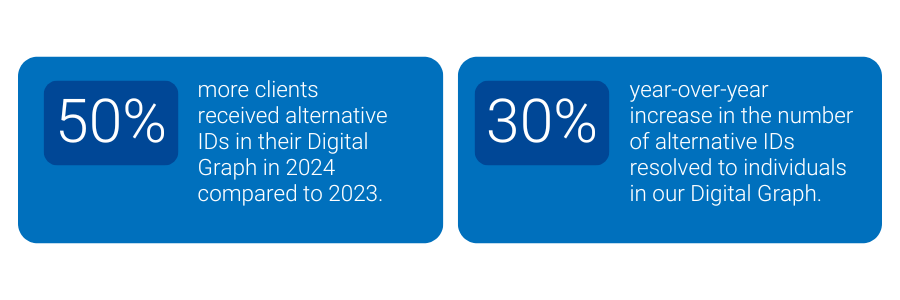
As traditional cookies crumble, marketers need fresh ingredients to keep the flavor coming. Already, about 40% of browser traffic doesn’t support third-party cookies, and marketers are spicing things up with first-party data, alternative identifiers like Unified I.D. 2.0 (UID2) and ID5, and contextual targeting strategies. In fact, 50% more of our clients received alternative IDs (UID2, ID5, Hadron ID) in their Digital Graph in 2024 compared to 2023. The number of alternative IDs resolved to individuals in our Digital Graph increased by 30% year-over-year – as everyone looks beyond the cookie jar.
There is no secret sauce to replace cookies. Instead, expect a multi-ID recipe that brings together different identifiers, unified by an identity graph. This approach turns a fragmented pantry of data into a cohesive meal, giving you a complete view of your customer on every plate.
2. The rising power of CTV: A hearty entrée of opportunities
CTV is quickly becoming the main dish on the streaming menu, as viewers load up on their favorite shows. While CTV is slated to make up 20% of daily U.S. media consumption by 2026, advertisers are still holding back on pouring in the ad spend. To unlock its full flavor, marketers need to whip up solutions like frequency capping and unified audience activation.
Although CTV will account for 20% of daily U.S. media consumption by 2026, it’s projected to command only 8.1% of ad spend. Frequency capping and unified audience activation solutions will be key to unlocking CTV’s full potential.
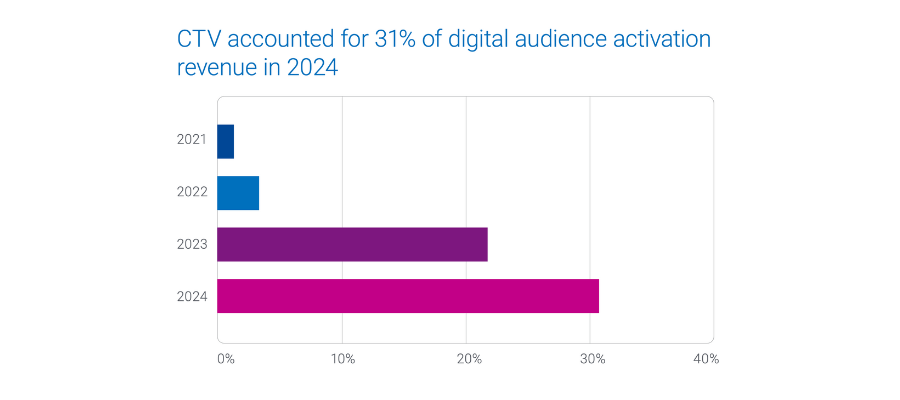
By 2025, nearly half of CTV “diners” will choose free ad-supported streaming TV (FAST). Marketers need strategies to prevent ad overexposure. With 50% of U.S. consumers avoiding products due to ad overload, and 30% of marketers willing to increase their CTV spend if frequency capping improves, unified identity solutions help ensure every impression is served just right.
3. Omnichannel: A flavorful fusion plate
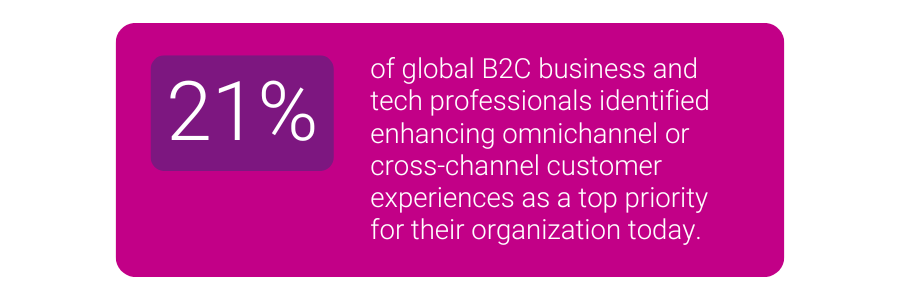
No one likes a one-flavor meal. Marketers are moving beyond single-channel “side dishes” to omnichannel “fusion feasts” that blend direct mail, digital, CTV, and retail media networks (RMNs) into a truly cohesive culinary experience. Even though only 21% of global B2C professionals currently put omnichannel at the top of their shopping list, the growing demand for seamless, audience-first campaigns is heating up.
In 2025, having an audience-first approach will be like having a perfect pairing for every course. Unified identity solutions act as your master sommelier, ensuring that each channel complements the next, and every customer enjoys a well-rounded, memorable journey.
Vertical trends: A dessert sampler from four unique kitchens
Different markets have their own signature flavors.
- In Auto, crossover utility vehicles (CUVs) claim 51% of new vehicle registrations, and consumers in the 35-54 age group and families are the primary buyers. Automotive marketers should prioritize CUV advertising with a strong focus on family-oriented and income-appropriate messaging
- In Financial Services, marketers need to anticipate shifts in consumer behavior tied to economic conditions, such as increasing demand for deposit products when interest rates are high. For insurance, aligning campaigns with life events, like new home purchases or marriage, can maximize engagement.
- In Healthcare, advertisers are prioritizing personalized, regulation-compliant campaigns that address social determinants of health (SDOH).
- In Retail, advertisers are increasingly activating on both CTV and social platforms, with many managing their own in-house campaigns. While larger brands often rely on media agencies, a shift toward in-house media buying is emerging among some bigger players, offering more control over audience targeting and performance metrics.
Our report covers each vertical’s unique menu, helping you select the right “ingredients” for your customers. With the top Experian Audiences on hand, you can create feasts that delight, nourish, and convert.
Hungry for more? Download our full menu
The three “samples” you’ve just tasted are just the starters. Our 2025 Digital trends and predictions report serves up five insights, complete with strategies, data, and tools to help you adapt, scale, and thrive in 2025.
Ready for the full menu? Download our report now and discover all five trends that will shape your marketing “cookbook” in 2025. Bon appétit!
Latest posts
Every year, the Experian team attends the Consumer Electronics Show (CES) in Las Vegas, to immerse ourselves in the world's most significant consumer tech showcase and stay at the forefront of the latest technological advancements and innovations that shape the AdTech industry. This year's event was a vibrant melting pot of innovation and vision, from streamers taking a bigger bite of the advertising pie to the emergence of AI-powered solutions and drone delivery services. Amidst these advancements, the dynamic interplay of technology, media, and advertising raised important questions, especially in the context of evolving regulations and cookie deprecation. During CES, we captured insights from various thought leaders, and in the coming months, we'll be sharing these valuable perspectives with you. Watch the video below for full insights coming from our content studio onsite during the event. Or, keep reading for a recap on four key trends from CES and what they mean for your business in 2024! “My first CES was a major success. You could feel the buzz in the air as new ideas and partnerships were being created within and across industries. The intersection of the different players within retail media, connected TV, retail technology, the demand and supply-side, and agencies all in an ever-changing world of regulation and privacy begs for a solution that can maximize a successful outcome for all.”anne passon, sr director, sales, retail & cpg 1. Audience targeting: How first- and third-party data work together A central theme at CES was the importance of audience targeting, highlighting the crucial role of first-party data. However, it’s clear that to maximize its potential, this data needs to be augmented with sophisticated identity solutions and enriched with third-party insights, all while navigating the complexities of privacy regulations. This integrated approach is vital to understanding audiences and for creating more effective marketing strategies that comply with privacy regulations. 2. Standardizing metrics in retail media networks The challenges around retail media networks, particularly in terms of standardizing metrics like incremental return on ad spend (iROAS), were a hot topic at CES. This complexity around this topic underscores the need for neutral, expert third parties to help bring clarity and consensus, aiding businesses in navigating this multifaceted domain. 3. The challenge of switching data solutions Discussions covered the broader challenges associated with transitioning to new data solutions. For businesses, this involves a critical assessment of the benefits versus the costs and complexities of adopting new platforms or systems. This decision-making process is increasingly significant as data strategies become integral to marketing success. 4. Identity solutions in a cookieless future With the industry moving toward a cookieless future, the spotlight at CES was on the importance of robust identity solutions. Understanding the functionality and necessity of various universal IDs is essential to minimize data loss and maintain effective targeting. Investing in flexible and adaptable identity solutions like the Experian Graph is essential to maintain effective targeting and audience engagement in this new landscape. Announcements and advertising innovations at CES 2024 CES was a stage for significant announcements and innovative marketing initiatives: Criteo and Albertsons announced their collaboration in retail media. Instacart's partnership with Google for enhanced shopping ads and AI shopping carts. NBCUniversal's advancements in streamlining programmatic advertising. Brands like Netflix, LG, Freewheel, and Amazon Ads also captured attention with their creative marketing strategies, ranging from unique collaborations to themed promotions and captivating events. These insights from CES provide a glimpse into the future of technology, media, and advertising. They highlight the need for adaptability, innovation, and informed decision-making in these dynamic industries, especially in the context of privacy regulations. Stay tuned for our series of posts where we'll dive deeper into these topics, sharing exclusive insights from industry thought leaders. Follow us on LinkedIn or sign up for our email newsletter for more informative content on the latest industry insights and data-driven marketing. Latest posts

Short-form video content is becoming more prevalent on video-sharing platforms. Keep up with trends and marketing strategies to stay relevant.

Experian received top ranks for hashed emails (HEMs) and demographic data from Truthset Data Collective Advertisers, technology partners, and agencies are all chasing accurate data to power their marketing strategies. Turns out, not all data is created equal and unless you’re working with the right partner, high-quality data can be hard to find. That’s because accuracy can vary widely across the industry and the partner you choose is important. A recent study conducted by data validation company Truthset showed that 51% of the data used for ad targeting and audience measurement is wrong, with average accuracy rates ranging between 32%-69% across data providers. The data quality challenge The lack of high-quality data poses multiple challenges in the advertising world: Wasted ad spend: without accurate data at the start, marketers can’t reach the right audiences, resulting in wasted impressions. Privacy and compliance: in an increasingly privacy-centric world, advertisers need to be especially mindful of accurate targeting to avoid putting their brand reputation at risk. Poor campaign performance: low-quality data skews metrics and attribution models, making it difficult to measure campaign success and optimize spend. Low-quality data can come in different forms like inconsistent or outdated information – think demographics (age, gender) and interests (dog versus cat lover) or simply the wrong relationship can be made between datasets. Data records can be incomplete or duplicative and data segments could be misclassified or inaccurate. For example, a kids snack food company may think they’re targeting a 35-year old man, who lives in the suburbs with his young family when in fact it’s a 65-year-old woman who moved to the city after her kids went to college. It’s wasted dollars!Build the data foundation Data quality needs to be addressed if advertisers and advertising technology partners want to fulfill consumers’ demand for personalized marketing. Per eMarketer, more than 75% of internet users worldwide said they were willing to share their email address, brand interest, and name in exchange for personalized experiences. Without accurate data, marketers won’t be able to provide the level of personalization that consumers desire. Validation can help advertisers evaluate third party data and help build trust across the ecosystem. Companies like Truthset review and provide an unbiased evaluation of data fidelity and quality on a regular basis. "As cookies and mobile ad identifiers continue to phase out, consented, durable identifiers (hashed email, postal addresses) are going to serve as the foundation for identity solutions of the future,” said Chip Russo, President at Truthset. “And the only way to ensure you are transacting on the highest quality identity and demography data is to actively validate the data you rely on with a third party.” Not all data is created equal: Experian leads the way In Q3 2023 Truthset reviewed Experian’s marketing data – as well as several other large data providers – and found: Experian is the #1 data provider in terms of largest volume of high-accuracy hashed e-mails (HEMs) with demographic data Experian ranks #1 in accuracy for 15 marketing data attributes, including but not limited to Age, Gender, Home Owner/Renter, Geography, Education, Presence of Children, and Pet Owner Experian consistently has the largest number of HEMs with demographic data that are 90% or more likely to be accurate “As a member of the Truthset Data Collective, Experian received top ranks across a variety of categories for its data,” continued Russo. “The entire digital advertising world runs on data, but focusing on data accuracy is going to drive the next phase of innovation for the industry, enhancing ROI for advertisers, CPMs for publishers, and relevant experiences for consumers.” As Truthset's recent study highlights, the data matched between hashed e-mails and postal addresses is crucial, underpinning everything from targeted ads to TV audience measurement. Highly accurate HEMs linked to high-quality demographic data should be the foundation of any marketing plan. Advertisers are able to overcome the complexities of identity resolution by tying online and offline touchpoints together to deliver a consistent message across channels. Companies are striving to eliminate marketing waste and provide consumers with personalized marketing and the advertising industry can have confidence that Experian’s marketing data has been externally validated as being highly accurate. The accuracy of our data will power smarter marketing initiatives, like insights, targeting, identity, and measurement. Let's start a conversation about how we can fully realize the potential of data-driven advertising together. Contact us today Latest posts