
Agencies, platforms, and marketers stand at the crossroads of transformation, as privacy regulations tighten, technology accelerates, and consumer behaviors evolve. Yet these challenges also present extraordinary opportunities.
Our 2025 Digital trends and predictions report highlights five trends that will shape 2025 and digs into:
- What’s changing in the market
- How to keep learning about your customers
- How to reach your customers in different places
- How to measure what’s really working along the way
In this blog post, we’ll give you a sneak peek of three of these trends — from cracking the code of signal loss to tapping into the buzz around connected TV (CTV) and stepping up your omnichannel game. Think of it as a taste test before the main course. Ready for the full menu? Download our report to get the lowdown on all five trends.
1. Signal loss: A rich appetizer of alternate ingredients
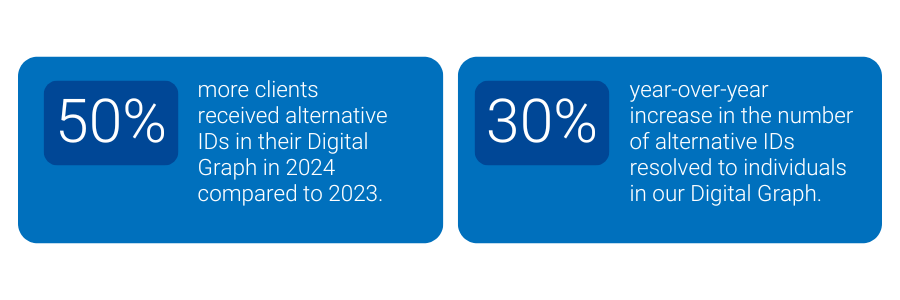
As traditional cookies crumble, marketers need fresh ingredients to keep the flavor coming. Already, about 40% of browser traffic doesn’t support third-party cookies, and marketers are spicing things up with first-party data, alternative identifiers like Unified I.D. 2.0 (UID2) and ID5, and contextual targeting strategies. In fact, 50% more of our clients received alternative IDs (UID2, ID5, Hadron ID) in their Digital Graph in 2024 compared to 2023. The number of alternative IDs resolved to individuals in our Digital Graph increased by 30% year-over-year – as everyone looks beyond the cookie jar.
There is no secret sauce to replace cookies. Instead, expect a multi-ID recipe that brings together different identifiers, unified by an identity graph. This approach turns a fragmented pantry of data into a cohesive meal, giving you a complete view of your customer on every plate.
2. The rising power of CTV: A hearty entrée of opportunities
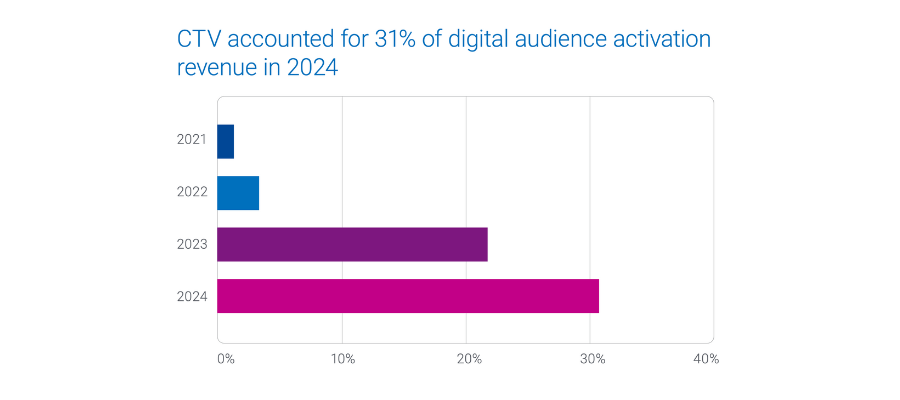
CTV is quickly becoming the main dish on the streaming menu, as viewers load up on their favorite shows. While CTV is slated to make up 20% of daily U.S. media consumption by 2026, advertisers are still holding back on pouring in the ad spend. To unlock its full flavor, marketers need to whip up solutions like frequency capping and unified audience activation.
Although CTV will account for 20% of daily U.S. media consumption by 2026, it’s projected to command only 8.1% of ad spend. Frequency capping and unified audience activation solutions will be key to unlocking CTV’s full potential.
By 2025, nearly half of CTV “diners” will choose free ad-supported streaming TV (FAST). Marketers need strategies to prevent ad overexposure. With 50% of U.S. consumers avoiding products due to ad overload, and 30% of marketers willing to increase their CTV spend if frequency capping improves, unified identity solutions help ensure every impression is served just right.
3. Omnichannel: A flavorful fusion plate
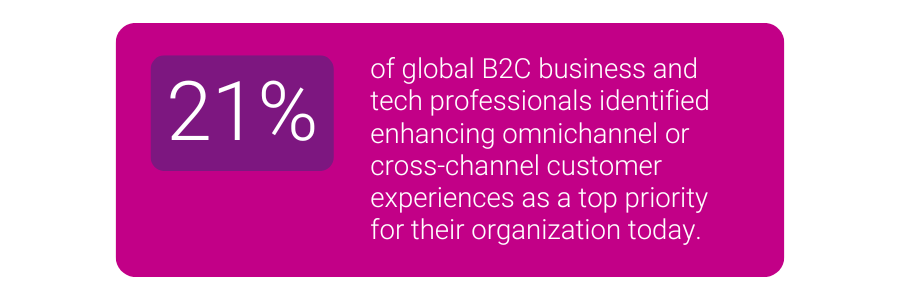
No one likes a one-flavor meal. Marketers are moving beyond single-channel “side dishes” to omnichannel “fusion feasts” that blend direct mail, digital, CTV, and retail media networks (RMNs) into a truly cohesive culinary experience. Even though only 21% of global B2C professionals currently put omnichannel at the top of their shopping list, the growing demand for seamless, audience-first campaigns is heating up.
In 2025, having an audience-first approach will be like having a perfect pairing for every course. Unified identity solutions act as your master sommelier, ensuring that each channel complements the next, and every customer enjoys a well-rounded, memorable journey.
Vertical trends: A dessert sampler from four unique kitchens
Different markets have their own signature flavors.
- In Auto, crossover utility vehicles (CUVs) claim 51% of new vehicle registrations, and consumers in the 35-54 age group and families are the primary buyers. Automotive marketers should prioritize CUV advertising with a strong focus on family-oriented and income-appropriate messaging
- In Financial Services, marketers need to anticipate shifts in consumer behavior tied to economic conditions, such as increasing demand for deposit products when interest rates are high. For insurance, aligning campaigns with life events, like new home purchases or marriage, can maximize engagement.
- In Healthcare, advertisers are prioritizing personalized, regulation-compliant campaigns that address social determinants of health (SDOH).
- In Retail, advertisers are increasingly activating on both CTV and social platforms, with many managing their own in-house campaigns. While larger brands often rely on media agencies, a shift toward in-house media buying is emerging among some bigger players, offering more control over audience targeting and performance metrics.
Our report covers each vertical’s unique menu, helping you select the right “ingredients” for your customers. With the top Experian Audiences on hand, you can create feasts that delight, nourish, and convert.
Hungry for more? Download our full menu
The three “samples” you’ve just tasted are just the starters. Our 2025 Digital trends and predictions report serves up five insights, complete with strategies, data, and tools to help you adapt, scale, and thrive in 2025.
Ready for the full menu? Download our report now and discover all five trends that will shape your marketing “cookbook” in 2025. Bon appétit!
Latest posts

Advertisers continue to increase their spending across addressable TV, connected TV (CTV), and digital. According to IAB's "2021 Video Ad Spend and 2022 Outlook" report, digital video ad spending is expected to increase by 26% to $49.2 billion in 2022. Understanding who consumers are and how to best reach them in their preferred channel is becoming more complex. Damian Amitin and Colleen Dawe discuss how a seamless identity strategy can address the complexity of the emerging TV space. The evolution of identity resolution Around ten years ago, the idea of digital “identity resolution” or “Device Graphs” was born. This idea connected cookies and MAIDs to understand when many IDs were the same person or household. In more recent years, our industry began to connect that initial understanding to the CTV ecosystem. But, a large part of the TV ecosystem existed in silos, like first and third-party audience data, and the growing advanced TV market. The goal of identity resolution has always been to understand the consumer better. To achieve more accurate targeting and measurement in the CTV ecosystem, we must incorporate the following: What we know about the household and consumer from an ID perspective Who the consumer is as it relates to audience data, as well as the wealth of first-party data in the advanced TV space We know the cookie is a flawed way to collect data. While Google delayed the deprecation of third-party cookies, there are other challenges that we face right now. Such as the glaring gap in Safari traffic and the Identifier for Advertisers (IDFA) turning to “opt-in." Understanding consumer behavior across devices and platforms continues to challenge marketers and publishers. These challenges are creating the need to find more stable identifiers. Though the cookie remains valuable, it has an uncertain future. This has led advertisers to place bigger bets on the combination of addressable and CTV. The overlap in addressable and CTV data leads to fragmentation Personally identifiable information (PII) makes up the majority of addressable TV households' data. Part of the attraction to CTV is that their IDs remain universal, persistent, and stable. Analysts project that CTV ad spending will hit $23B in 2023. Consumers now have an average of 4.7 streaming subscriptions per household. It’s no surprise then, that Disney+, HBO, and Netflix released or announced ad-supported tiers. Addressable TV and CTV are often thought of as distinct markets across the industry. But, in the context of identity, we should look at them through the same lens. Millions of households still consume TV and video content via a set-top box or through apps on CTVs. This is in addition to what they consume on their laptops, tablets, and phones. Of the top 11 cable and satellite providers, 65 million U.S. households still have a box in their homes. On the other hand, approximately 96 million U.S. households have at least one or more Smart TVs and streaming services. With about 126 million total U.S. TV households, that’s a lot of overlap. There are still significant numbers of both addressable and CTV homes. How can we address fragmented TV consumption? Through a holistic and comprehensive approach to identity. An approach that captures addressable TV, CTV, and digital identifiers. An approach that captures all audience attributes inside of a single identity graph. This is the ideal approach for publishers, AdTech vendors, and brands. Discover how to unlock holistic identity How can we achieve a holistic identity? Through a three-pillared approach: First-party data onboarding Digital identifiers Consumer data First-party data onboarding Bringing offline data from a brand’s consumers is very valuable due to the quality of the data. Because the data is being collected right from the source, you know it’s accurate. It provides the foundation you can build your identity strategy from. Digital identifiers Once you create a foundation with first-party data, you need to connect it. Either with an internal or licensed digital ID graph. Then you can understand the connections between all devices within the household. Consumer data After you know which devices tie to a single consumer, you'll want to act on that knowledge. The next step is to partner with a data provider that can help you understand your consumers. Establishing this partnership will help improve targeting, measurement, and the customer experience. To achieve a well-rounded customer view tomorrow, we need to start today The three-pillared approach bridges the gap between the offline and online worlds. This provides a well-rounded view of customers and audiences. However, the ability to tie these aspects of identity together still presents several challenges. To achieve the three-pillared approach today, you need to use many vendors and fragmented data sources. Often with conflicting data. As we look forward, the tools to do this are becoming more advanced and unified. The players in our ecosystem should adopt a seamless identity strategy. One that provides a privacy-safe yet full-picture solution. That means capturing and unifying all devices within a household. While also understanding the consumer behaviors and profiles behind those devices. As TV becomes more sophisticated, our data and services will enable you to unlock a holistic identity. Chris Feo, SVP of Advanced TV and Platforms, spoke with Broadcasting & Cable about how our data powers measurement, audience insights, and results for businesses within the TV space. "As more and more companies enter the general TV space, whether you're a publisher, an advertiser or anyone in between that's doing measurement, insights, analytics, our data or our services will play a role in some part of that value exchange." – Chris Feo, SVP of Advanced TV and Platforms, Experian Marketing Services Keep up with your customers and their data Once we create an informed identity strategy, we can begin to understand the makeup of each household and the individuals within. In this new world, personalizing the experience for an audience is key. Where do they prefer to spend their time? What type of content are they most engaged in? Only then can we as an industry provide an optimal experience for each consumer. All while driving greater ROI for advertisers and publishers. Are you ready to know more about your customers than ever before? Let's get to work together to achieve your marketing goals. Contact us to learn how we can connect the complex dots of identity resolution. About our experts Damian Amitin, VP of Enterprise Partnerships, Experian Marketing Services Damian Amitin is the VP of Enterprise Partnerships and joined Experian during the Tapad acquisition in November 2020. Damian is a senior sales and partnerships executive, specializing in the identity resolution and marketing data ecosystem. Damian helps brands, publishers, and technology vendors enable enhanced ID resolution through The Experian/Tapad platform to attain a 360 view of the customer across targeting analytics, attribution, and personalization. Colleen Dawe, Senior Account Executive, Experian Marketing Services Colleen Dawe is a Senior Account Executive on the Advanced TV Team within Experian Marketing Services. With 15 years of experience working within the television ecosystem, Colleen works with clients to bring the value and expertise of Experian to support their objectives in the areas of data, identity, activation, and measurement.

Brands can leverage non-clinical factors, like the social determinants of health, to gain a holistic view of their patients and increase access to care.

Next up in our Ask the Expert series, we hear from Sarah Ilie and Lauren Portell. Sarah and Lauren talk about the internet’s value exchange – what we gain and lose when it’s so easy to share our information. Is convenience hurting or helping us? The age of connectivity Today, it’s almost unimaginable to think about how your day-to-day life would look without the convenience of the internet, smartphones, apps, and fitness trackers; the list goes on and on. We live in the age of connectivity. We have the convenience to buy products delivered to our homes on the same day. We can consume content across thousands of platforms. We also have watches or apps that track our health with more granularity than ever before. The internet's value exchange In exchange for this convenience and information, we must share various kinds of data for these transactions and activities to take place. Websites and apps give you the option to “opt in” and share your data. They also often let you know that they are collecting your data. This can feel like an uncomfortable proposition and an invasion of privacy to many people. What does it mean to opt-in to a website or app’s tracking cookies? What value do we exchange? What opting in means for you Opting in to cookies means that you are allowing the app or website to track your online activity and collect anonymous data that is aggregated for marketing analytics. The data provides valuable information to understand users better to create better online experiences or offer more useful products and content. Granting access to “tracking” offers several benefits to users such as a customized, more personal user experience or advertising that is more likely to be relevant. For example, let’s imagine you have recently been using an app or website to plan a camping trip. By sharing your data, the website or app has visibility into what is interesting or useful to you which can lead to related content suggestions (best campsites) or relevant advertising and product recommendations (tents and camping equipment). It’s important to know that the marketing data collected when you opt in is extremely valuable. The revenue that advertising generates is often very important to websites and apps because this is how they make money to continue providing content and services to consumers. Data privacy practices Privacy concerns regarding how companies and developers use tracking information have risen over the last couple of years and have resulted in additional protection for consumers’ privacy while still allowing companies to improve their products and advertising. One big step in this direction has been simply making people aware that their data is being collected, why it’s being collected, and providing users with the option to share this data for marketing analytics through opting-in or not. Other important steps to maintain online privacy include formal legal legislation and self-regulation. The right to privacy is protected by more than 600 laws between individual states and federal legislation and the U.S. House Committee on Energy and Commerce recently voted to pass the American Data Privacy and Protection Act. Additionally, marketing organizations such as the Interactive Advertising Bureau and Association of National Advertisers regulate themselves with codes of conduct and standards given there is so much attention on privacy issues. Is the internet's value exchange worth it? The data that we choose to share by opting in has a lot of benefits for us as consumers. There are laws in place to protect our data and privacy. Of course, it’s important to be aware that data is collected and used for marketing purposes, but it’s also reasonable to share a certain amount of data that translates into benefits for you as well. The best data unlocks the best marketing. Contact us to tap into the power of the world’s largest consumer database. Learn how you can use Experian Marketing Services' powerful consumer data to learn more about your customers, drive new business, and deliver intelligent interactions across all channels. Meet the Experts: Lauren Portell, Account Executive, Advanced TV, Experian Marketing Services Sarah Ilie, Strategic Partner Manager, Experian Marketing Services