Loading...

Announcing Experian’s Digital Graph and Marketing Attributes joint solution

Published: September 23, 2024 by Experian Marketing Services

Introducing Experian's Digital Graph and Marketing Attributes joint solution

Experian, the leader in powering data-driven advertising through connectivity, is thrilled to unveil our latest solution, Digital Graph and Marketing Attributes. This joint solution supplies marketers and platforms with the insights and connectivity needed to understand who their customers are and reach them across digital channels.

The uncertainty around third-party cookies in Chrome and the overall decline in signal complicates the industry’s ability to reach the right consumer. Omnichannel media consumption results in scattered data, making it harder for marketers and platforms to understand consumer behavior and reach them across channels. These challenges call for a comprehensive solution.

Our Digital Graph and Marketing Attributes solution addresses these challenges by providing identifiers for seamless cross-channel engagement. By adding Marketing Attributes, like demographic and behavioral data, marketers and platforms also gain a better understanding of their customers. This solution uses Experian’s Living Unit ID (LUID) to combine offline and digital data, giving customers deeper insights into consumer behavior, greater audience reach, and improved cross-channel visibility.
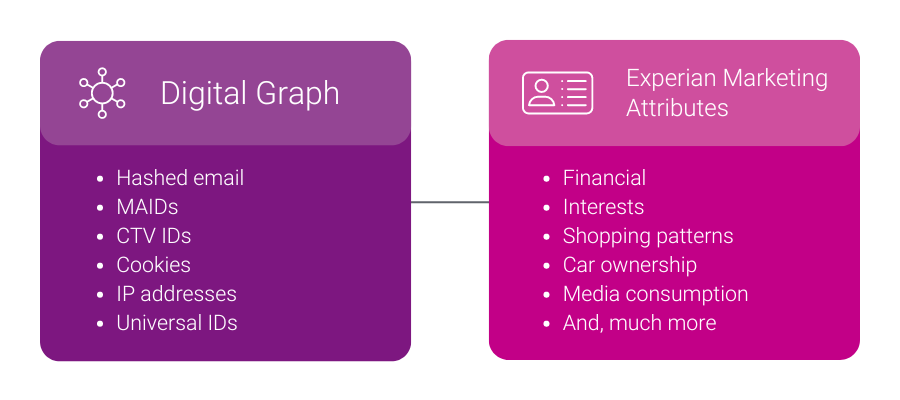
Digital Graph: Hased email, MAIDs, CTV IDs, Cookies, IP addresses, Universal IDs Experian Marketing Attributes: financial, interests, shopping patterns, car ownership, media consumption, and, much more

Benefits of Digital Graph and Marketing Attributes

Both our Digital Graph and Marketing Attributes provide value to clients as standalone products. When clients license our Digital Graph and Marketing Attributes joint solution, they have more data at their fingertips, unlocking:

  • Consumer connectivity: When clients license Experian’s Digital Graph, they get access to digital identifiers like mobile ad IDs (MAIDs), connected TV (CTV) IDs, hashed emails (HEMs), and universal IDs so they can target the right consumers with the relevant messages across all digital media channels.
  • Consumer insights: Experian’s 5,000 Marketing Attributes provide our clients with detailed consumer information and insights, such as age, gender, purchase behaviors, and content consumption habits. Marketing Attributes help clients create more relevant messaging and informed audience segmentation.
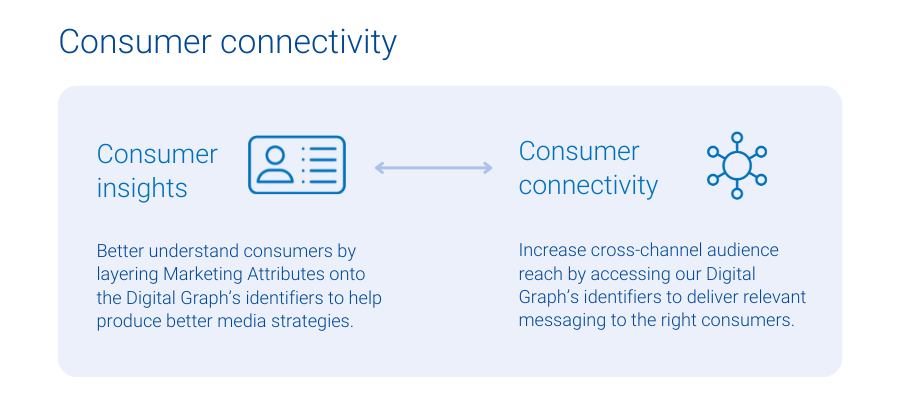
Consumer connectivity to consumer insights

Client examples

How OpenX offers richer targeting and more connectivity with Experian

OpenX is an independent omni-channel supply-side platform (SSP) and a global leader in audience, data, and identity-targeting. With industry-leading technology, exceptional client service, and extensive scalability across all formats, including CTV, app, mobile web, and desktop, OpenX has a legacy of innovating products that enhance buyer outcomes and publisher revenue while addressing complex challenges in programmatic.

In recent years, OpenX has licensed Experian’s Digital Graph with identifiers, contributing to the SSP’s largest independent supply-side identity graph, which offers advanced audiences to buyers and improved data resolution to content owners. 

More recently, OpenX licensed Experian’s Marketing Attributes to enrich its supply-side identity graph, which includes IPs, MAIDs, and client IDs, with a variety of attributes. This strategic move has helped OpenX’s clients benefit from enhanced consumer insights and addressability, in turn delivering greater reach to the demand side and higher revenue for publishers, despite industry signal loss.

“We built on our long-term partnership with Experian to enrich our digital IDs with Experian’s Marketing Attributes, which help provide buyers better insights to audiences, thereby helping our publishers monetize their inventory. With partners like Experian, OpenX effectively facilitates the value exchange between demand and supply, ensuring our partners are able to drive results for their business in the era of signal loss”

Craig Golaszewski, Sr. Director of Strategic Partnerships, OpenX

How StackAdapt licenses our product bundle to address three different use cases

StackAdapt is the multi-channel programmatic advertising platform trusted by marketers to deliver exceptional campaigns. They drive superior results through a variety of solutions, like contextual and first-party targeting, brand lift measurement, and optimization through insights.

StackAdapt licensed a similar yet unique product combination, our Digital Graph and our Audiences. StackAdapt uses the Digital Graph to allow clients to onboard their first-party data in a seamless, self-serve manner that allows them to further segment their data using Experian Audiences.

“StackAdapt has been recognized as the most trusted programmatic platform by marketers, and with the integration of Experian’s Digital Graph and Audiences, we are strengthening our leadership in the space. This partnership improves our ability to deliver precise cross-channel segmentation, reach, and measurement, helping advertisers run more successful campaigns. Our collaboration with Experian allows us to offer a differentiated solution in the market and ensure our clients can deliver the most precise and impactful ads to their audiences.”

Denis Loboda, Senior Director of Data, StackAdapt

We recently announced a new partnership with StackAdapt. This collaboration brings the power of Experian’s identity graph, syndicated and custom audiences directly to the StackAdapt platform. Read the full details in our press release here.

Four ways to use Digital Graph and Marketing Attributes

When these two products come together, our clients have a 360-degree view of their consumers, which helps them power four critical use cases:

  1. Analytics and insights: Learn more about your consumers by connecting our Marketing Attributes with our Digital Graph’s identifiers. For example, a retailer can discover that their recent customers over-index as pickleball fans and players, leading the retailer to sponsor a professional pickleball event.
  2. Inventory monetization: When supply-side partners know their audience better, they can attract advertisers in search of that audience. For example, a publisher might find out that their audience is full of pickleball fans, leading them to reach out to brands that want to reach this audience.
  3. Activation: Companies with access to more digital identifiers from our Digital Graph can reach more people, while controlling frequency across channels. A company might know that they want to reach pickleball fans. Now, they have the digital identifiers needed to reach pickleball fans across all digital channels where they consume content, leading to increased reach.
  4. Measurement and attribution: Use the Digital Graph’s support for various digital identifiers to understand all consumer touchpoints, from media impressions to conversions. Then, lean on our Marketing Attributes to determine who your messaging resonated with. For example, a company uses our Digital Graph to know if it was the same individual who was exposed to an ad on CTV and converted via e-commerce. On top of that, the company can use our Marketing Attributes data to find out that the people who purchased were overwhelmingly pickleball fans.

Connect with us to learn more about how our Digital Graph and Marketing Attributes joint solution can provide the data and insights you need to create, activate, and measure cross-channel media campaigns.


Latest posts

Loading…
Best digital audience strategies for 2023

2022 was a year of adjustment. Consumers adjusted to a post-pandemic world and returned to pre-pandemic shopping behaviors. Consumers adjusted their budgets as the price of goods skyrocketed, as a result of high inflation. To combat inflation, the U.S. Federal Reserve adjusted interest rates. This further restricted consumer buying power. The AdTech ecosystem also experienced adjustments. Google adjusted the date of cookie deprecation. Federal legislation forced technology companies to adjust their consumer privacy practices. Marketers and advertisers adjusted how they address interoperability issues by investing in clean room solutions. This year of adjustment makes it harder to predict where consumers will spend and how marketers should plan their digital audience strategies.   What will 2023 bring to AdTech? Download our 2023 AdTech trends and predictions report to access our forecast to help you plan for 2023. Our report will answer:    How has digital activation changed over the last four years?    What are the top advertising platforms?    Which digital audiences are advertisers buying?   Do digital audience strategies vary by vertical?   Our AdTech trends forecast    In 2023, digital activation will increase. Digital audience activation continues to grow at a significant rate despite market shocks like the pandemic, inflation, and higher interest rates.   Given the current economic uncertainty, we predict that marketers will look toward tried and true channels where they are confident they will have quality audiences, inventory, and be able to drive ROI.  What will digital activation look like in 2023?   Between 2018-2021, digital audience activation increased annually by 46%. Using projected 2022 results, between 2018-2022, it will increase annually by 34%. We anticipate continued growth in 2023.  Top advertising platforms in 2023   2023 will see increased digital activation, but which platforms will advertisers use to serve their ads?   Advertisers will shift their focus to demand-side, video, and supply-side platforms.  Social media platforms will continue to experience volatility.   Advertisers will place bigger bets on the combination of addressable and CTV.  Our report will also reveal which platforms are creating a path toward a post-cookie future and where data-sharing relationships will become the strongest.  The most popular advertiser audiences trending now in AdTech   Which digital audiences are advertisers buying?   Demographics    Modeled Lifestyles   Behavioral  Custom Audiences   Traditional targeting methods like Demographics and Modeled Lifestyles are the baseline of many marketing strategies. We predict that we will continue to see marketers activate against these data sets.  Digital audience strategies by vertical  Digital audience strategies vary by vertical. Download our report to uncover the digital audiences purchased by advertisers in the following industries:   Financial Services   Health   Retail & CPG   Technology & Communication   Download our new 2025 Digital trends and predictions report Marketers, agencies, and platforms are facing new challenges as privacy regulations evolve, AI technology advances, and consumer behaviors shift. Our latest report highlights actionable strategies for navigating these changes and improving how you connect with audiences, measure impact, and deliver results. What you’ll learn Navigating signal loss: Explore the rise of alternative IDs and contextual targeting as privacy regulations and signal loss reshape data-driven advertising.  Connected TV (CTV): Understand the growth of connected TV (CTV), the importance of frequency capping, and strategies for effective audience activation.  Omnichannel campaigns: Learn how marketers are moving from channel-specific strategies to audience-led omnichannel campaigns that tell a more cohesive story. Retail media networks: Learn how retail media networks (RMNs) are capitalizing on enriched first-party data to learn more about their customers and reach them across on-site and off-site inventory.  Curation: Examine how curation is transforming programmatic campaigns by combining audience, contextual, and supply chain signals to deliver premium inventory packages that maximize addressability, efficiency, and performance. Download now

Dec 20,2022 by Experian Marketing Services

Advanced TV and identity: A holistic approach

Advertisers continue to increase their spending across addressable TV, connected TV (CTV), and digital. According to IAB's "2021 Video Ad Spend and 2022 Outlook" report, digital video ad spending is expected to increase by 26% to $49.2 billion in 2022. Understanding who consumers are and how to best reach them in their preferred channel is becoming more complex. Damian Amitin and Colleen Dawe discuss how a seamless identity strategy can address the complexity of the emerging TV space. The evolution of identity resolution Around ten years ago, the idea of digital “identity resolution” or “Device Graphs” was born. This idea connected cookies and MAIDs to understand when many IDs were the same person or household. In more recent years, our industry began to connect that initial understanding to the CTV ecosystem. But, a large part of the TV ecosystem existed in silos, like first and third-party audience data, and the growing advanced TV market. The goal of identity resolution has always been to understand the consumer better. To achieve more accurate targeting and measurement in the CTV ecosystem, we must incorporate the following: What we know about the household and consumer from an ID perspective Who the consumer is as it relates to audience data, as well as the wealth of first-party data in the advanced TV space We know the cookie is a flawed way to collect data. While Google delayed the deprecation of third-party cookies, there are other challenges that we face right now. Such as the glaring gap in Safari traffic and the Identifier for Advertisers (IDFA) turning to “opt-in." Understanding consumer behavior across devices and platforms continues to challenge marketers and publishers. These challenges are creating the need to find more stable identifiers. Though the cookie remains valuable, it has an uncertain future. This has led advertisers to place bigger bets on the combination of addressable and CTV. The overlap in addressable and CTV data leads to fragmentation Personally identifiable information (PII) makes up the majority of addressable TV households' data. Part of the attraction to CTV is that their IDs remain universal, persistent, and stable. Analysts project that CTV ad spending will hit $23B in 2023. Consumers now have an average of 4.7 streaming subscriptions per household. It’s no surprise then, that Disney+, HBO, and Netflix released or announced ad-supported tiers. Addressable TV and CTV are often thought of as distinct markets across the industry. But, in the context of identity, we should look at them through the same lens. Millions of households still consume TV and video content via a set-top box or through apps on CTVs. This is in addition to what they consume on their laptops, tablets, and phones. Of the top 11 cable and satellite providers, 65 million U.S. households still have a box in their homes. On the other hand, approximately 96 million U.S. households have at least one or more Smart TVs and streaming services. With about 126 million total U.S. TV households, that’s a lot of overlap. There are still significant numbers of both addressable and CTV homes. How can we address fragmented TV consumption? Through a holistic and comprehensive approach to identity. An approach that captures addressable TV, CTV, and digital identifiers. An approach that captures all audience attributes inside of a single identity graph. This is the ideal approach for publishers, AdTech vendors, and brands. Discover how to unlock holistic identity How can we achieve a holistic identity? Through a three-pillared approach: First-party data onboarding Digital identifiers Consumer data First-party data onboarding Bringing offline data from a brand’s consumers is very valuable due to the quality of the data. Because the data is being collected right from the source, you know it’s accurate. It provides the foundation you can build your identity strategy from. Digital identifiers Once you create a foundation with first-party data, you need to connect it. Either with an internal or licensed digital ID graph. Then you can understand the connections between all devices within the household. Consumer data After you know which devices tie to a single consumer, you'll want to act on that knowledge. The next step is to partner with a data provider that can help you understand your consumers. Establishing this partnership will help improve targeting, measurement, and the customer experience. To achieve a well-rounded customer view tomorrow, we need to start today The three-pillared approach bridges the gap between the offline and online worlds. This provides a well-rounded view of customers and audiences. However, the ability to tie these aspects of identity together still presents several challenges. To achieve the three-pillared approach today, you need to use many vendors and fragmented data sources. Often with conflicting data. As we look forward, the tools to do this are becoming more advanced and unified. The players in our ecosystem should adopt a seamless identity strategy. One that provides a privacy-safe yet full-picture solution. That means capturing and unifying all devices within a household. While also understanding the consumer behaviors and profiles behind those devices. As TV becomes more sophisticated, our data and services will enable you to unlock a holistic identity. Chris Feo, SVP of Advanced TV and Platforms, spoke with Broadcasting & Cable about how our data powers measurement, audience insights, and results for businesses within the TV space. "As more and more companies enter the general TV space, whether you're a publisher, an advertiser or anyone in between that's doing measurement, insights, analytics, our data or our services will play a role in some part of that value exchange." – Chris Feo, SVP of Advanced TV and Platforms, Experian Marketing Services Keep up with your customers and their data Once we create an informed identity strategy, we can begin to understand the makeup of each household and the individuals within. In this new world, personalizing the experience for an audience is key. Where do they prefer to spend their time? What type of content are they most engaged in? Only then can we as an industry provide an optimal experience for each consumer. All while driving greater ROI for advertisers and publishers. Are you ready to know more about your customers than ever before? Let's get to work together to achieve your marketing goals. Contact us to learn how we can connect the complex dots of identity resolution. About our experts Damian Amitin, VP of Enterprise Partnerships, Experian Marketing Services Damian Amitin is the VP of Enterprise Partnerships and joined Experian during the Tapad acquisition in November 2020. Damian is a senior sales and partnerships executive, specializing in the identity resolution and marketing data ecosystem. Damian helps brands, publishers, and technology vendors enable enhanced ID resolution through The Experian/Tapad platform to attain a 360 view of the customer across targeting analytics, attribution, and personalization. Colleen Dawe, Senior Account Executive, Experian Marketing Services Colleen Dawe is a Senior Account Executive on the Advanced TV Team within Experian Marketing Services. With 15 years of experience working within the television ecosystem, Colleen works with clients to bring the value and expertise of Experian to support their objectives in the areas of data, identity, activation, and measurement.

Oct 31,2022 by Experian Marketing Services

Increase healthcare equity with the social determinants of health

Over the past two decades, we’ve seen healthcare become increasingly interconnected. Healthcare systems can share a patient's clinical information in a variety of ways. A Pharmacy Benefits Manager can share it through an Electronic Health Record. An MRI scanner can also capture and store patient images on a picture archiving and communication system (PACS). Despite this wealth of information, according to the CDC, 20 million U.S. citizens don’t have access to medical care when they need it. A patient’s well-being should represent more than their clinical data. How can we increase access to care for those individuals? We can look towards non-clinical factors, like the social determinants of health, for answers. Coordinate care for at-risk patients What if you could identify patients who are likely to readmit due to factors outside of their medical conditions? We can use demographic, geographic, and socioeconomic data to discover patients that need greater access to care. The social determinants of health (SDOH) can uncover factors that may increase the burden of disease for some populations. What are the social determinants of health? They are the conditions in the environments where people are born, live, learn, work, play, worship, and age. Think of factors like safe housing, transportation, job opportunities, and education. These conditions can affect a wide range of health, functioning, and quality-of-life outcomes and risks. What insights can the social determinants of health reveal? Experian Health’s Social Determinants of Health solution offers holistic insight into the financial, transportation, and technological barriers individuals may experience. These barriers could hinder their access to care, medication, food, and housing. It's important to find a solution like ours that offers prioritized, proactive suggestions for interventions that help remove or reduce such barriers for improved health outcomes. Our rich household data sets can provide key insights into the SDOH. This data can answer key questions such as: Are there existing populations with housing instability issues? How much price sensitivity do consumers have for medication? Are there markets or locations that have food instability issues? Is transportation an issue that makes it hard for patients to access care facilities? Are there geographic influences that drive or prevent diagnosis and care? In the chart below, we break down the SDOH into five categories. We outline key considerations that offer insights to provide patient-specific context for your caregivers. Finally, we present patient engagement strategies that are SDOH factor-specific and based on best practice interventions and program types.                                 Social determinants of health data in action While much of healthcare focuses on clinical outcomes, our Consumer View data can provide a wealth of insight into a variety of non-clinical factors that can influence quality of care. A profile of core demographics such as age, ethnicity, and gender can uncover new opportunities or highlight areas where engagement does not align with medical research. We can discover patients at-risk for not being able to access essential services utilizing key, social determinants of health and geographic profiling. When combined with core demographics like age, gender, and ethnicity, we can compare any patient population against expected SDOH norms to uncover significant gaps in access to care. Our data shows that: 1 in 12 households have no access to a vehicle 1 in 4 households are sensitive to the cost of medication 1 in 5 households have very low technology sophistication 1 in 7 households live below the federal poverty level Once you have this data, what can you do with it? You can develop an inclusive education and communication campaign with our data-driven content and contact engagement solution. This solution empowers you to pair the perfect messaging styles with the right channels to deliver a personalized experience to broaden your reach. For those individuals who have little access to technology, an email campaign may not reach them. We can identify additional engagement channels like the traditional newspaper, radio, direct mail, or even broadcast TV to determine the best medium to expand your market while increasing access to care. By using decision making styles and engagement channels, together we can reduce the burden of care on the medically underserved. Let’s drive inclusive healthcare together Develop a more holistic view of your patient population while increasing healthcare equity. We can help you use the social determinants of health for actionable care management. Contact us to learn how you can fold this data into your healthcare ecosystem.

Oct 17,2022 by Experian Marketing Services

Subscribe to our newsletter

Enter your name and email for the latest updates

This site is protected by reCAPTCHA and the Google Privacy Policy and Terms of Service apply.

About Experian Marketing Services

At Experian Marketing Services, we use data and insights to help brands have more meaningful interactions with people. As leaders in the evolution of the advertising landscape, Experian Marketing Services can help you identify your customers and the right potential customers, uncover the most appropriate communication channels, develop messages that resonate, and measure the effectiveness of marketing activities and campaigns.

Visit our website

Subscribe to our newsletter

Stay up to date on the latest industry news and receive expert tips from our marketing experts.
Subscribe now!