Experian, the leader in powering data-driven advertising through connectivity, is thrilled to unveil our latest solution, Digital Graph and Marketing Attributes. This joint solution supplies marketers and platforms with the insights and connectivity needed to understand who their customers are and reach them across digital channels.
The uncertainty around third-party cookies in Chrome and the overall decline in signal complicates the industry’s ability to reach the right consumer. Omnichannel media consumption results in scattered data, making it harder for marketers and platforms to understand consumer behavior and reach them across channels. These challenges call for a comprehensive solution.
Our Digital Graph and Marketing Attributes solution addresses these challenges by providing identifiers for seamless cross-channel engagement. By adding Marketing Attributes, like demographic and behavioral data, marketers and platforms also gain a better understanding of their customers. This solution uses Experian’s Living Unit ID (LUID) to combine offline and digital data, giving customers deeper insights into consumer behavior, greater audience reach, and improved cross-channel visibility.
Benefits of Digital Graph and Marketing Attributes
Both our Digital Graph and Marketing Attributes provide value to clients as standalone products. When clients license our Digital Graph and Marketing Attributes joint solution, they have more data at their fingertips, unlocking:
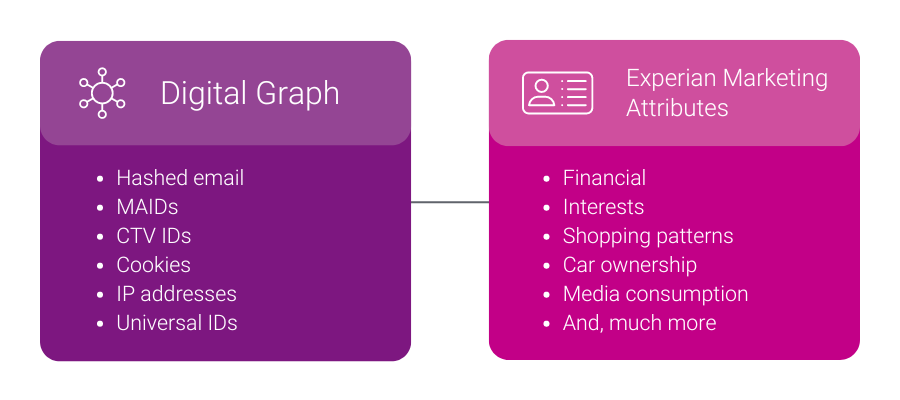
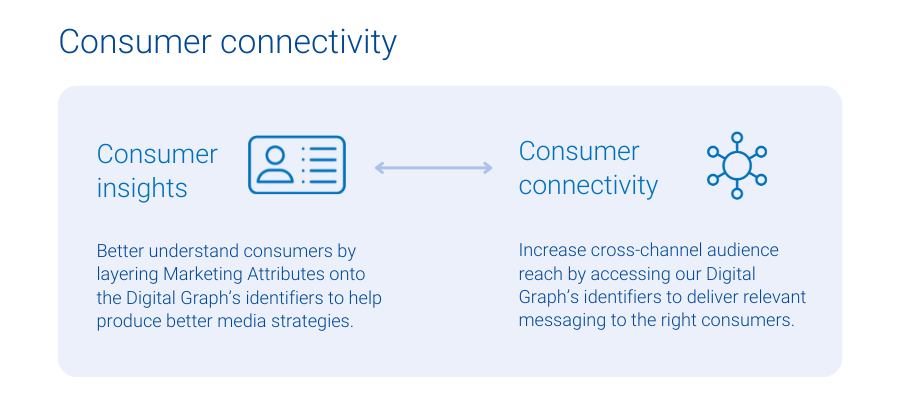
- Consumer connectivity: When clients license Experian’s Digital Graph, they get access to digital identifiers like mobile ad IDs (MAIDs), connected TV (CTV) IDs, hashed emails (HEMs), and universal IDs so they can target the right consumers with the relevant messages across all digital media channels.
- Consumer insights: Experian’s 5,000 Marketing Attributes provide our clients with detailed consumer information and insights, such as age, gender, purchase behaviors, and content consumption habits. Marketing Attributes help clients create more relevant messaging and informed audience segmentation.
Client examples
How OpenX offers richer targeting and more connectivity with Experian
OpenX is an independent omni-channel supply-side platform (SSP) and a global leader in audience, data, and identity-targeting. With industry-leading technology, exceptional client service, and extensive scalability across all formats, including CTV, app, mobile web, and desktop, OpenX has a legacy of innovating products that enhance buyer outcomes and publisher revenue while addressing complex challenges in programmatic.
In recent years, OpenX has licensed Experian’s Digital Graph with identifiers, contributing to the SSP’s largest independent supply-side identity graph, which offers advanced audiences to buyers and improved data resolution to content owners.
More recently, OpenX licensed Experian’s Marketing Attributes to enrich its supply-side identity graph, which includes IPs, MAIDs, and client IDs, with a variety of attributes. This strategic move has helped OpenX’s clients benefit from enhanced consumer insights and addressability, in turn delivering greater reach to the demand side and higher revenue for publishers, despite industry signal loss.
“We built on our long-term partnership with Experian to enrich our digital IDs with Experian’s Marketing Attributes, which help provide buyers better insights to audiences, thereby helping our publishers monetize their inventory. With partners like Experian, OpenX effectively facilitates the value exchange between demand and supply, ensuring our partners are able to drive results for their business in the era of signal loss”
Craig Golaszewski, Sr. Director of Strategic Partnerships, OpenX
How StackAdapt licenses our product bundle to address three different use cases
StackAdapt is the multi-channel programmatic advertising platform trusted by marketers to deliver exceptional campaigns. They drive superior results through a variety of solutions, like contextual and first-party targeting, brand lift measurement, and optimization through insights.
StackAdapt licensed a similar yet unique product combination, our Digital Graph and our Audiences. StackAdapt uses the Digital Graph to allow clients to onboard their first-party data in a seamless, self-serve manner that allows them to further segment their data using Experian Audiences.
“StackAdapt has been recognized as the most trusted programmatic platform by marketers, and with the integration of Experian’s Digital Graph and Audiences, we are strengthening our leadership in the space. This partnership improves our ability to deliver precise cross-channel segmentation, reach, and measurement, helping advertisers run more successful campaigns. Our collaboration with Experian allows us to offer a differentiated solution in the market and ensure our clients can deliver the most precise and impactful ads to their audiences.”
Denis Loboda, Senior Director of Data, StackAdapt
We recently announced a new partnership with StackAdapt. This collaboration brings the power of Experian’s identity graph, syndicated and custom audiences directly to the StackAdapt platform. Read the full details in our press release here.
Four ways to use Digital Graph and Marketing Attributes
When these two products come together, our clients have a 360-degree view of their consumers, which helps them power four critical use cases:
- Analytics and insights: Learn more about your consumers by connecting our Marketing Attributes with our Digital Graph’s identifiers. For example, a retailer can discover that their recent customers over-index as pickleball fans and players, leading the retailer to sponsor a professional pickleball event.
- Inventory monetization: When supply-side partners know their audience better, they can attract advertisers in search of that audience. For example, a publisher might find out that their audience is full of pickleball fans, leading them to reach out to brands that want to reach this audience.
- Activation: Companies with access to more digital identifiers from our Digital Graph can reach more people, while controlling frequency across channels. A company might know that they want to reach pickleball fans. Now, they have the digital identifiers needed to reach pickleball fans across all digital channels where they consume content, leading to increased reach.
- Measurement and attribution: Use the Digital Graph’s support for various digital identifiers to understand all consumer touchpoints, from media impressions to conversions. Then, lean on our Marketing Attributes to determine who your messaging resonated with. For example, a company uses our Digital Graph to know if it was the same individual who was exposed to an ad on CTV and converted via e-commerce. On top of that, the company can use our Marketing Attributes data to find out that the people who purchased were overwhelmingly pickleball fans.
Connect with us to learn more about how our Digital Graph and Marketing Attributes joint solution can provide the data and insights you need to create, activate, and measure cross-channel media campaigns.
Latest posts

Cross-device matching and pixel-based foot traffic attribution reporting empower digital marketers with greater control of location-based campaigns.RALEIGH, N.C. (PRWEB) AUGUST 04, 2020 Tapad, part of Experian a global leader in digital identity resolution, and Reveal Mobile, a leader in location-based marketing, today announced a collaboration that combines Tapad's digital cross-device matching technology and pixel-based attribution features with Reveal Mobile’s VISIT Local, the software that hundreds of digital agencies and brands use for location-based analytics. The partnership is designed to drive improved performance by optimizing ad targeting and messaging for location-based campaigns. Powered by Tapad’s privacy-safe cross device matching, marketers using VISIT Local to power location-based campaigns can enhance how they reach shoppers. When one member of a household shops for groceries, clothes, household goods or any other consumer item, a conversation between multiple members of the household typically takes place beforehand. With cross device matching, marketers can reach everyone who has influence over what to buy and where to buy it. VISIT Local users can expand location-based services with a single click to include devices that share the same household, including targeting across multiple devices owned by the same user, allowing advertisers to maximize messaging and increase their share of wallet among consumers. “VISIT Local has always given our customers access to high-intent location-based audiences. With the addition of cross device matching from Tapad, advertisers can boost audience sizes up to 300 percent while maintaining full confidence in quality and relevance,” says Brian Handly, CEO of Reveal Mobile. “VISIT Local users can now apply multiple criteria and attributes to a single location-based audience, giving them the advanced control and transparency they need.” As reliable attribution becomes increasingly complex for marketers and ad buyers who need to prove value, the addition of Tapad’s pixel-based foot traffic attribution to VISIT Local enables the measurement of actual campaign effectiveness by tying ad views to in-store foot traffic. This new feature, which will be available in VISIT Local this fall, lets Reveal Mobile customers understand who visited a retail location as a result of being served an ad, providing a more accurate view into return on ad spend during and after advertising campaigns. “Tapad’s goal is to empower marketers with digital advertising efficiencies at scale across devices,” says Mark Connon, COO of Tapad. “With cross device matching and pixel-based foot traffic attribution, marketers using VISIT Local can better address the consumer’s preferences and habits, and deliver them consistently actionable information on user behavior. These capabilities advance location-based advertising in ways marketers need and want.” In addition to these new features, VISIT Local’s location-based audience builder now enables marketers to create custom audiences made up of people who have visited different places on different dates. This gives VISIT Local users the ability to segment and create the most highly targeted audiences possible. For example, a marketer who wants to advertise for a chain of restaurants can easily target visitors of different competitors in different cities. Or a marketer who wants to advertise vacation destinations can target people who have been to various resorts at different times of year. Or a marketer who wants to advertise the release of new music can target people who have been to concert venues in different cities on different dates. “Many of our customers need to create highly custom audiences so they can run experiments, test messaging, and run increasingly competitive campaigns,” says Handly. “Everyone who uses VISIT Local can now apply multiple criteria and attributes to a single location-based audience, giving them the advanced control and transparency they need.”To learn more about Tapad’s digital identity resolution products, visit our identity solution page. To learn more about Reveal Mobile’s location-based marketing offerings, visit http://www.revealmobile.com. About TapadTapad, Inc. is a global leader in digital identity resolution. The Tapad Graph, and its related solutions, provide a transparent, privacy-safe approach connecting brands to consumers through their devices globally. Our one-of-a-kind Graph Select offering enables marketers the flexibility and freedom of choice to correlate devices to varied objectives, driving campaign effectiveness and business results. Tapad is recognized across the industry for its product innovation, workplace culture and talent, and has earned numerous awards including One World Identity's 2019 Top 100 Influencers in Identity Award. Headquartered in New York, Tapad also has offices in Chicago, London, Oslo, Singapore and Tokyo. About Reveal MobileReveal Mobile is a leader in location-based marketing, analytics, audiences, and attribution. Creator of VISIT Local, VISIT Match and VISIT Data, the company’s products help digital agencies, brands and retailers of any size leverage location data to understand and reach the right audiences. Reveal Mobile is CCPA compliant and a member of the Network Advertising Initiative, which conducts an annual privacy certification. The company is based in Raleigh, NC. For more information, visit https://revealmobile.com. Contact us today

As the pandemic took hold of the country and stay-at-home orders were put in place, one of the consumer categories that was most adversely affected was the restaurant industry. But while sit-down restaurants were forced to pivot to curbside delivery and other inventive means to make ends meet, quick-service restaurants (QSRs) that already had a solid delivery program or drive-through in place saw a surge in new guests. “Dinner and a movie” took on a different meaning as people either picked up or ordered in to make date night happen, and QSRs rose to the occasion like never before. With some states beginning phased re-openings of non-essential businesses, some restaurants are now allowed to open so long as they follow social distancing rules or allow for outdoor dining areas. But that doesn’t mean consumers will be ready to race out and participate in this new dining experience. Many may remain apprehensive about safety and continue to “dine at a distance” until they’re confident that they can remain healthy, or until a successful vaccine goes into use. Even as states begin their phased re-opening plans, many continue to work from home—which has greatly affected both dine-in and QSR venues. Those who saw a robust lunchtime crowd probably saw a drop-off while business-based locals shifted their office plans. However, new opportunities have emerged for restaurants to reach out to their regular lunch crowd to offer delivery or attract a whole new lunch crowd who may not have thought to order from them before. Between the challenges of a post-pandemic world, a shifting of diner priority, and an uncertain future facing the restaurant world, it’s now more important than ever before to leverage an intelligent, data-driven marketing strategy to ensure your campaigns reach the right consumers, and also attract new customers to expand your customer base over time. All of this can be done using the power of data, but having the right data is key to making the most of your marketing efforts. As you’re crafting your current marketing plans, it’s important to look at all the variables you need to address to create more targeted messaging, thus helping you zero in on your most desired consumer base. The first thing to consider is, how well do you know your guests, and what do you know about them? If you have no insight into their dining habits or preferences, it will be challenging to come up with messaging that will speak to them. But with the right data, you can discover if they frequent your competitor’s locations (and if so, how often), which apps they’re using to order food, which days of the week, and even which meals they are most likely to order. You can also use this information to better understand how often you factor into your customer’s dining plans by understanding if they are beginning to commute again, or continuing to work from home, and if the latter, do they live near one of your locations. Data can also help you discover more about who they are, so you can even further tailor your messaging to their needs. Let’s say your target customer is married with children. Addressing their busy life as a professional and a parent, and sharing how you can ease the burden of dinnertime to make life easier for them, may be exactly the kind of message of support they need to encourage them to reach out to you. Using data based on demographics, lifestyle, behavior, attitudinal and mobile location data can help you cook up a marketing strategy with precision and success, resulting in more diners knocking on your door (or at least, calling for take-out). Another key component to consider is the use of mobile location data, which Zeta Global cites1 as being the most important data chain restaurants can use for their marketing plans. Not only can this data be used to better understand share of wallet and potential up-sell opportunities, but it can also be leveraged to reach out directly to potential new customers that have historically frequented your top competitors. You can also use mobile location data to connect with consumers who may be more drawn to your restaurant because of your delivery or curbside pick-up options, and craft outreach based on that information that will encourage them to order with you. As Hospitality Tech pointed out2, building trust in a post-pandemic world is key for QSRs who want to continue to encourage loyalty with current guests, and entice new ones to place orders. The key to making that happen is data. By deploying marketing messages that resonate, activating them on the channels your guests use most, then measuring the impact of your campaigns, QSRs can create more opportunities for success and customer connection that can translate into real, long-term results. Plus, the right data can help you increase store traffic with high value guests, reactivate guests who haven’t visited in a while and find new individuals who live nearby that closely resemble your current high value guests. Experian has decades of experience in helping organizations better communicate with their customers across all marketing channels. How can we help you? Find out more about our restaurant marketing solutions. 1https://zetaglobal.com/blog/chain-restaurants-need-customer-data/ 2https://hospitalitytech.com/new-marketing-communications-playbook-during-covid-19

2020 has been a year of change and challenges for businesses and consumers alike. With the global pandemic, we have seen stay at home orders put in place, a shift to work from home for many, major events canceled, schools shifted to online format, graduations and other end-of-year activities canceled, and more. As we move through the phases of reopening, everyone is figuring out how to navigate the ‘new normal’ in the wake of new safety requirements, businesses are working to determine what their day-to-day operations will look like as they reopen. The changing times have implications on how consumers act, what and how they purchase, and how they manage their daily lives. With these changing times, consumers are quickly adapting their lifestyles which impacts the choices they make on how they shop, bank and provide for their families. Businesses across the United States are trying to understand how consumers are feeling during this time and how that might correlate with their visitation patterns. Using Experian’s Mobile Location data, coupled with Consumer Sentiment data, we looked at foot traffic and sentiment trends in the retail space throughout the pandemic. As you can see from the chart, there has been a steady increase in household visits to retail locations since March that correlates with the rise in sentiment. Note the differences in visitation patterns across the regions. You can see some foot traffic spikes, which correlate to reopening phases in several states during the week of May 4th and Memorial Day weekend. However, you see a lower average of foot traffic in the Northeast U.S. where reopening phases are rolling out at a slower pace. It is going to be essential for businesses to craft marketing strategies on a regional level as guidelines for reopening are the state-level. This means that a business’s consumers look different based on where they are located and might require more targeted and sensitive messaging. For example, using Experian’s Mosaic segmentation, we further delved into what consumers look like today by analyzing those Mosaics who have the most positive change in regard to the pandemic, versus those that had the most negative. You can see in the charts that there is a significant difference between the Mosaics trending positively versus those trending negatively. Consumer segments have drastically different sentiment, and foot traffic patterns and understanding how your consumers are feeling and where they are shopping will help improve your ROI. Having a comprehensive and targeted marketing plan will be essential for companies as they navigate the intricacies of reopening. Experian’s Reopening Package allows brands to take a phased approach to better understand and reach both new and existing customers through targeting, analytics and key insights. Companies can analyze their consumers’ sentiments and visitation patterns during the pandemic, segmented by Experian Mosaic® lifestyle segmentation group. Businesses can then take those insights and apply them to other models, or create their own models, to build out and run effective marketing campaigns that target current and prospective customers. A successful long-term marketing strategy needs to be data-driven, leveraging data and analytics to help craft targeted messaging. We can see that consumers want to shop again – foot traffic patterns appear to have increased since June, and sentiment is up – now it is necessary to understand where your customers fit into the spectrum. Missed our recent webinar, How COVID-19 Has Shaped Consumer Behavior for Retailers? Access the on demand version here.