In 2022, Google began changing the availability of the information available in User-Agent strings across their Chromium browsers. The change is to use the set of HTTP request header fields called Client Hints. Through this process, a server can request, and if approved by the client, receive information that would have been previously freely available in the User-Agent string. This change is likely to have an impact on publishers across the open web that may use User-Agent information today.
To explain what this change means, how it will impact the AdTech industry, and what you can do to prepare, we spoke with Nate West, our Director of Product.
What is the difference between User-Agents and Client Hints?
A User-Agent (UA) is a string, or line of text, that identifies information about a web server’s browser and operating system. For example, it can indicate if a device is on Safari on a Mac or Chrome on Windows.
Here is an example UA string from a Mac laptop running Chrome:

To limit the passive fingerprinting of users, Google is reducing components of the UA strings in their Chromium browsers and introducing Client Hints. When there is a trusted relationship between first-party domain owners and third-party servers, Client Hints can be used to share the same data.
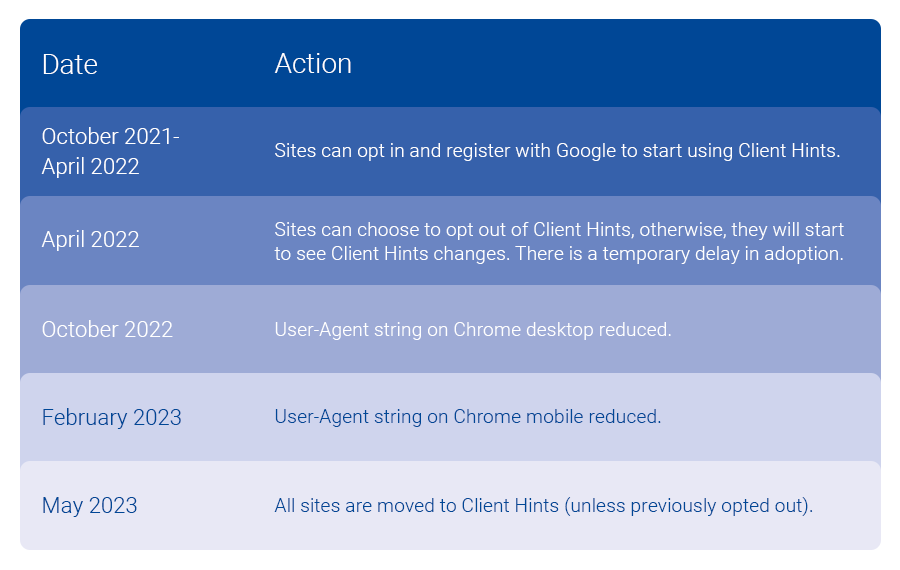
This transition began in early 2022 with bigger expected changes beginning in February 2023. You can see in the above example, Chrome/109.0.0.0, where browser version information is already no longer available from the UA string on this desktop Chrome browser.
How can you use User-Agent device attributes today?
UA string information can be used for a variety of reasons. It is a component in web servers that has been available for decades. In the AdTech space, it can be used in various ad targeting use cases. It can be used by publishers to better understand their audience. The shift to limit access and information shared is to prevent nefarious usage of the data.
What are the benefits of Client Hints?
By using Client Hints, a domain owner, or publisher, can manage access to data activity that occurs on their web properties. Having that control may be advantageous. The format of the information shared is also cleaner than parsing a string from User-Agents. Although, given that Client Hints are not the norm across all browsers, a long-term solution may be needed to manage UA strings and Client Hints.
An advantage of capturing and sharing Client Hint information is to be prepared and understand if there is any impact to your systems and processes. This will help with the currently planned transition by Google, but also should the full UA string become further restricted.
Who will be impacted by this change?
Publishers across the open web should lean in to understand this change and any potential impact to them. The programmatic ecosystem supporting real-time bidding (RTB) needs to continue pushing for adoption of OpenRTB 2.6, which supports the passing of client hint information in place of data from UA strings.
What is Google’s timeline for implementing Client Hints?
Do businesses have to implement Client Hints? What happens if they don’t?
Not capturing and sharing with trusted partners can impact capabilities in place today. Given Chromium browsers account for a sizable portion of web traffic, the impact will vary for each publisher and tech company in the ecosystem. I would assess how UA strings are in use today, where you may have security concerns or not, and look to get more information on how to maintain data sharing with trusted partners.
We can help you adopt Client Hints
Reach out to our Customer Success team at tapadcustomersuccess@experian.com to explore the best options to handle the User-Agent changes and implement Client Hints. As leaders in the AdTech space, we’re here to help you successfully make this transition. Together we can review the options available to put you and your team on the best path forward.
About our expert

Nate West, Director of Product
Nate West joined Experian in 2022 as the Director of Product for our identity graph. Nate focuses on making sure our partners maintain and grow identity resolution solutions today in an ever-changing future state. He has over a decade of experience working for media organizations and AdTech platforms.
Latest posts
Short-form video content is becoming more prevalent on video-sharing platforms. Keep up with trends and marketing strategies to stay relevant.
Experian received top ranks for hashed emails (HEMs) and demographic data from Truthset Data Collective Advertisers, technology partners, and agencies are all chasing accurate data to power their marketing strategies. Turns out, not all data is created equal and unless you’re working with the right partner, high-quality data can be hard to find. That’s because accuracy can vary widely across the industry and the partner you choose is important. A recent study conducted by data validation company Truthset showed that 51% of the data used for ad targeting and audience measurement is wrong, with average accuracy rates ranging between 32%-69% across data providers. The data quality challenge The lack of high-quality data poses multiple challenges in the advertising world: Wasted ad spend: without accurate data at the start, marketers can’t reach the right audiences, resulting in wasted impressions. Privacy and compliance: in an increasingly privacy-centric world, advertisers need to be especially mindful of accurate targeting to avoid putting their brand reputation at risk. Poor campaign performance: low-quality data skews metrics and attribution models, making it difficult to measure campaign success and optimize spend. Low-quality data can come in different forms like inconsistent or outdated information – think demographics (age, gender) and interests (dog versus cat lover) or simply the wrong relationship can be made between datasets. Data records can be incomplete or duplicative and data segments could be misclassified or inaccurate. For example, a kids snack food company may think they’re targeting a 35-year old man, who lives in the suburbs with his young family when in fact it’s a 65-year-old woman who moved to the city after her kids went to college. It’s wasted dollars!Build the data foundation Data quality needs to be addressed if advertisers and advertising technology partners want to fulfill consumers’ demand for personalized marketing. Per eMarketer, more than 75% of internet users worldwide said they were willing to share their email address, brand interest, and name in exchange for personalized experiences. Without accurate data, marketers won’t be able to provide the level of personalization that consumers desire. Validation can help advertisers evaluate third party data and help build trust across the ecosystem. Companies like Truthset review and provide an unbiased evaluation of data fidelity and quality on a regular basis. "As cookies and mobile ad identifiers continue to phase out, consented, durable identifiers (hashed email, postal addresses) are going to serve as the foundation for identity solutions of the future,” said Chip Russo, President at Truthset. “And the only way to ensure you are transacting on the highest quality identity and demography data is to actively validate the data you rely on with a third party.” Not all data is created equal: Experian leads the way In Q3 2023 Truthset reviewed Experian’s marketing data – as well as several other large data providers – and found: Experian is the #1 data provider in terms of largest volume of high-accuracy hashed e-mails (HEMs) with demographic data Experian ranks #1 in accuracy for 15 marketing data attributes, including but not limited to Age, Gender, Home Owner/Renter, Geography, Education, Presence of Children, and Pet Owner Experian consistently has the largest number of HEMs with demographic data that are 90% or more likely to be accurate “As a member of the Truthset Data Collective, Experian received top ranks across a variety of categories for its data,” continued Russo. “The entire digital advertising world runs on data, but focusing on data accuracy is going to drive the next phase of innovation for the industry, enhancing ROI for advertisers, CPMs for publishers, and relevant experiences for consumers.” As Truthset's recent study highlights, the data matched between hashed e-mails and postal addresses is crucial, underpinning everything from targeted ads to TV audience measurement. Highly accurate HEMs linked to high-quality demographic data should be the foundation of any marketing plan. Advertisers are able to overcome the complexities of identity resolution by tying online and offline touchpoints together to deliver a consistent message across channels. Companies are striving to eliminate marketing waste and provide consumers with personalized marketing and the advertising industry can have confidence that Experian’s marketing data has been externally validated as being highly accurate. The accuracy of our data will power smarter marketing initiatives, like insights, targeting, identity, and measurement. Let's start a conversation about how we can fully realize the potential of data-driven advertising together. Contact us today Latest posts

Programmatic TV can be an inexpensive option. Some platforms can offer a discounted path to prime-time ad spots on major networks.