In 2022, Google began changing the availability of the information available in User-Agent strings across their Chromium browsers. The change is to use the set of HTTP request header fields called Client Hints. Through this process, a server can request, and if approved by the client, receive information that would have been previously freely available in the User-Agent string. This change is likely to have an impact on publishers across the open web that may use User-Agent information today.
To explain what this change means, how it will impact the AdTech industry, and what you can do to prepare, we spoke with Nate West, our Director of Product.
What is the difference between User-Agents and Client Hints?
A User-Agent (UA) is a string, or line of text, that identifies information about a web server’s browser and operating system. For example, it can indicate if a device is on Safari on a Mac or Chrome on Windows.
Here is an example UA string from a Mac laptop running Chrome:

To limit the passive fingerprinting of users, Google is reducing components of the UA strings in their Chromium browsers and introducing Client Hints. When there is a trusted relationship between first-party domain owners and third-party servers, Client Hints can be used to share the same data.
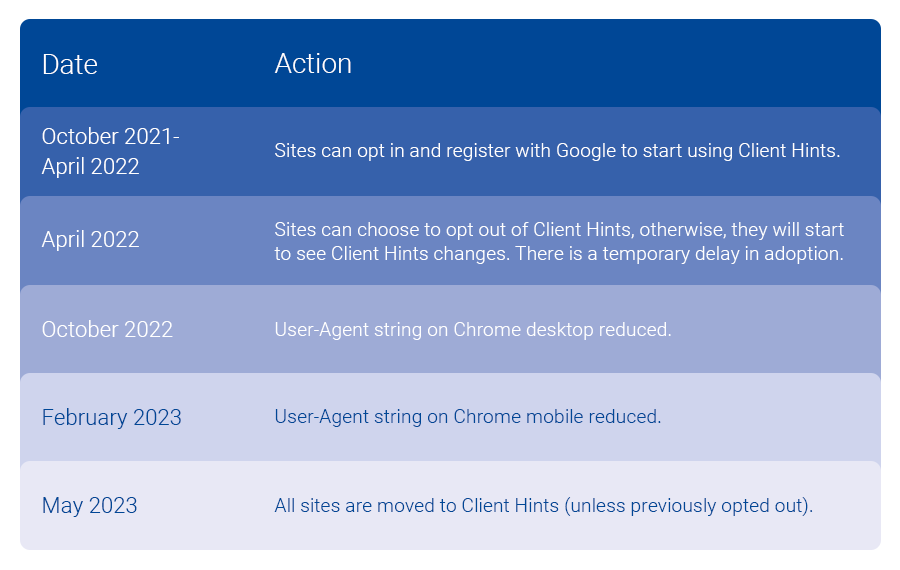
This transition began in early 2022 with bigger expected changes beginning in February 2023. You can see in the above example, Chrome/109.0.0.0, where browser version information is already no longer available from the UA string on this desktop Chrome browser.
How can you use User-Agent device attributes today?
UA string information can be used for a variety of reasons. It is a component in web servers that has been available for decades. In the AdTech space, it can be used in various ad targeting use cases. It can be used by publishers to better understand their audience. The shift to limit access and information shared is to prevent nefarious usage of the data.
What are the benefits of Client Hints?
By using Client Hints, a domain owner, or publisher, can manage access to data activity that occurs on their web properties. Having that control may be advantageous. The format of the information shared is also cleaner than parsing a string from User-Agents. Although, given that Client Hints are not the norm across all browsers, a long-term solution may be needed to manage UA strings and Client Hints.
An advantage of capturing and sharing Client Hint information is to be prepared and understand if there is any impact to your systems and processes. This will help with the currently planned transition by Google, but also should the full UA string become further restricted.
Who will be impacted by this change?
Publishers across the open web should lean in to understand this change and any potential impact to them. The programmatic ecosystem supporting real-time bidding (RTB) needs to continue pushing for adoption of OpenRTB 2.6, which supports the passing of client hint information in place of data from UA strings.
What is Google’s timeline for implementing Client Hints?
Do businesses have to implement Client Hints? What happens if they don’t?
Not capturing and sharing with trusted partners can impact capabilities in place today. Given Chromium browsers account for a sizable portion of web traffic, the impact will vary for each publisher and tech company in the ecosystem. I would assess how UA strings are in use today, where you may have security concerns or not, and look to get more information on how to maintain data sharing with trusted partners.
We can help you adopt Client Hints
Reach out to our Customer Success team at tapadcustomersuccess@experian.com to explore the best options to handle the User-Agent changes and implement Client Hints. As leaders in the AdTech space, we’re here to help you successfully make this transition. Together we can review the options available to put you and your team on the best path forward.
About our expert

Nate West, Director of Product
Nate West joined Experian in 2022 as the Director of Product for our identity graph. Nate focuses on making sure our partners maintain and grow identity resolution solutions today in an ever-changing future state. He has over a decade of experience working for media organizations and AdTech platforms.
Latest posts

Marketers are under more pressure than ever before to prove ROI and efficiency of marketing activities in relation to business performance. On top of that, there are new privacy regulations and uncertainty around what new technologies will have to be implemented in order to replace the granular level targeting and measurement the industry historically has used third-party cookies for. It’s clear marketers are going to need the right tech stack and partners to continue to prove their team’s efficacy. We recently partnered with Forrester Consulting to evaluate the current state of customer data-driven marketing and surveyed over 300 global marketing decision makers at the brand and agency levels. We found that marketing is facing increased demands today, insights from the study include: Consumers expect brands to deliver engaging experiences across highly fragmented journeys. Seventy-two percent of decision-makers reported that customers demand more relevant, personalized experiences at the time and place of their choosing. Marketing runs on data, but the rules governing customer data usage are changing quickly. More than 70% of study participants stated that consumer data is the lifeblood of their marketing strategies, fueling the personalized, omnichannel experiences customers demand. These demands paint a challenging picture. Just as marketers are poised (and tasked) with delivering greater value to their organizations and customers, the ground rules are changing and threatening their ability to deliver. Indeed, 62% of respondents said that the forces of data deprecation will have either a “Significant” (40%) or “Critical” (21%) impact on their marketing strategies over the next two years. Effective identity resolution can help brands prepare for data deprecation challenges Marketers face a daunting landscape, but they can leverage the data, technology, and processes that comprise identity resolution to address business objectives, combat ecosystem complexity, and future-proof customer engagement efforts. By utilizing identity resolution, marketers will be able to match and connect multiple identifiers across devices and touchpoints. This allows for a cohesive, omnichannel view that enables brands to continue to deliver personalized and contextually relevant messages throughout the customer journey and without the use of cookies. The identity graph is the underlying infrastructure that defines connections between the numerous, fluid, and disparate identifiers created during moments of consumer engagement, turning disparate signals into addressable and actionable steps. These connections enable brands to bolster their ability to gain deeper customer insights and power audience building, attribution, and connected measurement. Identity resolution encompasses a wide range of capabilities that support an equally diverse set of marketing use cases. These include the targeting, personalization, and measurement of both known and pseudonymous audiences in the offline and digital worlds, which enables marketers to improve customer data management, drive more effective personalization, and gain insights and efficiencies through measurement across touchpoints. By taking the time to vet the privacy procedures and data collection processes of identity solutions you can reduce your regulatory risk and maintain customer trust. In an open-ended survey response, a marketer shared, “We’ve found that users are willing to volunteer data when they understand what it’s being used for and are asked for clear consent.” Finding the right partners to help navigate the changes The scramble to find an alternative to third-party cookies has slowed down since Google announced they will be delaying their cookie removal until late 2023. However, this gives marketers a unique opportunity to take advantage of the additional time and feel more prepared and confident in their solutions. With the delay, marketers can now test ID solutions and compare apples to apples with data from the third-party cookie while it’s still active and addressable. Test and find a solution that works now, so there are no surprises once cookies have finally made their way out the door in 2023. At Tapad, a part of Experian, we’ve developed a solution that provides agnostic interoperability for the myriad of cookieless identifiers emerging in the market. As a new module in the Tapad Graph, Switchboard will connect traditional digital identifiers to cookieless IDs to support the entire ad ecosystem with privacy-safe future-proof identity resolution. Get started with The Tapad Graph For personalized consultation on the value and benefits of The Tapad Graph for your business, email Sales@tapad.com today!

Identity is being constrained, forcing the industry to rethink the way it has operated for 27 years. Industry, regulatory, technology and data trends are leading to a fundamental shift in the way that data is permissioned, accessed, and used for marketing purposes. How the industry defines digital identity moving forward, consumer trust and transparency need to be at the forefront. We, as an industry, have the opportunity to build a more effective advertising framework that puts consumers and data privacy at its core, a framework that won’t rely on a single prevailing identifier. That approach requires all of us to be upfront and transparent about our data practices and usage and make it easy for consumers to opt-out of the use of their information for advertising and marketing solicitations. We, at Experian, also believe that there are a lot of ways to improve the experience for consumers, who are becoming more aware and apprehensive of giving away their data. We believe we can ease the minds of consumers and work within these new constraints by offering better controls and practices around the ways data is shared and utilized. There will be new approaches that come to the market as well that include modeled, non-identifiable information, cohorts, contextual

It’s no secret that the COVID-19 Delta variant is threatening holiday plans across the country. As CDC mandates change and the flu season matures, we’re asking big questions that impact businesses and marketers across the country: Will customers mostly stay at home and order online? Or will people drive to the store and fly to family gatherings? The answer is probably both—but, as we’ve learned, a lot can change overnight. And we want to be prepared this time around. While many of us make vacation plans with a “wait and see” attitude, we want firmer footing at work. To cope with uncertainty, holiday marketing strategies straddle assumptions and require agility. To protect some of the biggest campaigns of the year, marketers need the ability to: Monitor changing customer behaviors during flu season. Track marketing KPIs for campaign performance and quick adaptability. Pivot audience targeting strategy when safety guidelines change. We built Discovery Platform to give you all three so that you can execute your marketing strategy with confidence. Discovery is built on top of robust consumer data and the best-in-class Identity graph that Experian is known for. It offers turn-key activation capability to keep your marketing campaigns agile and efficient this holiday season. Here’s how you can use Discovery Platform to protect your marketing interests from rapidly changing safety guidelines. Track store traffic against competitors Discovery Platform enables Experian clients to keep a tap on their store traffic and relate it to how competitors and overall business category is doing. Monitoring these trends can help marketers adapt to changing consumer behaviors as flu season evolves. Track marketing KPIs Tracking and adjusting ongoing campaign targeting strategy remains a top priority throughout the pandemic, especially during colder, winter months. Discovery enables you to evaluate your campaign targeting strategy in relation with your loyalty card shoppers and in-flight campaign KPIs to drive higher return on ad spend and Customer Lifetime Value. With Discovery’s OmniImpact integration clients can even conduct control test measurement studies. Pivot campaigns quickly You can use Discovery’s Audience Engine integration to build and deploy custom audiences to social, digital, email and Connected TV partners. This gives you the ability to quickly pivot campaign channels once you detect changes in consumer behavior or dips in campaign performance. The sales and customer data flowing into Discovery Platform puts all the insights you need in one place to inform your team’s next marketing strategy. Watch our Discovery Platform demo or contact us to learn how Experian can help you create more effective, agile marketing campaigns for the holidays.