In 2022, Google began changing the availability of the information available in User-Agent strings across their Chromium browsers. The change is to use the set of HTTP request header fields called Client Hints. Through this process, a server can request, and if approved by the client, receive information that would have been previously freely available in the User-Agent string. This change is likely to have an impact on publishers across the open web that may use User-Agent information today.
To explain what this change means, how it will impact the AdTech industry, and what you can do to prepare, we spoke with Nate West, our Director of Product.
What is the difference between User-Agents and Client Hints?
A User-Agent (UA) is a string, or line of text, that identifies information about a web server’s browser and operating system. For example, it can indicate if a device is on Safari on a Mac or Chrome on Windows.
Here is an example UA string from a Mac laptop running Chrome:

To limit the passive fingerprinting of users, Google is reducing components of the UA strings in their Chromium browsers and introducing Client Hints. When there is a trusted relationship between first-party domain owners and third-party servers, Client Hints can be used to share the same data.
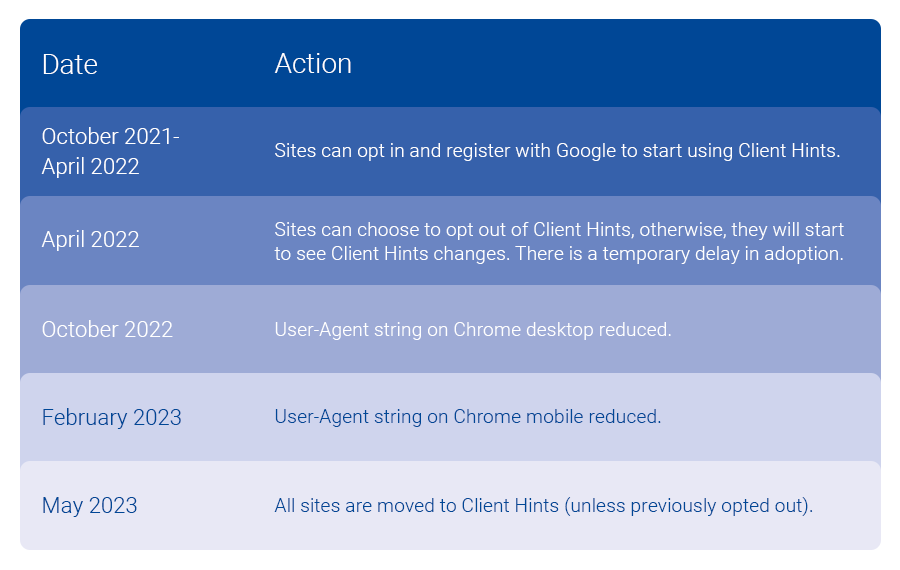
This transition began in early 2022 with bigger expected changes beginning in February 2023. You can see in the above example, Chrome/109.0.0.0, where browser version information is already no longer available from the UA string on this desktop Chrome browser.
How can you use User-Agent device attributes today?
UA string information can be used for a variety of reasons. It is a component in web servers that has been available for decades. In the AdTech space, it can be used in various ad targeting use cases. It can be used by publishers to better understand their audience. The shift to limit access and information shared is to prevent nefarious usage of the data.
What are the benefits of Client Hints?
By using Client Hints, a domain owner, or publisher, can manage access to data activity that occurs on their web properties. Having that control may be advantageous. The format of the information shared is also cleaner than parsing a string from User-Agents. Although, given that Client Hints are not the norm across all browsers, a long-term solution may be needed to manage UA strings and Client Hints.
An advantage of capturing and sharing Client Hint information is to be prepared and understand if there is any impact to your systems and processes. This will help with the currently planned transition by Google, but also should the full UA string become further restricted.
Who will be impacted by this change?
Publishers across the open web should lean in to understand this change and any potential impact to them. The programmatic ecosystem supporting real-time bidding (RTB) needs to continue pushing for adoption of OpenRTB 2.6, which supports the passing of client hint information in place of data from UA strings.
What is Google’s timeline for implementing Client Hints?
Do businesses have to implement Client Hints? What happens if they don’t?
Not capturing and sharing with trusted partners can impact capabilities in place today. Given Chromium browsers account for a sizable portion of web traffic, the impact will vary for each publisher and tech company in the ecosystem. I would assess how UA strings are in use today, where you may have security concerns or not, and look to get more information on how to maintain data sharing with trusted partners.
We can help you adopt Client Hints
Reach out to our Customer Success team at tapadcustomersuccess@experian.com to explore the best options to handle the User-Agent changes and implement Client Hints. As leaders in the AdTech space, we’re here to help you successfully make this transition. Together we can review the options available to put you and your team on the best path forward.
About our expert

Nate West, Director of Product
Nate West joined Experian in 2022 as the Director of Product for our identity graph. Nate focuses on making sure our partners maintain and grow identity resolution solutions today in an ever-changing future state. He has over a decade of experience working for media organizations and AdTech platforms.
Latest posts
Addressable TV has been through a transformation in the past year. Streaming content has become the most coveted space for creators and advertisers with the rise of new apps and platforms; but the influx of stay-at-home orders around the country have shifted television viewership as we know it, and streaming apps are popping up in droves to take advantage. So, how can you? With no shortage of opportunities to advertise on addressable TV and CTV, how does it fit into the media mix? And furthermore, how can you attribute this household-level device into your overall strategy? Tying it all together Layering addressable TV within digital ad campaigns couldn’t be easier today — but applying the right targeting and cadence between all of your digital efforts; and tying them together in attribution takes the right kind of data. Marketers can use CTV identifiers coupled with other device identifiers available in The Tapad Graph to not only target impressions but also map addressable TVs within the consumer journey; and unify strategies between household decision makers to better personalize messaging. Let's get to work, together At Tapad, we provide actionable insights for marketers to deliver better ad experiences to their consumers through identity resolution. Interested in learning more? Contact us today at sales@tapad.com for a more personal conversation about your identity strategy. 1 The Trade Desk Q2 2020 Earnings Call Transcript, August 2020; 2 iSpot Report, via Deadline, July 2020; 3 Flixed.io, January 2020
For the past several years ad-tech defined the value of identity at the individual level; made possible by the evolution of data, technology and machine-learning. But, earlier this year COVID-19 set in motion many shifts in consumer digital behavior. The more we’ve been working and learning from home, using devices that are shared amongst an entire household, the more apparent it is that marketers need to shift their strategies to align with these changes. Did you know the average household owns eleven or more connected devices? And the longer we’ve been at home, the more these devices are shared by multiple individuals. If you’re looking for a few simple ways to evolve from an individual focused strategy to a household strategy, here’s a good place to start: Audience segmentation Traditionally, audiences are built with a narrow focus on a single user, and what known attributes about that individual or their brand engagement can be leveraged for a targeting strategy. Now that screens are being shared between multiple users in a home, how can you be sure you’re identifying them correctly, and thus, segmenting them in the right buckets for targeting? The key lies in the ability to connect those points through identity resolution. Using ad exposure from household level devices, followed by a second engagement from an individual within that household can indicate a user is a better candidate for purchase or conversion than others. So before you build audiences for targeting, you can qualify them at the household level for segmentation with more confidence. Example: An auto advertiser uses audience segments from a third party provider such as ‘auto intenders’ to target individuals with new pricing offers. They would continue retargeting these users, unaware that some are connected in the same household, and thus are probably not all in the market to actually get a new car. By bucketing users that share a common household device within this third party segment, they can hone in on which individuals are actually in-market for a car and evolve their strategy to be more effective. Targeting Retargeting, frequency capping and sequential messaging have always been meant for an individual user — the more they’re exposed to your brand in a personalized way, the more likely they are to take the desired action. But, have you considered that multiple users could have a shared initial exposure to your brand? Today, you can target a household of potential consumers on a shared device like a CTV, and employ those retargeting strategies based on that common initial exposure. Starting at the household level, means you can compare movement through the funnel between different individuals in that household, and tailor your targeting accordingly. Perhaps you realize only one person in that household will convert and you tailor messaging to them more frequently, while confidently suppressing the other individuals. Example: a CPG brand uses OTT advertising, but doesn’t incorporate it within their sequential strategy, because they consider it just a ‘brand awareness’ opportunity. By using OTT more strategically as a household level engagement, it can reveal which individuals within a household are more favorable towards a brand further down the funnel. So, you can spend impressions targeting those users, rather than wasting impressions on multiple individuals within the household. Measurement Measurement and attribution are imperative to understanding the path to purchase and making strategies more efficient over time. Often that efficiency involves adding or removing devices and channels from a targeting strategy based on their contribution to an action or conversion by an individual. This year we’re seeing addressable TV devices explode in use, which are shared at the household level. Even desktop computers are being used by more people in the home due to COVID-19. So, assuming a linear path of attribution by an individual is missing the full picture. Identity resolution can help you understand where messaging was more effective for some users in the household than others, and leverage that insight to continue more effective strategies in the future. Example: Without a household view, a direct-to-consumer brand would assume all interactions from one device would be coming from a single individual, and that could create a higher cost-per analysis. By incorporating the household level devices into attribution models, they can find efficiencies between touch points of multiple users, and learn how those split off into individual paths to conversion. Not only can this DTC create a more effective model, but they can use that model to create cost efficiencies in the future. Get started with The Tapad Graph For personalized consultation on the value and benefits of The Tapad Graph for your business, email Sales@tapad.com today!

QSRs have emerged as superheroes during the pandemic, creating an entirely different consumer experience in record time by offering contactless delivery, curbside pick-up, and other innovations that have allowed them to stay open and operational when so many other businesses have shuttered. But as many states are still moving through their phased re-opening plans and more options become available to consumers, QSRs are challenged with keeping their momentum going. How can they continue to build on their success? The key is activation. Advertising on the right channels at the right time. The more QSRs can offer experiences that leverage the power of data to better speak to their customers and address their unique needs, the better chance they have of continuing to succeed in these unwieldy times. As we move into the fall and winter, and as more and more people look to QSR’s to help with their meal plans, consider the following: 1. Use data to create a more robust loyalty program. There’s no question consumers have plenty of QSRs to choose from and using a loyalty program is an excellent way to ensure they continue to view you as a preferred dining destination. But you might be surprised to learn how much of a difference it can make to your bottom line. PYMNTS reported that in 2019, Starbucks President and CEO Kevin Johnson shared how the company’s active mobile app rewards membership grew to 16.8 million users, which comprised 41% of sales in U.S. stores. The PYMNTS Restaurant Readiness Index also shows that 79.5% of QSR customers and 47.5% of QSR managers see loyalty programs as a feature that is important to a restaurant’s success. Now is a great time to review your loyalty program (or create a new one) and see if you can expand it to offer more perks, thereby enticing more customer interaction. A strong loyalty program should include a combination of your own customer data, enriched with third-party data for deeper customer insights, such as behavior, lifestyle and interests. 2. Make it easy for customers to order, purchase and pick-up with mobile ordering. Mobile ordering is no longer the wave of the future—it’s part of the new now. PYMNTS reported that Dunkin’ Brands CEO Dave Hoffmann noted on-the-go ordering experienced an average weekly sales increase of 25% year over year—and this growth was especially key in locations without a drive-through. For customers who want an easy option that allows them to order, pay and pick-up at curbside, mobile ordering is the ultimate in simplicity, and your data can help you determine who is most primed to take advantage of this option so you can push it directly to them. 3. Offer demographic and location-specific promos. The power of data can help you know a lot about your customers, from age and occupation to whether or not they have a family, how they spend their time, and how much of that time is spent at your competitor’s restaurant. This data can help you craft promotions that can speak directly to your consumer, ensure you’re advertising on the channels they prefer and frequent and get them in your door. When you know you cater to parents who are tired of a long day of homeschooling and work Zoom meetings, you can tailor and execute a promo campaign that speaks directly to their needs and deliver it to their preferred channel, encouraging them to skip cooking and order from you instead. Or maybe you have locations that are close to college campuses, allowing you to entice students with a two-for-one deal they just can’t pass up. And as offices start the slow process of opening back up, there’s an opportunity to welcome workers back to the neighborhood with a special curbside or delivery pick-up deal. 4. Ensure your customer knows your brand values. More and more, consumers are becoming conscious of who they spend their money with and why. As Longitude Design points out, this is something Ben & Jerry’s does exceptionally well, and their value message is spread across everything the brand does, from their scoop shops to their store-bought pints to their company-branded events. This is your opportunity to share what you value as a company and a brand, and how it aligns with your consumer’s lifestyle. Is your food sustainably sourced? Is your packaging environmentally friendly? Be transparent about your supply chain, share how you care for your employees, give some insight into the prep process behind your food, as these insights will help your consumer gain trust in you, which in turn creates loyalty. Social media is a great way to get the word out about your value-based operational initiatives. To learn more about how you can use data to build on and enhance the new customer QSR experience, visit our Restaurant Marketing Solutions page.