In 2022, Google began changing the availability of the information available in User-Agent strings across their Chromium browsers. The change is to use the set of HTTP request header fields called Client Hints. Through this process, a server can request, and if approved by the client, receive information that would have been previously freely available in the User-Agent string. This change is likely to have an impact on publishers across the open web that may use User-Agent information today.
To explain what this change means, how it will impact the AdTech industry, and what you can do to prepare, we spoke with Nate West, our Director of Product.
What is the difference between User-Agents and Client Hints?
A User-Agent (UA) is a string, or line of text, that identifies information about a web server’s browser and operating system. For example, it can indicate if a device is on Safari on a Mac or Chrome on Windows.
Here is an example UA string from a Mac laptop running Chrome:

To limit the passive fingerprinting of users, Google is reducing components of the UA strings in their Chromium browsers and introducing Client Hints. When there is a trusted relationship between first-party domain owners and third-party servers, Client Hints can be used to share the same data.
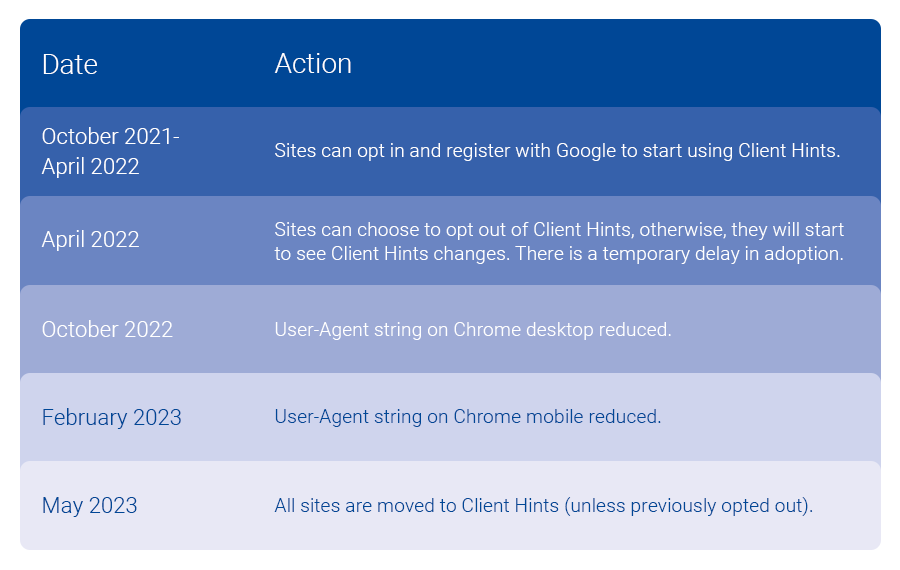
This transition began in early 2022 with bigger expected changes beginning in February 2023. You can see in the above example, Chrome/109.0.0.0, where browser version information is already no longer available from the UA string on this desktop Chrome browser.
How can you use User-Agent device attributes today?
UA string information can be used for a variety of reasons. It is a component in web servers that has been available for decades. In the AdTech space, it can be used in various ad targeting use cases. It can be used by publishers to better understand their audience. The shift to limit access and information shared is to prevent nefarious usage of the data.
What are the benefits of Client Hints?
By using Client Hints, a domain owner, or publisher, can manage access to data activity that occurs on their web properties. Having that control may be advantageous. The format of the information shared is also cleaner than parsing a string from User-Agents. Although, given that Client Hints are not the norm across all browsers, a long-term solution may be needed to manage UA strings and Client Hints.
An advantage of capturing and sharing Client Hint information is to be prepared and understand if there is any impact to your systems and processes. This will help with the currently planned transition by Google, but also should the full UA string become further restricted.
Who will be impacted by this change?
Publishers across the open web should lean in to understand this change and any potential impact to them. The programmatic ecosystem supporting real-time bidding (RTB) needs to continue pushing for adoption of OpenRTB 2.6, which supports the passing of client hint information in place of data from UA strings.
What is Google’s timeline for implementing Client Hints?
Do businesses have to implement Client Hints? What happens if they don’t?
Not capturing and sharing with trusted partners can impact capabilities in place today. Given Chromium browsers account for a sizable portion of web traffic, the impact will vary for each publisher and tech company in the ecosystem. I would assess how UA strings are in use today, where you may have security concerns or not, and look to get more information on how to maintain data sharing with trusted partners.
We can help you adopt Client Hints
Reach out to our Customer Success team at tapadcustomersuccess@experian.com to explore the best options to handle the User-Agent changes and implement Client Hints. As leaders in the AdTech space, we’re here to help you successfully make this transition. Together we can review the options available to put you and your team on the best path forward.
About our expert
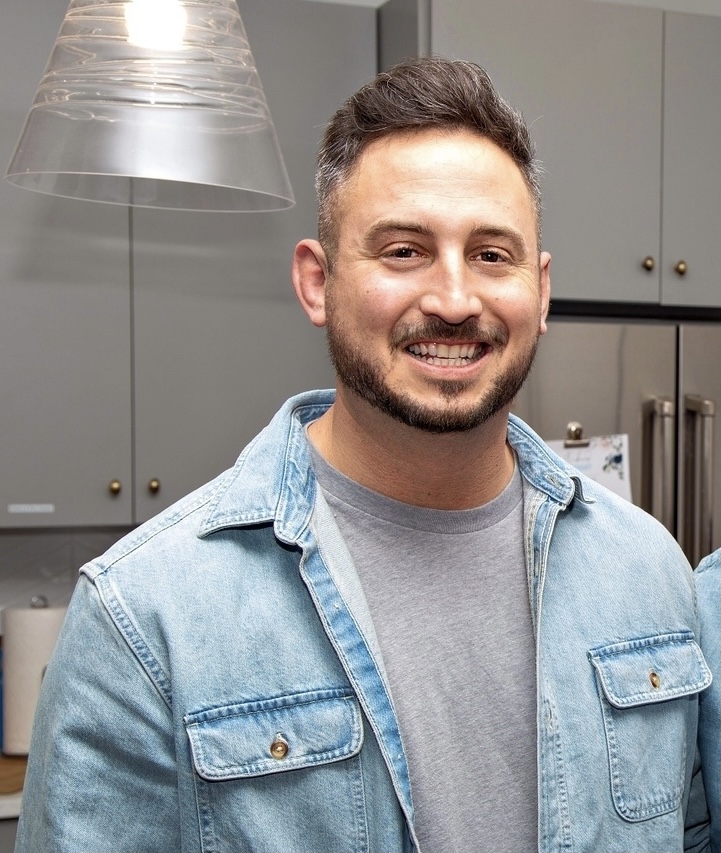
Nate West, Director of Product
Nate West joined Experian in 2022 as the Director of Product for our identity graph. Nate focuses on making sure our partners maintain and grow identity resolution solutions today in an ever-changing future state. He has over a decade of experience working for media organizations and AdTech platforms.
Latest posts

Question #1 Lorem ipsum dolor sit amet, consectetur adipiscing elit. Nullam interdum odio in viverra mattis. Praesent at lectus vitae massa convallis vehicula. Vivamus et ex sed ex aliquet ultrices sed nec ante. Vestibulum a tincidunt massa. Vivamus tincidunt condimentum magna in tempor. Suspendisse dictum, elit at commodo dignissim, sem nisl luctus erat, nec consectetur leo mi sit amet nibh. Vestibulum at nisi ac libero aliquet volutpat congue ut mi. Morbi in congue eros, a faucibus nibh. Vivamus consequat a purus eu tempor. Morbi eu diam dui. Aliquam erat volutpat. Sed odio felis, sollicitudin consequat pellentesque ac, congue sed nisl. Maecenas sagittis mauris at ante ultricies elementum. Pellentesque vestibulum dolor ut tincidunt cursus. Question #2 Lorem ipsum dolor sit amet, consectetur adipiscing elit. Nullam interdum odio in viverra mattis. Praesent at lectus vitae massa convallis vehicula. Vivamus et ex sed ex aliquet ultrices sed nec ante. Vestibulum a tincidunt massa. Vivamus tincidunt condimentum magna in tempor. Suspendisse dictum, elit at commodo dignissim, sem nisl luctus erat, nec consectetur leo mi sit amet nibh. Vestibulum at nisi ac libero aliquet volutpat congue ut mi. Morbi in congue eros, a faucibus nibh. Vivamus consequat a purus eu tempor. Morbi eu diam dui. Aliquam erat volutpat. Sed odio felis, sollicitudin consequat pellentesque ac, congue sed nisl. Maecenas sagittis mauris at ante ultricies elementum. Pellentesque vestibulum dolor ut tincidunt cursus. Question #3 Lorem ipsum dolor sit amet, consectetur adipiscing elit. Nullam interdum odio in viverra mattis. Praesent at lectus vitae massa convallis vehicula. Vivamus et ex sed ex aliquet ultrices sed nec ante. Vestibulum a tincidunt massa. Vivamus tincidunt condimentum magna in tempor. Suspendisse dictum, elit at commodo dignissim, sem nisl luctus erat, nec consectetur leo mi sit amet nibh. Vestibulum at nisi ac libero aliquet volutpat congue ut mi. Morbi in congue eros, a faucibus nibh. Vivamus consequat a purus eu tempor. Morbi eu diam dui. Aliquam erat volutpat. Sed odio felis, sollicitudin consequat pellentesque ac, congue sed nisl. Maecenas sagittis mauris at ante ultricies elementum. Pellentesque vestibulum dolor ut tincidunt cursus.
H2 Heading Lorem ipsum dolor sit amet, consectetur adipiscing elit. Aenean quis ipsum et orci dictum accumsan eget nec purus. Sed varius finibus augue, sed egestas risus posuere et. Donec elit sem, finibus ut tellus a, maximus hendrerit diam. Suspendisse commodo metus nec nisi consectetur, interdum fringilla sem ultricies. Integer semper molestie viverra. Cras a pharetra nisi, ac vulputate lorem. Vestibulum vitae efficitur odio, vel pharetra sem. Duis vel arcu mauris. Donec nec elementum magna. Orci varius natoque penatibus et magnis dis parturient montes, nascetur ridiculus mus. Nulla vel consectetur risus. Donec quis feugiat ante. Morbi quis lacus ac augue bibendum hendrerit vitae vel purus. Orci varius natoque penatibus et magnis dis parturient montes, nascetur ridiculus mus. Orci varius natoque penatibus et magnis dis parturient montes, nascetur ridiculus mus. Orci varius natoque penatibus et magnis dis parturient montes, nascetur ridiculus mus. Lorem ipsum dolor sit amet, consectetur adipiscing elit. Aenean quis ipsum et orci dictum accumsan eget nec purus. Sed varius finibus augue, sed egestas risus posuere et. Donec elit sem, finibus ut tellus a, maximus hendrerit diam. Suspendisse commodo metus nec nisi consectetur, interdum fringilla sem ultricies. Integer semper molestie viverra. Cras a pharetra nisi, ac vulputate lorem. Vestibulum vitae efficitur odio, vel pharetra sem. Duis vel arcu mauris. Donec nec elementum magna. Orci varius natoque penatibus et magnis dis parturient montes, nascetur ridiculus mus. Nulla vel consectetur risus. Donec quis feugiat ante. Morbi quis lacus ac augue bibendum hendrerit vitae vel purus. Icon Heading #1 Lorem ipsum dolor sit amet, consectetur adipiscing elit. Aenean quis ipsum et orci dictum accumsan eget nec purus. Sed varius finibus augue, sed egestas risus posuere et. Donec elit sem, finibus ut tellus a, maximus hendrerit diam. Suspendisse commodo metus nec nisi consectetur, interdum fringilla sem ultricies. Icon Heading #2 Lorem ipsum dolor sit amet, consectetur adipiscing elit. Aenean quis ipsum et orci dictum accumsan eget nec purus. Sed varius finibus augue, sed egestas risus posuere et. Donec elit sem, finibus ut tellus a, maximus hendrerit diam. Suspendisse commodo metus nec nisi consectetur, interdum fringilla sem ultricies. Icon Heading #3 Lorem ipsum dolor sit amet, consectetur adipiscing elit. Aenean quis ipsum et orci dictum accumsan eget nec purus. Sed varius finibus augue, sed egestas risus posuere et. Donec elit sem, finibus ut tellus a, maximus hendrerit diam. Suspendisse commodo metus nec nisi consectetur, interdum fringilla sem ultricies. Lorem ipsum dolor sit amet, consectetur adipiscing elit. Aenean quis ipsum et orci dictum accumsan eget nec purus. Sed varius finibus augue, sed egestas risus posuere et. Donec elit sem, finibus ut tellus a, maximus hendrerit diam. Suspendisse commodo metus nec nisi consectetur, interdum fringilla sem ultricies. Integer semper molestie viverra. Cras a pharetra nisi, ac vulputate lorem. Vestibulum vitae efficitur odio, vel pharetra sem. Duis vel arcu mauris. Donec nec elementum magna. Orci varius natoque penatibus et magnis dis parturient montes, nascetur ridiculus mus. Nulla vel consectetur risus. Donec quis feugiat ante. Morbi quis lacus ac augue bibendum hendrerit vitae vel purus.
This is my test Test 2 "Lorem ipsum dolor sit amet, consectetur adipiscing elit, sed do eiusmod tempor incididunt ut labore et dolore magna aliqua. Ut enim ad minim veniam, quis nostrud exercitation ullamco laboris nisi ut aliquip ex ea commodo consequat. Duis aute irure dolor in reprehenderit in voluptate velit esse cillum dolore eu fugiat nulla pariatur. Excepteur sint occaecat cupidatat non proident, sunt in culpa qui officia deserunt mollit anim id est laborum.""Lorem ipsum dolor sit amet, consectetur adipiscing elit, sed do eiusmod tempor incididunt ut labore et dolore magna aliqua. Ut enim ad minim veniam, quis nostrud exercitation ullamco laboris nisi ut aliquip ex ea commodo consequat. Duis aute irure dolor in reprehenderit in voluptate velit esse cillum dolore eu fugiat nulla pariatur. Excepteur sint occaecat cupidatat non proident, sunt in culpa qui officia deserunt mollit anim id est laborum.""Lorem ipsum dolor sit amet, consectetur adipiscing elit, sed do eiusmod tempor incididunt ut labore et dolore magna aliqua. Ut enim ad minim veniam, quis nostrud exercitation ullamco laboris nisi ut aliquip ex ea commodo consequat. Duis aute irure dolor in reprehenderit in voluptate velit esse cillum dolore eu fugiat nulla pariatur. Excepteur sint occaecat cupidatat non proident, sunt in culpa qui officia deserunt mollit anim id est laborum." This is my 2nd test