Contextual ad targeting paves the way for new opportunities
Advertisers and marketers are always looking for ways to remain competitive in the current digital landscape. The challenge of signal loss continues to prompt marketers to rethink their current and future strategies. With many major browsers phasing out support for third-party cookies due to privacy and data security concerns, marketers will need to find new ways to identify and reach their target audience. Contextual ad targeting offers an innovative solution; a way to combine contextual signals with machine learning to engage with your consumers more deeply through highly targeted accuracy. Contextual advertising can help you reach your desired audiences amidst signal loss – but what exactly is contextual advertising, and how can it help optimize digital ad success?
In a Q&A with our experts, Jason Andersen, Senior Director of Strategic Initiatives and Partner Solutions with Experian, and Alex Johnston, Principal Product Manager with Yieldmo, they explore:
- The challenges causing marketers to rethink their current strategies
- How contextual advertising addresses signal loss
- Why addressability is more important than ever
- Why good creative is still integral in digital marketing
- Tips for digital ad success

By understanding what contextual advertising can offer, you’ll be on the path toward creating powerful, effective campaigns that will engage your target audiences.
Check out Jason and Alex’s full conversation from our webinar, “Making the Most of Your Digital Ad Budget With Contextual Advertising and Audience Insights” by reading below. Or watch the full webinar recording now!
Macro impacts affecting marketers
How important is it for digital marketers to stay informed about the changes coming to third-party cookies, and what challenges do you see signal loss creating?
Jason: Marketers must stay informed to succeed as the digital marketing landscape continuously evolves. Third-party cookies have already been eliminated from Firefox, Safari, and other browsers, while Chrome has held out. It’s just a matter of time before Chrome eliminates them too. Being proactive now by predicting potential impacts will be essential for maintaining growth when the third-party cookie finally disappears.
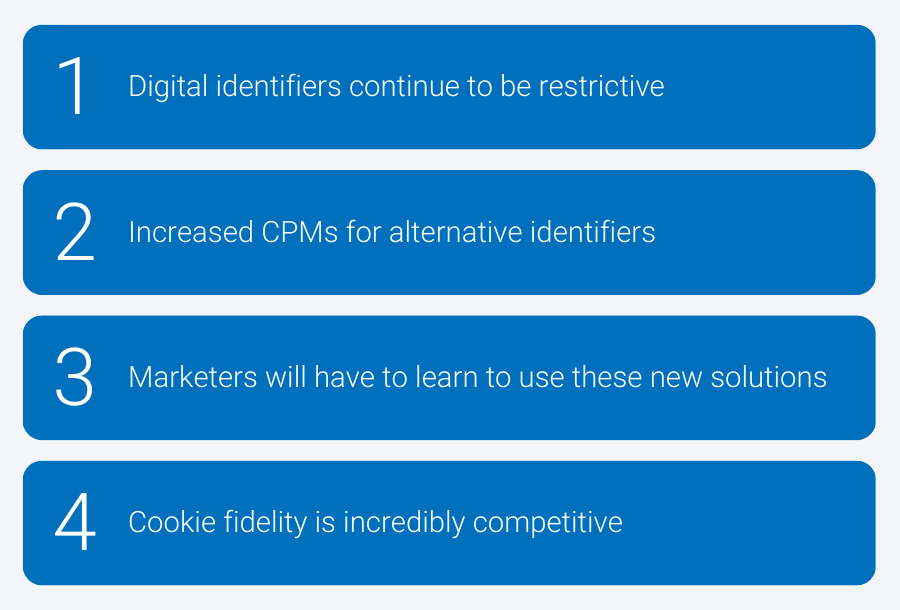
Alex: Jason, I think you nailed it. Third-party cookie loss is already a reality. As regulations like the General Data Protection Regulation (GDPR) and the California Consumer Privacy Act (CCPA) take effect, more than 50% of exchange traffic lacks associated identifiers. This means that marketers have to think differently about how they reach their audiences in an environment with fewer data points available for targeting purposes. It’s no longer something to consider at some point down the line – it’s here now!
Also, as third-party cookies become more limited, reaching users online is becoming increasingly complex and competitive. Without access to as much data, the CPMs (cost per thousand impressions) that advertisers must pay are skyrocketing because everyone is trying to bid on those same valuable consumers. It’s essential for businesses desiring success in digital advertising now more than ever before.
Contextual ad targeting: A solution for signal loss
How does contextual ad targeting help digital marketers find new ways to reach and engage with consumers? What can you share about some new strategies that have modernized marketing, such as machine learning and Artificial Intelligence (AI)?
Jason: We’re taking contextual marketing to the next level with advanced machine learning. We are unlocking new insights from data beyond what a single page can tell us about users. As third-party cookies go away, alternative identifiers are coming to market, like RampID and UID2. These are going to be particularly important for marketers to be able to utilize.
As cookie syncing becomes outdated, marketers will have to look for alternative methods to reach their target audiences. It’s essential to look beyond cookie-reliant solutions and use other options available regarding advertising.
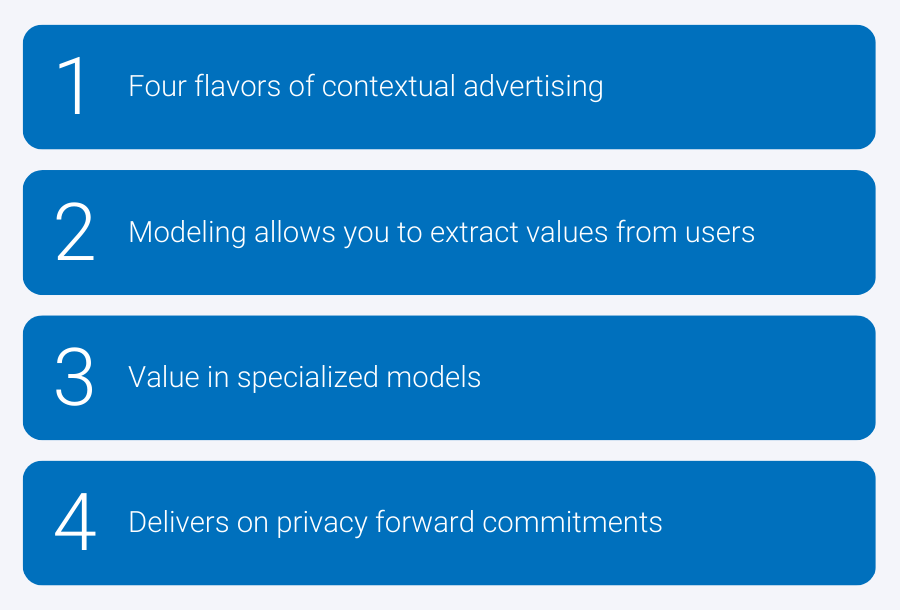
Alex: I think, as Jason alluded to, there’s a renaissance in contextual advertising over the last couple of years. If I were to break this down, there are three core drivers:
- The loss of identity signals. It’s forcing us to change, and we must look elsewhere and figure out how to reach our audiences differently.
- There have been considerable advances in our ability to store and operate across a set of contextual signals far more extensive than anything we’ve ever worked with in the past and in far more granular ways. That’s a huge deal because when it comes to machine learning, the power and the impact of those machine learning models are entirely based on how extensive and granular the data set is that you can collect. Machine learning can pull together critical contextual signals and figure out which constellations, or which combinations of those signals, are most predictive and valuable to a given advertiser.
- We can tailor machine learning models to individual advertisers using all those signals and find patterns across those in ways that were previously impractical or unfeasible. The transformation is occurring because of our ability to capture much more granular data, operate across it, and then build models that work for advertisers.
Addressability: Connect your campaigns to consumers
How does advanced contextual targeting help marketers reach non-addressable audiences?
Jason: Advanced contextual targeting allows us to take a set of known data (identity) and draw inferences from it with all the other signals we see across the bitstream. It’s taking that small seed set of either, customers that transacted with you before that you have an identity for, or customers that match whom you’re looking for. We can use that as a seed set to train these new contextual models. We can now look at making the unknown known or the unaddressable addressable. So, it’s not addressable in an identity sense, it is addressable in a contextual or an advanced contextual sense that’s made available to us, and we can derive great insight from it.
One of the terms I like to use is contextual indexing. This is where we take a set of users we know something about. So, I may know the identity of a particular group of households, and I can look at how those households index against any of the rich data sets available to us in any data marketplace, for example, the data Yieldmo has. We can look at how that data indexes to those known users to find patterns in that data and then extrapolate from that. Now we can go out and find users surfing on any of the other sites that traditionally don’t have that identifier for that user or don’t at that moment in time and start to be able to advertise to them based on the contextually indexed data.
Historically, we’ve done some contextual ad targeting based on geo-contextual, and this is when people wanted to do one to one marketing, and geo-contextual outperformed the one to one. But marketers weren’t ready for alternatives to one to one yet. We want marketers to start testing these solutions. Advertisers must start trying them, learning how they work, and learn how to optimize them because they are based on a feedback loop, and they’re only going to get better with feedback.
Alex: Jason, you described that perfectly. I think the exciting opportunity for many people in the industry is figuring out how to reach your known audience in a non-addressable space, that is based on environmental and non-identity based signals, that helps your campaign perform. Your known audience are people that are already converting – those who like your products and services and are engaged with your ads. Machine learning advancements allow you to take your small sample audience and uncover those patterns in the non-addressable space.
It’s also worth noting that in this world in which we are using seed audiences, or you are using your performing audiences to build non-addressable counterpart targeting campaigns, having high-quality, privacy-resilient data sets becomes incredibly important. In many cases, companies like Experian, who have high quality, deep rich training data, are well positioned to support advertisers in building those extension audiences. As we see the industry evolve, we’re going to see some significant changes in terms of the types of, and ways in which, companies offer data, and make that available to advertisers for training their models or supporting validation and measurement of those models.
Jason: Addressable users, the new identity-based users, are critical to marketers’ performance initiatives. They’re essential to training the models we’re building with contextual advertising. Together, addressable users and contextual advertising are a powerful combination. It’s not just one in isolation. It’s not just using advanced contextual, and it’s not just using the new identifiers. It’s using a combination to meet your performance needs.
It’s imperative to start thinking about how you can begin building your seed audiences. What can you start learning from, and how do you put contextual into play today? You are looking to build off a known set and build a more advanced model. These can be specialized models based on your data. You can hone in and create a customized model for your customer type, their profile, and how they transact. It’s a greenfield opportunity, and we’re super excited about the future of advanced contextual targeting.
Turn great creative into measurable data points
Why does good creative still play an integral part in digital advertising success?
Jason: Good creative has always been meaningful. It’s vital in getting people to click on your ad and transact. But it’s becoming increasingly important in this new world that we’re talking about, this advanced contextual world. The more signal that we can get coming into these models, the better. Good creative in the proper ad format that you can test and learn from is paramount. It comes back to that feedback loop. We can use that as another signal in this equation to develop and refine the right set of audiences for your targeting needs.
Alex: If you imagine within the broader context of identity and signal loss, creative and ad format becomes incredibly powerful signals in understanding how different audiences interact with and engage with different creative. In the case of the formats that serve on the Yieldmo exchange, we’re collecting data every 200 milliseconds around how individual users are engaging with those ads. Interaction data like the user scrolling back or the number of pixel seconds they stay on the screen, fills this critical gap between video completes and clicks. Clicks are sparse and down the funnel, and views and completes are up the funnel. All those attention and creative engagement type metrics occupy the sweet spot where they’re super prevalent, and you can collect them and understand how different audiences engage with your ads. That data lets you build powerful models because they predict all kinds of other downstream actions.
Throughout my career, I learned that designing or tailoring your creative to different audience groups is one of the best ways to improve performance. We ran many lift studies with analysis to understand how you can tailor creative customized for individual audiences. That capability and the ability to do that on an identity basis is starting to deteriorate. The ability to do that using a sample of data or using a smaller set of users, either where you’re inferring characteristics or you’re looking at the identity that does exist in a smaller group, becomes powerful for being able to customize your creative to tell the right story to the right audience. When you layer together all the interaction data collected at the creative level on top of all the contextual and environmental signals, you can build powerful models. Whether those are driving proxy metrics, or downstream outcomes, puts us in a powerful position to respond to the broader loss of identity that we’ve relied on for so many years.
Our recommendations for marketers for 2023 and beyond
Do you have recommendations for marketers building out their yearly strategies or a campaign strategy?
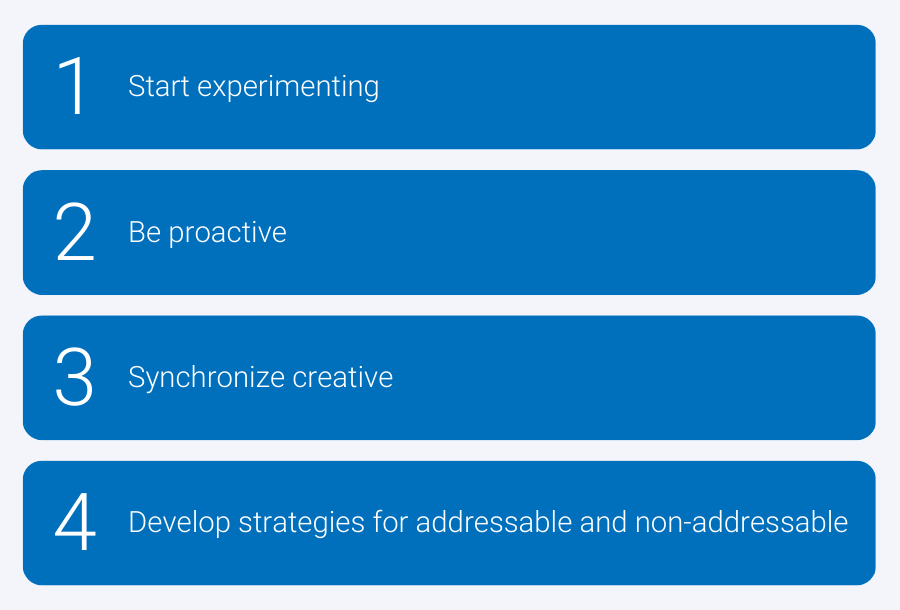
Jason: Be proactive and start testing and learning these new solutions. I mentioned addressability and being in the right place at the right time. That’s easier in today’s third-party cookie world. But as traditional identity is further constricted, you will have these first-party solutions that will not be at scale, so you’re less likely to find your user at the scale you want. It would be best if you thought about how to reach that user at the right place at the right time. They may not be seen from an identity basis. They might not be at the right place at the right time when you were delivering or trying to deliver an ad. But you increase your chance of reaching them by building these advanced contextual targeting audiences using this privacy-safe seed ‘opted-in’ user set; this is a way to cast that wider net and achieve targeted scale.
Alex: Build your seed lists, test your formats with different audiences, and understand what’s resonating with whom. Take advantage of some of the pretty remarkable advances in machine learning that are allowing us, really, for the first time to fully uncork the potential and the opportunity with contextual in a way that we’ve never done before.
Jason: At the end of the day, it’s making the unaddressable addressable. So, it’s a complementary strategy; having that addressable piece will feed the models. But also, that addressable piece still needs to be identity-based, addressable still needs to be part of your overall marketing strategy, and you need to complement it with other strategies like advanced contextual targeting. The two of them together are super complimentary. They learn from each other, and it’s a cyclical loop. Now is the time to take advantage and start testing and understanding how these solutions work.
We can help you get started with contextual ad targeting
Contextual advertising can help you stay ahead of the curve, identify your target audience, and continue to drive conversions despite signal loss. We’ve partnered with Yieldmo to help make sure that your marketing campaigns are reaching the right target audiences on the platforms that are most relevant. To get started with contextual ad targeting to reach the right audience at the right time and drive conversions, contact our marketing professionals. Let’s get to work, together.
Find the right marketing mix in 2023
Check out our webinar, “Find the right marketing mix with rising consumer expectations.” Guest speaker, Nikhil Lai, Senior Analyst from Forrester Research, joins Experian experts Erin Haselkorn, and Eden Wilbur. We discuss:
- New data on the complexity and uncertainty facing marketers
- Consumer trends for 2023
- Recommendations on finding the right channel mix and the right consumers
About our experts

Jason Andersen, Senior Director, Strategic Initiatives and Partner Solutions, Experian
Jason Andersen heads Strategic Initiatives and Partner Enablement for Experian Marketing Services. He focuses on addressability and activation in digital marketing and working with partners to solve signal loss. Jason has worked in digital advertising for 15+ years, spanning roles from operations and product to strategy and partnerships.

Alex Johnston, Principal Product Manager, Yieldmo
Alex Johnston is the Principal Product Manager at Yieldmo, overseeing the Machine Learning and Optimization products. Before joining Yieldmo, Alex spent 13 years at Google, where he led the Reach & Audience Planning and Measurement products, overseeing a 10X increase in revenue. During his time, he launched numerous ad products, including YouTube’s Google Preferred offering. To learn more about Yieldmo, visit www.Yieldmo.com.
Latest posts

Based on the Q1 U.S. Travel Association Consumer Quarterly Tracker conducted by Ipsos, 52% of American adults are eagerly planning to embark on leisure travel within the next six months. With the pandemic limiting travel opportunities for so long, people are more willing than ever to prioritize travel and make up for lost time. With the summer vacation season upon us, it's crucial to identify consumers who are eager to travel and implement a targeted travel advertising strategy. To help you stand out in the competitive marketplace, we’ll share five audiences you should consider when building out your summer travel advertising activation plan. Five travel advertising audience categories With so many travel audiences out there, it can be overwhelming to figure out which ones to target. That's why we've compiled a list of the top five audience categories you should focus on: Seasonal spenders Frequent travelers Travel transportation methods Luxury travelers Vacation type Let's break down each category so you can better understand the travel behaviors and preferences of each group. Seasonal spenders These travelers are known for their willingness to spend during peak travel seasons. They're willing to spend more for travel experiences and have a high propensity to travel. Let's take a look at a few audience segments included in this category that you can activate as part of your summer travel advertising strategy. Retail Shoppers: Purchase Based > Travel > Vacation/Leisure Travelers: Summer Trips: Consumers in this segment are frequent, high spenders of summer travel. Mobile Location Models > Visits > Summer Break Travelers: Consumers in this segment are likely to travel during summer break. Retail Shoppers: Purchase Based With Experian's Retail Shoppers: Purchase Based audiences, you can reach consumers who have a high propensity to buy in specific categories like toys, furniture, apparel, and more. This audience is created by combining known credit and debit transactions with advanced modeling to ensure the highest likelihood of future purchases. You can use these audiences to find travelers interested in the outdoors that spend their money on related gear and activities, or travelers who use rental cars throughout their trip. Mobile Location Models Our Mobile Location Models are based on a statistical analysis of mobile location data from devices. The model is built from individual, household, and area-level Experian Marketing Data. You can use these audiences to find travelers that like to visit theme parks, travel during the July 4th holiday, and travel during summer break. Frequent travelers Consumers in this audience category prioritize travel as a lifestyle choice and they're always looking for their next adventure. They're willing to spend money to make their travel dreams come true and often participate in loyalty programs to earn rewards. Here are just a few examples of the audience segments you can activate to target frequent travelers as part of your travel advertising strategy: Lifestyle and Interests (Affinity) > Travel > Frequent Flyer Program Member: Consumers in this segment are likely to be members of frequent flyer programs. Retail Shoppers > Purchase Based > Travel > Hotels > Frequent Spend: Consumers in this segment frequently spend at hotels like Holiday Inn, Hyatt, Marriott, and Wyndham. Lifestyle and Interests Experian’s Lifestyle and Interests audience segments make it easy to identify and target consumers based on their lifestyle characteristics. These audiences cover a wide array of lifestyle categories, such as: Activities/Interests Purchasing Behavior Contributors/Memberships Lifestyle/General You can use these audiences to find travelers that enjoy boating, like to visit zoos, and are fishing enthusiasts. Travel transportation methods This audience category consists of the transportation methods travelers use to reach their destination or use throughout their travel experience. Here are just a few examples of the audience segments you can activate to target travelers based on their preferred mode of transportation as part of your travel advertising strategy: Autos, Cars, and Trucks > Vehicle Lifestyle Ownership > Recreational Vehicle (RV) Travelers: Consumers in this segment are likely to currently own an RV and use it for travel. Lifestyle and Interests (Affinity) > Travelers > Air Travel (FLA / Fair Lending Friendly): Consumers in this segment are interested in traveling by plane based on their internet activity in the last 90 days. Luxury travelers These high-end travelers seek exclusive, high-end experiences, from top-tier dining to luxurious accommodations. Here are just a few examples of the audience segments you can activate to target luxury travelers as part of your travel advertising strategy: Consumer Financial Insights > Discretionary Spend – Travel > $10,000+: Consumers in this segment are likely to spend more than $10,000 for travel. Retail Shoppers: Purchase Based > Travel > Hotels: Luxury: Consumers in this segment are frequent, high spenders at high-end hotels like Renaissance Hotels, Westin, and Hilton Hotels. Vacation type Unlike the previous categories, our vacation type category focuses on the type of trip a traveler is planning and the destination they're heading to. Whether it's a beach getaway or an adventure-filled trip, segments within this category can help you target consumers looking for those particular experiences. Here are just a few examples of the audience segments you can activate to target travelers by vacation type as part of your travel advertising strategy: Retail Shoppers: Purchase Based > Travel > National Park Travelers: Consumers in this segment are likely to travel to national parks. Travel Intent > Activities > Winery Distillery Brewery Tours: Consumers in this segment are likely to visit wineries, distilleries, and breweries while traveling. Family size and structure In addition to our five recommended summer travel advertising audience categories, it's important to add audiences related to family size and structure to your targeting strategy for the summer travel season. Families with children, for example, are a significant market for summer travel, as parents are looking to create memories with their kids before they go back to school. Families with children have distinct needs and preferences when it comes to travel. For instance, they may need larger accommodation options, kid-friendly activities, and safe environments. On the other hand, married couples with no children or single travelers may have different preferences for their travel experiences. These groups may be looking for more adventurous or adult-oriented experiences, such as camping, hiking in national parks, or winery tours. By segmenting your audience based on family size and structure, you can provide more relevant and personalized recommendations to your target audience, leading to higher engagement and conversion rates. Here are just a few examples of the audience segments you can activate to target travelers based on their family size and structure as part of your travel advertising strategy: Demographics > Marital Status > Single: Consumers in this segment are likely to be single. Lifestyle and Interests (Affinity) > Moms, Parents, Families > Married Mothers: Consumers in this segment are likely to be married females with at least one child under the age of 18 years old. Demographics > Presence of Children > Ages: 0-18: Consumers in this segment are likely to have children between the ages 0 to 18 years old in a household. Demographics > Presence of Children > Ages: 7-9: Consumers in this segment are likely to have children between the ages 7 to 9 years old in a household. We can help you reach summer travelers From seasonal spenders to luxury travelers, there are a host of audiences you should keep in mind as you build out your summer travel advertising strategy. Experian audiences can help you tap into the potential of your summer campaigns by enabling you to identify, reach, and engage with a variety of travelers in their preferred channels. Contact us Latest posts

We’re excited to introduce the next segment in our Q&A series, Ask the Expert! Ask the Expert features a series of conversations with product experts where we dive into the areas you care most about like identity resolution, targeting, attribution, and more. Our next segment features a conversation about sell-side targeting. Mike Chowla, SVP of Product at OpenX joins us to chat with Experian’s SVP of Sales & Partnerships, Chris Feo. OpenX is the world's leading sell-side platform for audience, data, and identity targeting. In their conversation, Mike and Chris review: The shift to targeting on the sell-side How first- and third-party data are being used on the sell-side How OpenX is thinking about alternative IDs Watch the recording What is sell-side targeting? Sell-side targeting optimizes the way buyers and supply-side platforms (SSPs) work together. This approach moves the responsibility of inventory and audience targeting from the demand-side platform (DSP) into the SSP, providing advertisers with increased reach and better performance. With sell-side targeting, locating your target audience becomes easier as you have a more direct connection with publishers. This increases your ability to scale against a target audience. Specifically, the SSP directly matches the buyer's audience or data segment to the publisher inventory and audience and automatically sends the impression to the buyer's DSP of choice via a deal ID, providing advertisers with improved reach and performance metrics as well as control over their inventory. With more direct access, your budget can likely go further, and you can decrease your effective cost per mille (eCPM) and get more working media. "Supply-side targeting is the next phase of how supply path optimization (SPO) and buyers will need to work more closely with SSPs." – Mike Chowla, SVP, Product, OpenX Buying on the sell-side vs. open exchange When buying on the open exchange, you have access to a vast number of impressions. With sell-side targeting, you can apply your campaign targeting directly on the supply-side and activate those impressions through a deal ID. Sell-side targeting works across various formats including web display, mobile, in-app, and connected TV (CTV) for a seamless advertising experience. OpenX offers the unique capability to match users using their device graph within their SSP. This means you can target users from traditional data sources such as cookies or mobile ad IDs (MAIDs) and reach them in CTV or app environments. This gives you even more reach and precision in your advertising efforts. The role of first- and third-party data on the sell-side Buyers are showing a keen interest in bringing their own first-party data into the process of sell-side targeting. Meanwhile, certain agencies have been actively involved in working with identity and data. OpenX is currently collaborating with several agency ID solutions such as Choreograph, Merkel, and Horizon. Buyers are also purchasing third-party data and data segments from various providers through OpenX's platform for sell-side targeting purposes. By utilizing this data on the supply side, buyers are able to increase the match rate against their first- and third-party data segments in all environments. This ultimately maximizes scale against these audiences and drives a more efficient CPM due to eliminating waste. Measurement and attribution on the sell-side In the current state of SSP advertising, there is more of an emphasis on targeting capabilities than measurement and attribution. That said, SSPs can provide granular log level reports that can be utilized for multi-touch attribution (MTA) or mixed media models (MMM). These granular insights not only inform measurement and attribution models, but they also provide valuable optimization insights such as clearing price. Additionally, advertisers have all of the same reporting options that they’re used to getting through their DSP because their buys are activated via deal ID in the DSP of their choice. What to consider when transitioning to sell-side targeting There are two primary items you should consider when transitioning to sell-side targeting: Supply Reach Reach Collaborating with partners who have the right capabilities can greatly improve reach and audience extension across different devices. For instance, if you bring your first-party audience or a third-party audience and are identifying that consumer via a cookie or MAID, being able to extend that targeting segment to other devices and platforms can be highly beneficial. Supply It's crucial to collaborate with partners who have the right access to supply and direct connections with publishers. While targeting is essential, it's equally important to have high-quality supply to drive performance. Reaching consumers in a cookieless future Whether you're targeting on the demand or sell-side, it always starts with the consumer and who you're trying to reach. Significant changes in the consumer privacy landscape are impacting advertisers' ability to access various signals emitted by consumers through their devices and browsers. Recent developments from Apple and Google have further amplified this situation. Alternative IDs as a solution to signal loss In response, we're seeing the emergence of alternative IDs like UID2, Ramp ID, and ID5. OpenX supports these types of IDs and considers them crucial for audience buying in a privacy-centric cookie-less future. We are still in the early stages of this evolution. While some of the IDs have good coverage, cookies will continue to be the primary targeting method as long as they remain available. Nevertheless, we see alternative IDs as one of several solutions that will become increasingly important as third-party cookies disappear. Contextual buying will also emerge, and a set of solutions will come together to enable advertisers to keep finding their audience in a cookie-less world. Overcoming signal loss with identity resolution Looking ahead, as we continue to lose signals due to the evolving consumer privacy landscape, we will witness two things: Continued fragmentation A wide variety of identifiers Content will continue to be available on various devices. We're currently experiencing the emergence of connected TV, but who knows what other devices will surface over the next five to ten years. As cookies disappear, which have been the primary identifier, and alternative IDs are introduced, the wide variety of identifiers will create further fragmentation. This highlights the need for identity in the future. Identity resolution at Experian matches fragmented identifiers to a single profile to create a unified, cross-channel view of your consumers. Our identity resolution solutions can help future-proof your marketing strategies. How Experian and OpenX work together Experian is a key player in OpenX's OpenAudience solution and helps to power many of their data segments as well as their identity graph. While OpenX collaborates with a variety of providers and operates a fully interoperable platform, Experian remains valuable to the core technology within OpenX's SSP. "Experian powers a lot of the data segments and identity graph that OpenX has in our OpenAudience capabilities as part of our SSP." – Mike Chowla, SVP, Product, OpenX Watch the full Q&A Visit our Ask the Expert content hub to watch Mike and Chris's full conversation on sell-side targeting. In the Q&A, Mike and Chris also share their thoughts on the impact artificial intelligence (AI) will have on the AdTech industry and their go-to sources for staying up to date on all things AdTech. Watch now About our experts Mike Chowla, SVP, Product, OpenX Mike Chowla is the SVP of Product at OpenX where he leads product development and innovation, from customer discovery and user research to the development, delivery, and support of a market-leading product suite. Chowla holds a BS in Engineering from the University of Southern California, and an MBA from The University of Pennsylvania. Chris Feo, Chief Business Officer, Experian As SVP of Sales & Partnerships, Chris has over a decade of experience across identity, data, and programmatic. Chris joined Experian during the Tapad acquisition in November 2020. He joined Tapad with less than 10 employees and has been part of the executive team through both the Telenor and Experian acquisitions. He’s an active advisor, board member, and investor within the AdTech ecosystem. Outside of work, he’s a die-hard golfer, frequent traveler, and husband to his wife, two dogs, and two goats! Latest posts

As Earth Day approaches, it’s the perfect opportunity for marketers to explore innovative ways to engage with eco-conscious customers. With a strong and growing interest in sustainable business practices worldwide, green audiences are becoming increasingly influential. In addition to being good for the planet, engaging these customers is great for any brand or organization striving to become more eco-friendly and socially responsible. By taking advantage of this timely event and using appropriate tools, you can create personalized campaigns that will both promote your brand and increase customer loyalty. Eco-conscious audiences In this blog post, we'll cover three eco-conscious audiences to target this Earth Day: Solar energy GreenAwareTM Electric vehicles Solar energy Our first eco-conscious audience is Solar energy. Consumers in this audience show an inclination toward harnessing the power of the sun as a clean, renewable energy source. Our audience data can provide valuable insights into the Solar energy consumer base, including their age, education level, occupation, household income, and communication preferences. Let's explore these metrics to better understand how to reach this group effectively. Age and living situation Consumers in our Solar energy audience are more likely to live in a home with two or more adults and are between the ages of 45-74. Education level and occupation Consumers in our Solar energy audience are more likely to have graduated from college or graduate school and work in management-level occupations. Household income Consumers in our Solar energy audience have household incomes of more than $75,000 and their homes are valued at over $550,000. Preferred engagement channels Consumers in our Solar energy audience are most receptive to ads served through digital channels like digital newspapers and email. Solar energy audience pairings Consumers in our Solar energy audience also belong to three of our Mosaic® USA groups: Power Elite Flourishing Families Booming with Confidence Our consumer segmentation portal of 126 million households and 650 lifestyle and interest attributes empowers marketers like you to precisely target your ideal audience and communicate with them on a personal level. Mosaic’s data segments the U.S. into 19 overarching groups and 71 underlying types, giving you the insights needed to anticipate the behavior, attitudes, and preferences of your most profitable customers and communicate with them on their preferred channels, with messaging that resonates. Learn more about Mosaic GreenAware Our second eco-conscious audience is GreenAware. GreenAware segments the 126 million U.S. households within Consumer View into four distinct groups. Each group differs in their attitudes and behaviors toward purchasing products that are environmentally safe and working with companies that are eco-conscious. We created these groups using an enhanced application of traditional statistical clustering techniques based on environmentally relevant measurements in Simmons' National Consumer Study. Based on the distinctive mindset of consumers toward the environment, you can learn how environmental concerns fit into their lives through four major consumer segments: Eco-Friendly Enthusiasts Sustainable Spectators Passive Greenies Eco Critics Let's dive deeper into each group to understand their unique perspective on the environment and how this impacts their attitudes and behaviors. Eco-Friendly Enthusiasts This eco-conscious segment prioritizes a green lifestyle and takes pride in avoiding products that harm the planet. With traditional and liberal values, they embrace optimism and prioritize family. With their children out of the house, they take the time for some well-deserved rejuvenation and are committed to a healthy lifestyle. Some members of this group are transitioning into retirement and welcoming a new chapter in their life. Mature adults and retirees College graduate or more Above average income May be married or single Typically own their homes Sustainable Spectators This segment aspires to be more sustainable, but they struggle with translating their green ideas into action. They have a soft spot for a cozy home. While their love for interior design and taking care of their own space is evident, they're always looking for new experiences and opportunities to learn. Staying healthy and active is a top priority for this group, so it's no surprise that they're always looking for ways to stay fit and feel their best. Established and mid-life adults College graduate or more High income Typically married Likely to own their homes Passive Greenies This is the largest and one of the most youthful groups. Known for their love of exploration and self-discovery, they may not have fully embraced eco-conscious behaviors yet, but they are eager to stay current with the latest technology and trends. With their incredible ability to multitask, they're always on-the-go, and constantly seek the next best thing. Mainly young adults and diverse Education ranges from high school through some college Below average income More likely to be single or divorced Typically rent Eco Critics This group is not likely to be eco-conscious and may have negative attitudes about the environment. They are confident, driven, and focused on their personal growth. They crave instant gratification, seeking out quick and easy solutions to their everyday decisions. They place a high value on entertainment, their social life, and carefully curate their image. Young and established adults Education ranges from high school through post-graduate studies High income Married or single Typically own their homes Let's take a look at how the GreenAware segments stack up against each other in terms of age, household income, education level, and media preference. How do they compare? Let's find out. Age Consumers in the Eco-Friendly Enthusiasts segment are the oldest of the four GreenAware segments – about half of the consumers are 65 or older. Eco Critics are the youngest segment, with over half of consumers in this group between ages 25-44. Household income Sustainable Spectators and Eco Critics are the wealthiest GreenAware segments. The average household income of consumers in these segments is above $100,000. Passive Greenies have the lowest household income, with a majority below $50,000. Education level and occupation Passive Greenies are more likely to work Blue Collar jobs and have the lowest level of education. As the wealthiest segments, Sustainable Spectators and Eco Critics have the highest levels of college degrees and work in management, business, and financial operations. Eco-Friendly Enthusiasts are the most likely to be retired and out of the workforce. Preferred engagement channels Streaming TV is the preferred engagement channel for all GreenAware segments. Eco-Friendly Enthusiasts prefer digital channels like digital newspapers, mobile SMS, and email. They also engage with traditional channels like direct mail and newspaper. Passive Greenies have a high preference for digital display, mobile SMS, digital video, broadcast cable TV, and radio. Eco Critics have a high preference for digital channels like digital newspapers, mobile SMS, and digital display. Sustainable Spectators strongly prefer digital newspapers. They don't show as strong of a preference for mobile SMS and digital display as Eco Critics and Passive Greenies. GreenAware audience pairings Six of our Mosaic groups have at least one GreenAware segment with 10% or more of the population. For more precise targeting, below are suggested Mosaic audiences you can pair with each GreenAware segment: Eco-Friendly EnthusiastsSustainable SpectatorsPassive GreeniesEco CriticsBooming with ConfidencePower EliteSingles and StartersPower EliteAutumn YearsBooming with ConfidenceGolden Year GuardiansSuburban StyleGolden Year GuardiansSingles and Starters Electric vehicles Our third eco-conscious audience is electric vehicles. Electric vehicles (EVs) are having a major moment in the automotive industry. This is no surprise given that new EV models are being released and an increasing number of charging stations are popping up around the country. As EVs become more prominent, it's essential to stay up to date on relevant trends to make informed decisions about what lies ahead. The demand for electric vehicles (EVs) is on the rise Consumers are embracing the EV revolution, showing their desire for a cleaner, greener future. Automotive marketers are increasingly looking to reach in-market EV shoppers and current alternative fuel vehicle owners due to the growing availability of electric vehicles, improved infrastructure, and rising popularity. In 2022, EVs charged up the market and accounted for a remarkable 6% of new retail registrations. While Tesla continues to dominate the EV market, Ford, Chevrolet, and Hyundai are starting to compete, each holding more than 3% of the market share of new retail EV registrations. Geography Where are we seeing the most new retail EV registrations? The top designated market areas (DMAs) for new retail EV registrations are mostly located in heavily populated, coastal cities like Los Angeles, CA and New York, NY. The fastest growing DMAs, however, are in smaller cities like Tucson, AZ and Oklahoma City, OK. Generational demographics Gen X and Millennials make up the largest percentage of new retail EV buyers at 37.5% and 34.4%. Gen Z and the Silent generation represent the smallest shares at 5% and 2.1%. Boomers hover between Gen X and Millennials' share and account for 20.6% of new EV retail purchases. EV audience pairings Our top five Mosaic groups for new EV buyers include: American Royalty Cosmopolitan Achievers Philanthropic Sophisticates Couples with Clout Fast Track Couples How to target consumers in-market for electric vehicles We offer 70+ audiences that are focused on likely buyers and owners of EV and plug-in hybrid (PHEV) vehicles. We also offer a subset of 28 audiences focused on individual EV/PHEV vehicle models. Below is how you can find a few of these audiences on-the-shelf of most trusted advertising platforms: Autos, Cars, and Trucks > In Market-Fuel Type > Electric Autos, Cars, and Trucks > In Market-Fuel Type > Used Electric Autos, Cars, and Trucks > In-Market Make and Models > Tesla Autos, Cars, and Trucks > In-Market Make and Models > Chevrolet Bolt EV We can help you reach eco-conscious consumers Earth Day is a great opportunity to get creative with your marketing efforts with our three eco-conscious audiences: Solar energy, GreenAware, and electric vehicles. To find out how you can add eco-conscious audiences to your marketing plan, contact us. Get started today Latest posts