Loading...

How Cuebiq increased match rates amidst signal loss using Activity Feed

Published: June 26, 2024 by Lucy Simmonds

Cuebiq used Experian’s Activity Feed to resolve digital ad exposures to in-store purchases so that marketers could know the effectiveness of their clients’ media campaigns.

Cuebiq’s mission, as an offline intelligence and measurement company, is to deliver the most accurate and reliable insights on how digital marketing efforts impact offline consumer behavior. This case study shows how Cuebiq, despite signal loss, partnered with Experian to continue delivering in-store lift analyses. To achieve this, Cuebiq used Experian’s Activity Feed to resolve digital ad exposures to in-store purchases, so that marketers could know the effectiveness of their clients’ media campaigns.

Activity Feed helped Cuebiq increase its match rates by using all the identifiers supported in Experian’s signal-agnostic Digital Graph, reducing its reliance on third-party cookies. By partnering with Experian, Cuebiq could help their clients, marketers, more accurately measure their campaigns and optimize their media.

What is Activity Feed?

Experian’s Activity Feed pulls together fragmented digital event data from all digital channels, including browsers like Safari and Firefox that restrict traditional tracking methods. Activity Feed ingests and ties this digital ad exposure data to household or individual profiles hourly, helping clients associate that data to offline purchase activity made by that household or individual. Activity Feed plays a crucial role in overcoming fragmented data and helping marketers accurately measure their cross-channel marketing efforts.

Challenge: Increasing match rates across digital platforms

Cuebiq wanted to enhance how well they connect digital ad exposures, across web, mobile and connected TV (CTV) to specific mobile ad IDs (MAIDs), of those who visited clients’ stores. They needed a single technology partner who could collect data across these environments and improve these connections, especially as iOS updates, like iOS 14.5, posed potential challenges.

With the ability to resolve exposures to households, individuals, and MAIDs to then facilitate attribution of digital exposures to offline store visitation, Cuebiq could continue to provide accurate reports on how online ads impact offline consumer behavior. This clarity in data enables their clients to fine-tune their marketing strategies.

Cuebiq’s key objectives included:

  • Resolving digital exposures to MAIDs
  • Increasing overlap of offline and online data  
  • Improving the effectiveness of offline measurement offerings

Activity Feed: The solution to increase match rates

Cuebiq used Activity Feed to resolve data from cookieless environments like Safari to a single household or individual and saw significantly higher match rates. Cuebiq was able to track cross-channel media exposures, resolve them to MAIDs, and then use the Activity Feed output to correlate in-store visitation and sales to their clients’ media campaigns. Cuebiq also implemented the Experian pixel, which they placed to track all their marketers’ impressions (mobile, CTV, web traffic, etc.). The Experian pixel collects information in real-time, such as:

  • Timestamp
  • Cookies
  • Device ID (MAID/CTV) when available
  • IP address
  • User-Agent
  • Impression ID

“Before we started working with Experian, we couldn’t fully maximize ad views across the complex digital landscape. In just a few weeks, they were able to maximize the match rate across the fragmented digital inventory, solving a huge problem when it comes to cross-channel attribution.”

Luca Bocchiardi, Director of Product, Cuebiq

Results

Activity Feed combines separate data streams and matches them back to a household. This enables Cuebiq to expand household IDs and accurately identify MAIDs that are seen in-store for cross-channel measurement. Over a 21-day period, Cuebiq passed ~1 billion events to Experian. Activity Feed resolved 85% of total events to a household, 91% of which were tied to MAIDs.
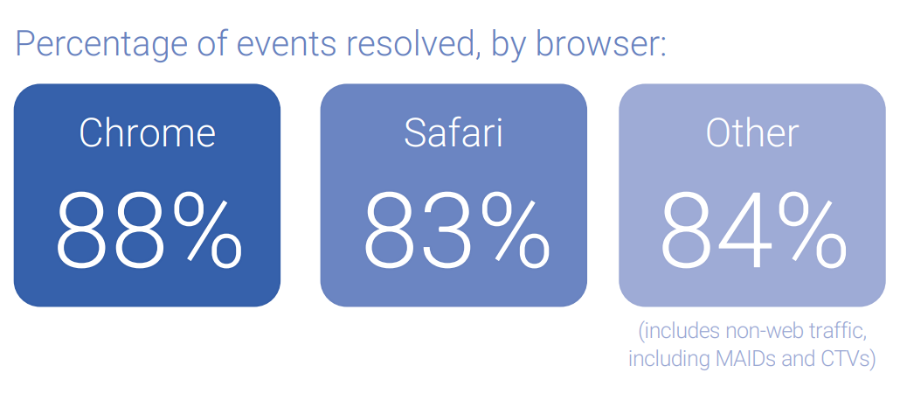
Percentage of events resolved by browser:  

Chrome: 88%  

Safari: 83%  

Other (including non-web traffic, including MAIDs and CTVs): 84%  

By implementing Activity Feed, Cuebiq was successfully able to:

  • Gain clearer insights into the success of their client‘s campaigns
  • Match consumer engagements in a privacy-compliant manner
  • Tell the story of the key performance indicators (KPIs) related to their marketing efforts

Prepare for a cookieless future with higher match rates

Activity Feed is prepared for a cookieless future and uses alternative IDs, like ID5 IDs, hashed emails, and IPs for identity resolution, ensuring no reliance on third-party cookies. Experian remains fully committed to exploring a suite of next-generation solutions and prioritizing continued testing of different industry solutions, including the Google Privacy Sandbox, to help customers prepare for a future without cookies. We’ve identified six viable alternatives to third-party cookies, how these alternatives fall short, and how Experian can help you navigate these alternatives.

“Experian’s customer service is extremely efficient and collaborative. We trust them to keep putting our business first long-term.”

Luca Bocchiardi, Director of Product, Cuebiq

Download the full case study to discover how Cuebiq used Activity Feed to overcome their challenges. Your path to maximizing match rates and resolving data from cookieless environments starts here.


About Cuebiq

Cuebiq is transforming the way businesses interact with mobility data to providing a high-quality and transparent currency to map and measure offline behavior. They are at the forefront of all industry privacy standards, establishing an industry-leading data collection framework, and making it safe and easy for businesses to use location data for innovation and growth.

To learn more, visit their website at www.cuebiq.com


Latest posts

Loading…
One million more households became cord-cutters last year

With online video viewing at an all-time high and television networks and system providers increasingly making video content available to those who don’t pay for television, many are wondering if we’re on the cusp of a massive spike in cord-cutting numbers. In our recent Cross-Device Video Analysis, Experian Marketing Services found that that 7.3 percent of all U.S. homes are cord-cutters, meaning they have high-speed Internet but don’t pay for TV. And the pace is increasing. In the last year alone, one million more homes joined the cord-cutter ranks bringing the total to 8.6 million households. It should come as little surprise that cord-cutting is on the rise. As we reported in our video viewing habits post, 57 percent of all American adults and 75 percent of Millennials now watch some sort of digital video during a typical week with the smartphone being the most commonly used device for watching video either streamed or downloaded from the Internet. Consumers thinking about cutting the cord will find an industry increasingly working to remove barriers that typically stand between cord-cutters and programming from their favorite networks — in exchange for a small fee. For instance, CBS recently announced the launch of CBS All Access, a digital subscription service that provides live and on demand viewing of CBS programming. And Dish Network launched Sling TV, an over-the-top pay service that allows cord-cutters to stream live and recorded programming from networks like ESPN, Univision, CNN, HGTV and more. With HBO announcing an April launch of their digital-only streaming service, HBO Now, March may be the last month that many pay for cable or satellite. If the cord-cutting ranks are, in fact, about to swell, a common question is: by how much? Experian Marketing Services estimates that there are currently 13.8 million Americans — representing 5.6 million homes — who are prime to cut the cord. Many of those individuals already have one foot out the door, if you will, given that they are more likely than average to say that they watch less television today because of the Internet. They are also more likely to watch HBO and be fans of at least one major professional sport making them good targets for Sling TV and HBO Now. Given that many cord-cutters already pay for Netflix and/or Hulu Plus, the net savings to those on the fence may be smaller than they think once they add up the costs they’ll assume from piecing together, à la carte, the various subscriptions and downloads required to keep watching their favorite programs. Whether or not we’re on the cusp of a major spike in cord-cutting, the fact is that consumers are increasingly getting their video content from digital sources and marketers need to understand where, how, when and what consumers are watching to ensure that their video campaigns are optimized for today’s digital consumer. For more information about cord-cutters and cross-device video consumption, including consumer receptivity to digital video advertising, download the Cross-Device Video Analysis.

Mar 06,2015 by

The digital consumer in 2015: Smartphone activities, TV multitasking and cord cutting

Advertising Age recently released their annual Marketing Fact Pack, featuring data from Experian Marketing Services that looks at habits of digital consumers. This post highlights some of these findings.  In the 2015 AdAge Marketing Fact Pack, we featured stats on key marketing and consumer trends impacting the advertising industry. Highlights include the lifestyle of the digitally connected consumer, including the habits of smartphone and television users, household and personal use of smart devices and the choice between becoming a cord-cutter and staying connected. An estimated 7.3 percent of U.S. households (8.6 million homes) today are considered “cord-cutters,” meaning they have high speed Internet but no cable or satellite television service. That number is up from 4.5 percent of households (5.1 million homes) in 2010, a comparative increase of 60 percent. Despite the growing number of consumers who use digital devices to watch video (as opposed to viewing on a television), it has not been enough to overwhelmingly convince all households to cut the cord. Instead, it seems as if the ability to stream or download video directly to the television is what ultimately seals the deal. As streaming devices like Roku, Apple TV, Amazon Fire TV and Google Chromecast become more common and as televisions themselves are increasingly connected to the Internet directly, we can only expect the number of cord-cutters to grow. To learn more about video viewing behaviors to improve your strategies for reaching digital consumers, register to join our upcoming webinar Online video: engaging consumers in a multi-screen world.

Feb 11,2015 by

Meet today’s 5 distinct mom segments

The next generation of mothers have emerged and they are under more pressure than ever before. In addition to balancing work and family life, moms have the added stress of making sure they are keeping their children safe in our digital-focused society. Moms today have access to a myriad of online information including communities where members can address everything from the elimination of processed foods from their family’s diet to whether or not to vaccinate their children. In a recent in-depth analysis, Experian Marketing Services identified five distinct segments of moms and revealed their attitudes, behaviors, motivations and media and consumer preferences. With these insights, marketers can effectively target and engage each segment with more personalized messages. Striving Moms – This segment accounts for 27 percent of moms. They are predominantly young, diverse, often single women who have confidence and aspirations of success. Fast facts: They commonly view money as the best measure of success They are more likely to have kids under the age of five They are tech-savvy and the segment most likely to say they need to be connected to the Internet from the minute they wake up until the moment they go to sleep They have a keen sense of fashion and are tuned in to current styles and consumer trends Conventional Moms – This segment accounts for 20 percent of moms. Although most of them have full-time jobs, family still comes first and faith plays an important role in their life. Fast facts: They are the most likely to drive an SUV or mini-van While discretionary income is plentiful, they have little interest in shopping They are active on social media; they like to post photos, write product reviews and read articles shared by friends They often turn to prepared foods or simple recipes to put food on the table due to their busy schedules Alpha Moms – This segment accounts for 19 percent of moms. They are high octane lean-in moms, early adopters and trendsetters with full-time jobs and packed calendars. Fast facts: They wear designer clothes, drive the latest model car or SUV and have the latest electronics They will do whatever it takes to keep a youthful appearance The environment is important is to them, and they are supporters of the arts They are heavy users of social media and leverage it to interact with brands and share opinions Modest Moms – This segment accounts for 16 percent of moms. Like conventional moms, they are family and faith-oriented but they have more modest means and prefer a simple life. Fast facts: They prefer to indulge their kids with the funds they have rather than buy shiny new gadgets Family and faith are the most important things to them Nearly one-third are stay-at-home mothers Their main source of entertainment is watching television They are heavy users of social media and leverage it to interact with brands and share opinions Maverick Moms – This segment accounts for 18 percent of moms. They are independent trailblazers who are not afraid to make unconventional life choices. Fast facts: They are environmentally conscious, spiritual and prefer to buy organic and natural products While they are the most likely to be stay-at-home moms, they are also the most likely to own their own business They lead uncomplicated lives and use technology and social media with caution They prefer to postpone purchases for special occasions and have no trouble saying no to their kids Want more insights? Check out The Mom Report for deeper insights into the attitudes, behaviors, motivations and media and preferences of these five types of moms. You’ll discover tips to help target your best customers and craft messaging and offers that are sure to resonate.  

Jan 29,2015 by

Subscribe to our newsletter

Enter your name and email for the latest updates

This site is protected by reCAPTCHA and the Google Privacy Policy and Terms of Service apply.

About Experian Marketing Services

At Experian Marketing Services, we use data and insights to help brands have more meaningful interactions with people. As leaders in the evolution of the advertising landscape, Experian Marketing Services can help you identify your customers and the right potential customers, uncover the most appropriate communication channels, develop messages that resonate, and measure the effectiveness of marketing activities and campaigns.

Visit our website

Subscribe to our newsletter

Stay up to date on the latest industry news and receive expert tips from our marketing experts.
Subscribe now!