At Experian, we power data-driven advertising through connectivity. Today, we’re excited to introduce our newest offering, which helps drive that connectivity: Experian’s Collaboration in clean rooms. This offering is now generally available in InfoSum, AWS Clean Rooms, and others. Experian can now facilitate successful data collaboration across multiple secure environments, such as at Experian, through crosswalks, and now in clean rooms.
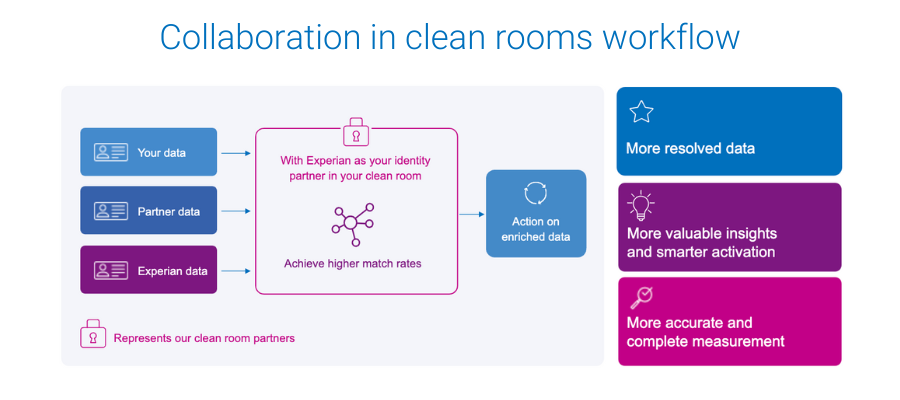
Whether you are a marketer or partner, introducing Experian’s signal-agnostic offline and digital identity graphs into your clean rooms lets you run identity resolution directly in the clean room. This means your data remains secure, while you and your partner experience higher match rates and you maximize your clean room investment, leading to:
- More resolved data
- More valuable insights and smarter activation
- More accurate and complete measurement
A leap forward in data collaboration
Backed by Experian’s Global Data Principles, Experian’s deep roots in identity and data security offer the most effective and trusted ways to match data and protect consumer privacy. Our signal-agnostic approach means we can resolve all types of offline and digital identity signals, which is valuable now and will become even more valuable as third-party cookies go away. Additionally, data hygiene is built right into our collaboration offering, helping to improve match rates.
The benefits of working with Experian’s rich identity data in a clean room environment are obvious so it is no surprise to see that 55% of data clean room users are using identity solutions in data clean rooms.
What are data clean rooms?
Data clean rooms are a tool typically used for data sharing, built on top of cloud providers such as AWS clean rooms. They protect data privacy while facilitating data collaboration among clients, marketers, businesses, and their partners. As the industry places greater emphasis on data security, clean rooms have emerged as secure environments that allow companies to:
- Enhance user privacy protection
- Minimize the impact of cookie deprecation
- Secure collaboration with data partners
The industry has quickly realized that, for what clean rooms offer by way of privacy and security, they lack resolution capabilities, typically yielding subpar match rates.
Benefits of Experian’s Collaboration in clean rooms offering
Built upon Experian’s rich offline and digital identity foundation, with support for various identifiers across platforms, Collaboration in clean rooms helps clients maximize the value of their data and meet the diverse needs of modern business.
Through Experian’s Collaboration in clean rooms offering, you can:
- Collaborate with partners for richer data insights
- Achieve higher match rates
- Improve audience building
- Produce more accurate and complete reports
- Ensure data privacy
Regardless of the identifier type you are looking to collaborate on, Experian has the identity data to support you and your partner. This leads to higher match rates and more resolved data for you to use to benefit your media initiatives.
Get started with Collaboration in clean rooms today
Get the most out of your first-party data with Collaboration in clean rooms, which is essential for businesses that want to compete in a fast-paced market and connect with consumers in today’s data-driven world. We understand the importance of data collaboration and make seamless, secure data sharing possible between partners.
Connect with us today to find out how Experian’s Collaboration in clean rooms offering ensures privacy while allowing you to extract valuable data insights for smarter data-driven advertising.
Latest posts
With the emergence of email addresses as a currency for brands to communicate with their consumers offline; attaching email data to in-store purchases lays the groundwork for future advertising strategies. However, this advantage in having an additional digital touchpoint also creates a new challenge for marketers. How do they connect what they know about their customers via offline data and PII, or personally identifiable information, with what they want to know about their online behaviors and interactions? Taken a step further, how can they create actionable strategies that connect these two streams of consumer insights in order to drive them to make more future purchases; and even become loyalists? At a time when the shift from traditional to online shopping feels more like a landslide; connecting online and offline data has never been more valuable or more urgent. The solution for these marketers lies in the framework of identity resolution; and a key capability called hashed email onboarding. Hashed email onboarding is a privacy-safe way to connect consumer email addresses to their related digital devices and other digital identifiers. The methodology prevents the consumers actual email address from being readable; while still providing marketers a connection between those emails and other touchpoints for an individual. Instead of understanding the customer journey in two distinct parts; how they interact with a brand or company offline and separately how they interact with a brand online; hashed email onboarding allows for the two parts to be woven together in a holistic view of that consumer. The power of connecting these data sets can be seen when combining offline and online attribution and measurement to improve frequency capping and look-alike modeling. It’s important to note that not all identity resolution vendors that onboard hashed emails function in the same way or provide the same level of data. Some connect only to desktop or only to mobile devices; while others don’t actually make direct linkages at all- they simply provide the hashed emails as a targetable digital audience for upload. While hashed email onboarding and the connection between offline and online data is a powerful strategy; it needs to be as structured as possible across the most data available to reveal truly efficient targeting and measurement strategies. Tapad, a part of Experian has built a hashed email product feature that works with the existing flexibility of The Tapad Graph to deliver the most holistic consumer view in the structure that works best for your business objectives. Get started with The Tapad Graph For personalized consultation on the value and benefits of The Tapad Graph for your business, email Sales@tapad.com today!

One of the biggest challenges marketers face when planning digital advertising campaigns is getting an adequate number of impressions that yields measurable results at the lowest possible cost. As agencies, operators and advertisers are increasingly challenged about media budget, it is more important than ever to plan campaigns that generate enough information at the lowest possible cost. Through our design, deployment and measurement of advertising on a variety of platforms, Experian has developed best practices when planning digital advertising campaigns. We share some of these here, to help marketers with future campaign planning to maximize marketing effectiveness at a minimal cost. Using Path to Purchase to Determine the Right Number of Touch Points The Path to Purchase Funnel provides a framework to determine the number of touchpoints required to turn a prospect into a buyer. There are various phases the consumer goes through at each contact, and these phases dictate the number of touch points (or ‘touches’) required to induce a purchase. In the table below, we’ve described what these phases are, and the number of touch points required for those phases. The required number of touches will vary greatly among marketers, who must consider the expected time for a prospect to make decisions, competition in the marketplace, the novelty of the offer, and the level of engagement of the audience. For example, 15-second or 30-second audio and video ads played during scheduled breaks in programming may require more repetition than an ad played at a moment of high engagement, such as when the user interacts with the app, or during a “pre-roll” advertisement view prior to streamed content. Determining the Target Number of Impressions Needed to Persuade The next step involves determining how many exposures will be required to get the impressions or touch points needed to satisfy the consumer’s path to purchase. Let’s say a marketer has decided that four impressions are enough to make the case for the consumer to purchase, and that the marketer plans to reach 1 million prospects during the campaign. Perhaps the most intuitive solution is to provide four impressions for each reached prospect, such that 4 million impressions would be served during the campaign. However, during a normal digital campaign, some prospects will have zero impressions while others will have many. Because of this, we recommend planning to reach a target fraction (typically 80%) of the audience to receive the required number of impressions for purchase. The following table shows the predicted percent of audience exposed by average number of impressions served. Factoring Advertising Half-Life into Impressions Required Advertisement decay, or the fading consumer memory that reduces ad effectiveness, should also be factored into determining the right number of impressions for a successful campaign. For example, if a campaign length is planned to be 6 weeks, but the half-life of the advertisement is only three weeks, then more impressions would be needed to attain the number of touches required for the path to purchase. When planning campaigns for our partners, we adjust the target mean exposure frequency by the square root of the proportion of campaign length over advertisement half-life. For example, assuming a 3-week half-life and a 6-week campaign, we should multiply our target 5.5MM impressions by to get 7.78MM impressions. In the table below, we’ve demonstrated several scenarios of varying advertisement half-life. Other Considerations During Post-Campaign Analysis Once the campaign is completed, Experian recommends analyzing the distribution of impression frequency to determine how closely the actual impression frequencies matched to what was predicted. If frequencies do not align with the predicted, check to see if these assumptions are met: Make sure that advertising impressions are independent of each other. If rules are in place such that a prior impression affects the likelihood of a subsequent impression, this can affect the impression frequency. Check that the entire targeted population is on the ad platform long enough to be available for targeting. Some campaigns may have been instructed to be deployed in phases, which could limit the number of impressions to be delivered. Confirm that exposures can only occur one at a time, so that the impressions are deployed at distinct time intervals, giving the consumer the opportunity to view the advertisement Planning a successful campaign is critical for a test-measure-learn environment for an agency, operator, platform or advertiser. While initial up-front costs can be expensive, the long-term value to the business is significantly greater if tests are designed and administered appropriately. As a result, spending a little extra time thinking about your consumer’s path to purchase, exposure frequency, and the half-life of your advertisement can pay significant dividends in developing your digital advertising strategy.
To our valued customers and partners,It’s been an exciting week here at Tapad! As announced in a press release this morning, Tapad is now a member of the Experian family. We’re thrilled to continue to grow as a leader in identity resolution under the umbrella of a global expert in data, analytics and technology. Tapad and Experian are deeply connected by our commitment to serving the needs of our customers; and with a focus on quality of the data we provide, we have a common goal for the future of identity in the advertising ecosystem. As part of this announcement, we wanted to assure you, our valued customer, that we remain deeply committed to serving you today just as we always have. Nothing will change in your daily operations with Tapad. Experian immediately recognized that the success and growth of Tapad was directly tied to the strength and depth of its team members. As such, the acquisition will not result in any changes to day-to-day contacts at Tapad, or processes with weekly graph deliveries and other product support. Experian’s faith and investment in Tapad’s future and the future of identity resolution underscores what we’ve always believed our products could achieve and that we will be able to continue serving brands, advertisers, publishers, and the advertising and marketing ecosystem for years to come. On a personal note, I am excited to be transitioning my role as Chief Operating Officer of Tapad to the General Manager position of a global business that’s achieved exponential growth over the past several years; culminating in this strategic acquisition that will no doubt bring even more value to our customers in the future. We remain committed to open communication and welcome any questions you may have. Thank you, Mark Connon | General Manager, Tapad