At Experian, we power data-driven advertising through connectivity. Today, we’re excited to introduce our newest offering, which helps drive that connectivity: Experian’s Collaboration in clean rooms. This offering is now generally available in InfoSum, AWS Clean Rooms, and others. Experian can now facilitate successful data collaboration across multiple secure environments, such as at Experian, through crosswalks, and now in clean rooms.
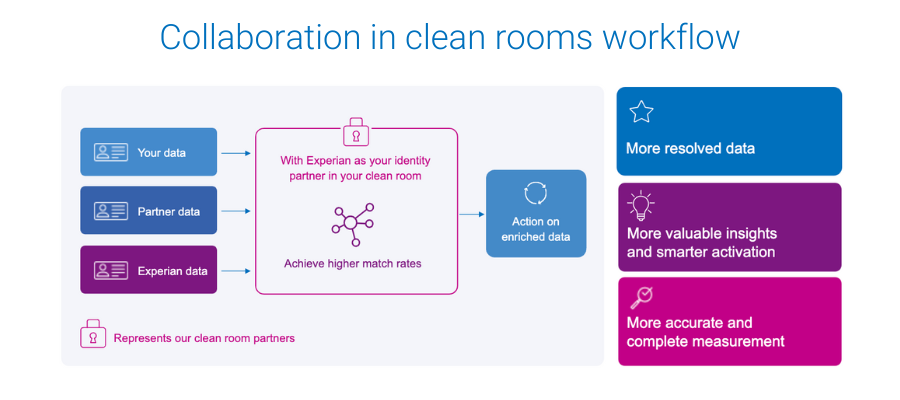
Whether you are a marketer or partner, introducing Experian’s signal-agnostic offline and digital identity graphs into your clean rooms lets you run identity resolution directly in the clean room. This means your data remains secure, while you and your partner experience higher match rates and you maximize your clean room investment, leading to:
- More resolved data
- More valuable insights and smarter activation
- More accurate and complete measurement
A leap forward in data collaboration
Backed by Experian’s Global Data Principles, Experian’s deep roots in identity and data security offer the most effective and trusted ways to match data and protect consumer privacy. Our signal-agnostic approach means we can resolve all types of offline and digital identity signals, which is valuable now and will become even more valuable as third-party cookies go away. Additionally, data hygiene is built right into our collaboration offering, helping to improve match rates.
The benefits of working with Experian’s rich identity data in a clean room environment are obvious so it is no surprise to see that 55% of data clean room users are using identity solutions in data clean rooms.
What are data clean rooms?
Data clean rooms are a tool typically used for data sharing, built on top of cloud providers such as AWS clean rooms. They protect data privacy while facilitating data collaboration among clients, marketers, businesses, and their partners. As the industry places greater emphasis on data security, clean rooms have emerged as secure environments that allow companies to:
- Enhance user privacy protection
- Minimize the impact of cookie deprecation
- Secure collaboration with data partners
The industry has quickly realized that, for what clean rooms offer by way of privacy and security, they lack resolution capabilities, typically yielding subpar match rates.
Benefits of Experian’s Collaboration in clean rooms offering
Built upon Experian’s rich offline and digital identity foundation, with support for various identifiers across platforms, Collaboration in clean rooms helps clients maximize the value of their data and meet the diverse needs of modern business.
Through Experian’s Collaboration in clean rooms offering, you can:
- Collaborate with partners for richer data insights
- Achieve higher match rates
- Improve audience building
- Produce more accurate and complete reports
- Ensure data privacy
Regardless of the identifier type you are looking to collaborate on, Experian has the identity data to support you and your partner. This leads to higher match rates and more resolved data for you to use to benefit your media initiatives.
Get started with Collaboration in clean rooms today
Get the most out of your first-party data with Collaboration in clean rooms, which is essential for businesses that want to compete in a fast-paced market and connect with consumers in today’s data-driven world. We understand the importance of data collaboration and make seamless, secure data sharing possible between partners.
Connect with us today to find out how Experian’s Collaboration in clean rooms offering ensures privacy while allowing you to extract valuable data insights for smarter data-driven advertising.
Latest posts
NEW YORK, Oct. 16, 2019 /PRNewswire/ — Tapad, part of Experian and a global leader in digital identity resolution, and The Trade Desk, a global advertising technology leader, partnered to integrate The Trade Desk's unified ID solution in April 2019. The Trade Desk's unified ID solution's objective is to serve as a standardized cookie ID to help marketers reach more of their audience on the open internet. After an initial six month period, Tapad reports significant adoption rates and enhanced customer results since their joint integration in April. As a result of the partnership, client brands, agencies, DMPs/ DSPs, Data Providers, Mobile Networks and Measurement/Analytics Providers, saw increased match rates up to 38% and more global coverage without compromising precision. With this combined offering, Tapad's global, privacy-safe digital cross-device solution, The Tapad Graph, connects brands with consumers over 4 billion devices globally. "There is a need for digital identity solutions outside the walled gardens that can accommodate the need for both precision and scale," said Chris Feo, SVP of Strategy and Global Partnerships at Tapad. "Through our partnership with The Trade Desk, we are empowering companies to have a comparable digital identity resolution across the open web as compared to the walled garden environments." Over 25 companies who license The Tapad Graph, such as Annalect, Semasio, Retargetly, and ThinkCX, have also included The Trade Desk's unified ID solution as a key identifier in their graph output. "The vast improvement in scale that Tapad has seen illustrates the value digital identity resolution products can bring for brands," said Nate Gawel, General Manager of Data Partnerships at The Trade Desk. "We're looking forward to continuing work with Tapad to prove that the open internet can deliver the very same benefits many reserve for large platforms." Adoption of the unified ID solution allows all parties across the supply chain (SSPs, DSPs, DMPs and data providers) to utilize The Trade Desk's cookie footprint to increase their own cookie coverage across the global independent internet. For more information, please visit The Trade Desk's unified ID solution site, or https://www.experian.com/marketing/consumer-sync to learn more about Tapad's digital identity resolution products. About Tapad:Tapad, Inc. is a global leader in digital identity resolution. The Tapad Graph, and its related solutions, provide a transparent, privacy-safe approach connecting brands to consumers through their devices globally. Our one-of-a-kind Graph Select offering enables marketers the flexibility and freedom of choice to correlate devices to varied objectives, driving campaign effectiveness and business results. Tapad is recognized across the industry for its product innovation, workplace culture and talent, and has earned numerous awards including One World Identity's 2019 Top 100 Influencers in Identity Award. Headquartered in New York, Tapad also has offices in Chicago, London, Oslo, Singapore and Tokyo. About The Trade Desk:The Trade Desk™ is a technology company that empowers buyers of advertising. Through its self-service, cloud-based platform, ad buyers can create, manage, and optimize digital advertising campaigns across ad formats and devices. Integrations with major data, inventory, and publisher partners ensure maximum reach and decisioning capabilities, and enterprise APIs enable custom development on top of the platform. Headquartered in Ventura, CA, The Trade Desk has offices across North America, Europe, and Asia Pacific. To learn more, visit thetradedesk.com or follow us on Facebook, Twitter, LinkedIn and YouTube. Contact us today!

Gen Z is ready to be noticed and become a force to be reckoned with in the market. In the auto market alone, Gen Z made up 3.8 percent of all new vehicle registrations in the first quarter of 2019.

For as long as the ad buying process has existed, most brands and agencies have put an emphasis on the channel – meaning there were specific campaigns for direct mail, email, TV, social media, banner ads, etc. In fact, the teams responsible for these campaigns often work in silos. But with more people consuming information through multiple channels, it’s important for brands and agencies to put the customer at the center of the ad buying process – to develop and implement true omnichannel campaigns. I recently wrote a byline article for Broadcasting & Cable that explored the concept of the “PeopleFronts.” While the Upfronts and Newfronts have dominated the ad buying world, brands and agencies need place larger emphasis on the customer. At the end of the day, the right mindset can open the door for more powerful campaigns and relevant messages that resonate with the consumer.