At Experian, we power data-driven advertising through connectivity. Today, we’re excited to introduce our newest offering, which helps drive that connectivity: Experian’s Collaboration in clean rooms. This offering is now generally available in InfoSum, AWS Clean Rooms, and others. Experian can now facilitate successful data collaboration across multiple secure environments, such as at Experian, through crosswalks, and now in clean rooms.
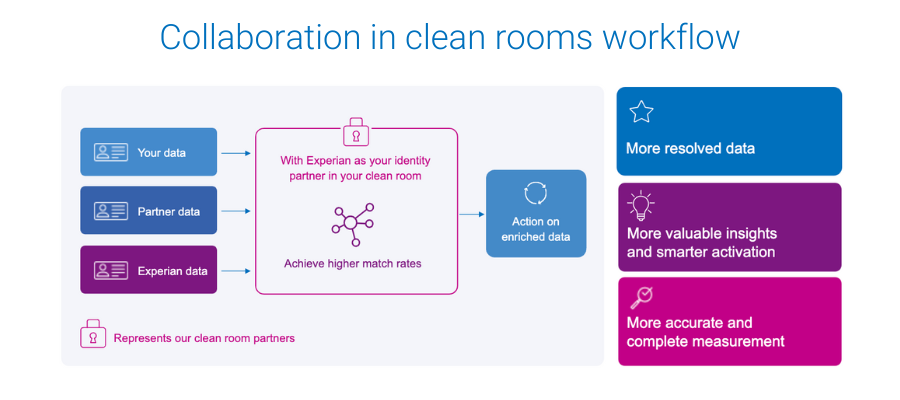
Whether you are a marketer or partner, introducing Experian’s signal-agnostic offline and digital identity graphs into your clean rooms lets you run identity resolution directly in the clean room. This means your data remains secure, while you and your partner experience higher match rates and you maximize your clean room investment, leading to:
- More resolved data
- More valuable insights and smarter activation
- More accurate and complete measurement
A leap forward in data collaboration
Backed by Experian’s Global Data Principles, Experian’s deep roots in identity and data security offer the most effective and trusted ways to match data and protect consumer privacy. Our signal-agnostic approach means we can resolve all types of offline and digital identity signals, which is valuable now and will become even more valuable as third-party cookies go away. Additionally, data hygiene is built right into our collaboration offering, helping to improve match rates.
The benefits of working with Experian’s rich identity data in a clean room environment are obvious so it is no surprise to see that 55% of data clean room users are using identity solutions in data clean rooms.
What are data clean rooms?
Data clean rooms are a tool typically used for data sharing, built on top of cloud providers such as AWS clean rooms. They protect data privacy while facilitating data collaboration among clients, marketers, businesses, and their partners. As the industry places greater emphasis on data security, clean rooms have emerged as secure environments that allow companies to:
- Enhance user privacy protection
- Minimize the impact of cookie deprecation
- Secure collaboration with data partners
The industry has quickly realized that, for what clean rooms offer by way of privacy and security, they lack resolution capabilities, typically yielding subpar match rates.
Benefits of Experian’s Collaboration in clean rooms offering
Built upon Experian’s rich offline and digital identity foundation, with support for various identifiers across platforms, Collaboration in clean rooms helps clients maximize the value of their data and meet the diverse needs of modern business.
Through Experian’s Collaboration in clean rooms offering, you can:
- Collaborate with partners for richer data insights
- Achieve higher match rates
- Improve audience building
- Produce more accurate and complete reports
- Ensure data privacy
Regardless of the identifier type you are looking to collaborate on, Experian has the identity data to support you and your partner. This leads to higher match rates and more resolved data for you to use to benefit your media initiatives.
Get started with Collaboration in clean rooms today
Get the most out of your first-party data with Collaboration in clean rooms, which is essential for businesses that want to compete in a fast-paced market and connect with consumers in today’s data-driven world. We understand the importance of data collaboration and make seamless, secure data sharing possible between partners.
Connect with us today to find out how Experian’s Collaboration in clean rooms offering ensures privacy while allowing you to extract valuable data insights for smarter data-driven advertising.
Latest posts

Digital Marketing Challenges Are you new to digital marketing? If you answered yes, then you may already know this is a complex world made up of cookies, pixels, attribution, and unique KPIs. With nearly 10 years of advertising experience, Experian is familiar with the challenges advertisers face as they prepare for their first digital marketing campaign. Those challenges include: determining a target audience, justifying data fees for targeting, sending a consistent message to every channel and measuring the success of a campaign. Of these challenges, creating an accurate, data-driven target audience and understanding the attribution process are the two most common. Coincidentally, these two challenges tend to be the most difficult to overcome and have the highest impact on a campaign’s success. 1.) Creating an accurate, data-driven target audience Understanding the basic demographics of your customer is the first step in the audience creation process. Your next step should be to understand your customers’ lifestyles, purchase behaviors, and current interests. By truly knowing your customer, you are then able to build out a multi-channel targeting strategy comprehensive of not only basic demographics and past behavioral data, but current behavioral trends that lead to individuals who are in market for a product or service. This reduces irrelevant marketing to individuals who may have the demographic characteristics, but are not yet in market. Overall, creating a relevant target audience saves media spend by focusing on targeting tactics that have a higher potential for success. 2.) Understanding the attribution process Now that you have your target audience, you need to determine how to measure the success of your campaign. Is your goal to increase online purchases? Drive store visits? Or, do you want your overall revenue to grow by a certain amount? Before launching your campaign, make sure you have a clear goal as well as a plan for measuring whether or not you meet your goal. Most digital marketers will judge the success of a campaign by online events, such as site visits, form completions, or online purchases. However, you may also want to measure offline metrics like phone calls or in person visits to a brick and mortar store. Offline metrics are essential to campaign performance, but are frequently over looked. Experian’s OmniActivation Strategic Services recommends having one clear goal that can be accurately measured. This ensures your campaign’s target audience and optimizations support the metric that will ultimately determine the success of your campaign.

Every day it seems, mobile device fragmentation increases. With consumers spending their time online across multiple devices – phones, tablets, over-the-top TV devices, gaming consoles, a nascent, yet growing internet-of-things, and a variety of other internet connected devices – the challenge of keeping up with consumers continues to be a daunting one. The industry has, of course, adopted many different identity solutions and cross-device technologies. Perhaps you’ve adopted some of them. Perhaps you feel like they are working. But perhaps you feel you could be doing a better job at connecting the dots. Marketers require solutions that can truly unify identities across channels and devices in order to understand consumer behavior, predict intent, and ultimately reach them with relevant communications. The easier it is to do that, the better. So, consider a couple scenarios and see how well are you doing. Within your core CRM data, are you able to connect your email subscribers to your in-store customers, all without relying on a loyalty program? Can you do this all the way down to an individual level? And are you leveraging this connected identity information to inform future online targeting? This kind of PII-based identity management is foundational to consumer engagement! Next scenario. Are you an app publisher? Or a media platform? Or any other type of organization that has a steady stream of device data? How much do you know about the consumer behind the device? Behavioral information is certainly a step in the right direction. But what about known consumer insights? How deep is the profile of information you’ve built for each device? Does it include both online and offline insights? Done in a compliant manner? There are a myriad of different techniques and approaches available to you to keep up with consumers. If you’re considering implementing a new strategy in the near future, or have questions about your current ones, contact Experian and we can help assess the opportunities available to you.
The Tapad Device Graph™ Complements Freckle’s IoT Capabilities to Extend Scale and Precision of Audience Data New York, NY — December 6, 2017 — Tapad, part of Experian, is the leader in cross-device marketing technology and Freckle IoT, the global leader in multi-touch, offline attribution, today announced they are partnering to provide brands with a holistic and insightful view of their customers, in predefined locations in all global markets. Starting today Freckle IoT will be leveraging the Tapad Device Graph™ to supplement the company’s data set to offer brands more granular attribution data. Consumer’s online behavior is becoming more and more complex, with the average consumer owning three or more devices and 35 percent of consumers converting on a different device from the one on which they started their research. These interactions become even more complicated when considering how online interactions and media impact offline sales. The collaboration between Tapad and Freckle, which combines Freckle IoT’s persistent location data with Tapad’s proprietary cross-device technology, is an important step in empowering brands with the information they need to better understand how digital media, consumed across multiple devices, is impacting offline attribution. Using its opt-in, first-party data, Freckle IoT helps brands measure the effectiveness of their advertising by independently matching media spend to in-store visits. Tapad’s technology extends Freckle’s data-set by allowing brands to access additional deterministic and probabilistic data, at scale and across all devices, to analyze consumer behavior ahead of in-store purchase. “Combining our technology with Tapad’s identity-driven solutions was a natural fit for our business,” said Neil Sweeney, founder and CEO at Freckle IoT. “With our unbiased, agnostic measurement and Tapad’s precise and privacy-safe data set, we knew this partnership would be a strong complement to providing more effective results for the needs of our brand partners.” “Freckle IoT is a valuable partner for Tapad as our cross-channel attribution capabilities continue to expand at global scale,” says Chris Feo, SVP, strategy and global partnership at Tapad. “Marketers today need a tool that can address the online and offline disconnect throughout the consumer journey. Freckle’s IoT innovations combined with the Tapad Device Graph help address this need by providing brands, across multiple verticals, accurate and precise identity-driven data powered by true consumer behavior — online and offline.” For more information about the Tapad Device Graph™, or to request a demonstration, contact us. For more information on Freckle IoT’s measurement offerings, please visit www.freckleiot.com.