At Experian, we power data-driven advertising through connectivity. Today, we’re excited to introduce our newest offering, which helps drive that connectivity: Experian’s Collaboration in clean rooms. This offering is now generally available in InfoSum, AWS Clean Rooms, and others. Experian can now facilitate successful data collaboration across multiple secure environments, such as at Experian, through crosswalks, and now in clean rooms.
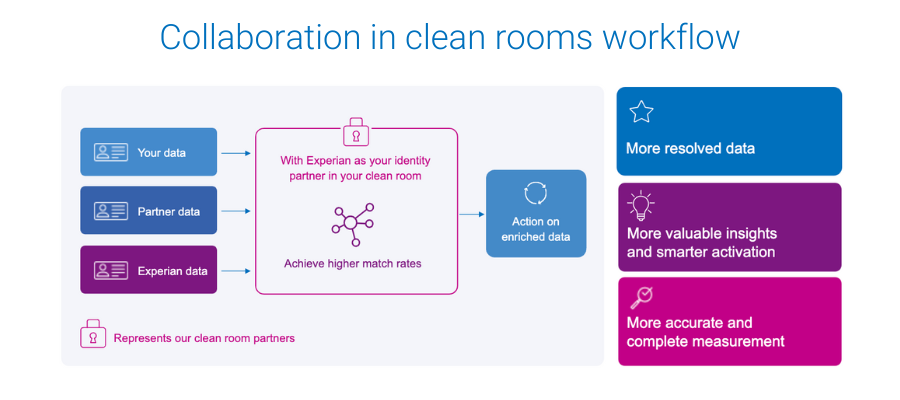
Whether you are a marketer or partner, introducing Experian’s signal-agnostic offline and digital identity graphs into your clean rooms lets you run identity resolution directly in the clean room. This means your data remains secure, while you and your partner experience higher match rates and you maximize your clean room investment, leading to:
- More resolved data
- More valuable insights and smarter activation
- More accurate and complete measurement
A leap forward in data collaboration
Backed by Experian’s Global Data Principles, Experian’s deep roots in identity and data security offer the most effective and trusted ways to match data and protect consumer privacy. Our signal-agnostic approach means we can resolve all types of offline and digital identity signals, which is valuable now and will become even more valuable as third-party cookies go away. Additionally, data hygiene is built right into our collaboration offering, helping to improve match rates.
The benefits of working with Experian’s rich identity data in a clean room environment are obvious so it is no surprise to see that 55% of data clean room users are using identity solutions in data clean rooms.
What are data clean rooms?
Data clean rooms are a tool typically used for data sharing, built on top of cloud providers such as AWS clean rooms. They protect data privacy while facilitating data collaboration among clients, marketers, businesses, and their partners. As the industry places greater emphasis on data security, clean rooms have emerged as secure environments that allow companies to:
- Enhance user privacy protection
- Minimize the impact of cookie deprecation
- Secure collaboration with data partners
The industry has quickly realized that, for what clean rooms offer by way of privacy and security, they lack resolution capabilities, typically yielding subpar match rates.
Benefits of Experian’s Collaboration in clean rooms offering
Built upon Experian’s rich offline and digital identity foundation, with support for various identifiers across platforms, Collaboration in clean rooms helps clients maximize the value of their data and meet the diverse needs of modern business.
Through Experian’s Collaboration in clean rooms offering, you can:
- Collaborate with partners for richer data insights
- Achieve higher match rates
- Improve audience building
- Produce more accurate and complete reports
- Ensure data privacy
Regardless of the identifier type you are looking to collaborate on, Experian has the identity data to support you and your partner. This leads to higher match rates and more resolved data for you to use to benefit your media initiatives.
Get started with Collaboration in clean rooms today
Get the most out of your first-party data with Collaboration in clean rooms, which is essential for businesses that want to compete in a fast-paced market and connect with consumers in today’s data-driven world. We understand the importance of data collaboration and make seamless, secure data sharing possible between partners.
Connect with us today to find out how Experian’s Collaboration in clean rooms offering ensures privacy while allowing you to extract valuable data insights for smarter data-driven advertising.
Latest posts

Leading data insights and cross-device-powered services bridge mobile insights with connectivity to drive real-time consumer intelligence NEW YORK, May 17, 2017 /PRNewswire/ — Tapad, now a part of Experian, the leader in cross-device marketing technology, has partnered with Resonate, a leading provider of real-time consumer intelligence and activation SaaS solutions. Through this partnership, Resonate will leverage the Tapad Device Graph™ to capture a deeper understanding of its mobile app audiences and provide brands with a more direct connection to their intended consumers. The integration of Resonate and Tapad's technologies equips mobile app brands with insights into their consumers' values, beliefs, motivations and purchase drivers. As a result, mobile app brands will better understand how to tailor messaging, drive advertising engagement, increase lift in performance across mobile consumers and ultimately boost revenue and returns. Utilizing the advanced data that the Tapad Device Graph™ provides, Resonate will create an Identity Service that connects mobile IDs to Resonate IDs for reporting insights both in-platform and out. To date, Tapad and Resonate have already driven incremental device connections for nearly 60 percent of customer profiles with an amplification rate of more than 120 percent, resulting in more than 400 million net new IDs within Resonate's user base. "After testing multiple partners over the course of 12 months, it was clear that Tapad was the partner for us, given their ability to provide cross-device connectivity for more than one billion unique IDs against our consumer base," said Joel Pulliam, SVP and chief product officer at Resonate. "In addition, Resonate customers have an inherent trust in Tapad's mix of probabilistic and deterministic mobile connectivity data to provide a unified understanding of their mobile audiences." "Partnering with Resonate will not only provide its brands with a more in-depth and actionable understanding of its consumers, but it will also allow our clients to connect with mobile consumers on a deeper level," said Pierre Martensson, SVP and GM of Tapad's global data division. "Resonate is not just answering the question of 'how' consumers are making purchases, but also tackling the more difficult question of 'why' they make certain buying decisions to best inform mobile brands about their audiences." Contact us today!

Marketers should focus on three core areas in their email marketing strategies, preference data, message relevancy, and a mobile-first approach.
Partnership leverages industry-leading Tapad Device Graph™ for more effective video marketing across all connected devices NEW YORK, April 11, 2017 /PRNewswire/ – Tapad, a part of Experian, the leading provider of privacy-safe, cross-device marketing technology solutions, has announced its partnership with Innovid, the world's leading video marketing platform. This integration enables Innovid to bring cross-device personalization and a more unified viewer experience to its video marketing clients including Bank of America, L'Oréal, Microsoft and Procter & Gamble. Innovid's proprietary technology is the only platform optimized for video, enabling marketers to thrive in an ever-changing digital television landscape. Since its launch last year, Innovid's Marketing Cloud Suite has helped marketers increase message relevance and the opportunity to drive conversions, retention and acquisition through video personalization. By leveraging the Tapad Device GraphTM, Innovid's marketers can now benefit from the ability to drive consistent, personalized user experiences across all devices, creating more impactful connections with consumers and increasing ROI. "Personalization is a must for every data-driven marketer and really needs to happen across all devices to ensure a unified customer journey," says Ronnie Lavi, SVP of product at Innovid. "At Innovid, we recognize one size does not fit all when it comes to video. As an open platform, we are always looking to add best-of-breed capabilities through integrations and partnerships, and we've chosen Tapad because of its superior cross-device expertise." "Innovid has long paved the way for effective personalization in the video marketing space," says Pierre Martensson, GM of Tapad's data division. "As video continues to gain popularity across digital formats, we're excited to see how our technology empowers Innovid to bring that renowned personalization to more customers across all of their devices." Contact us today!