
Loading...

Introducing Experian’s Contextually-Indexed Audiences

by Experian Marketing Services 4 min read October 3, 2024

Announcing Experian's Contextually-Indexed Audiences

Ditch the cookie, not the data with the next evolution of contextual targeting

Today, we’re excited to announce Contextually-Indexed Audiences, a game-changer in contextual targeting. Experian’s new solution offers advertisers a powerful, privacy-safe solution that combines the precision of deterministic audience targeting with the flexibility of contextual targeting. Powered by real-time analysis from two million websites, access to 1,400 trusted audience segments, and easy activation through the top demand-side platform’s contextual marketplace or Audigent private marketplaces (PMPs), this solution offers advertisers a scalable way to reach their target consumers.

With this solution, advertisers can reach consumers on websites that over-index for visitors with the demographics, behaviors, or interests, they are looking to target. For example, an automotive brand can select Experian’s “Contextually-indexed in-market for a luxury electric car” audience segment and reach consumers when they are browsing websites that often attract that exact segment. Best of all, this is done in a privacy-safe way since it’s not reliant on cookies, mobile ad IDs (MAIDs) or other user identifiers.

How Contextually-Indexed Audiences work

Contextually-Indexed Audiences harness advanced machine learning technology to move beyond traditional keyword-based strategies. The solution works in three steps:

  1. First, it analyzes traffic from over two million websites and mobile apps to identify the types of frequent visitors to those platforms.
  2. Next, using Experian’s Digital Graph, it resolves the identities of those visitors and maps them to more than 1,400 of Experian’s Syndicated Audiences, determining which audiences are most overrepresented on each site.
  3. Finally, the relevant audiences are assigned to those sites, allowing advertisers to deliver ads to people in those audiences while they are actively browsing the websites — without relying on user identifiers.
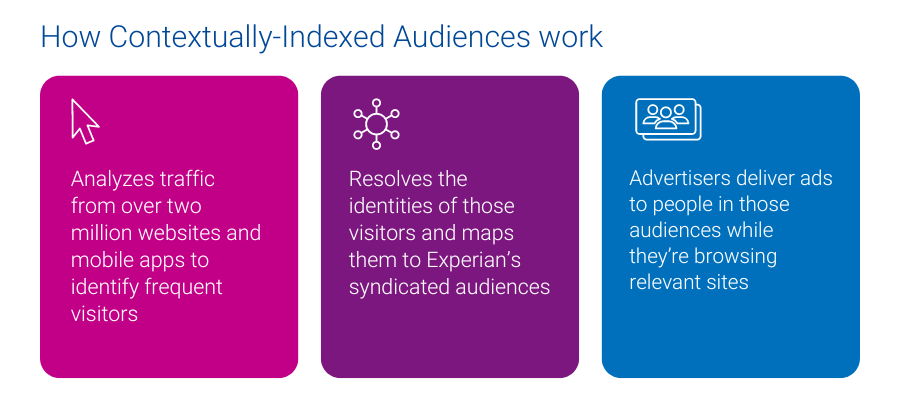
A graphic that explains how Contextually-Indexed Audiences work

Customer success story

A leading auto manufacturer was among the first clients to activate this new solution while we were in beta. The goal was to identify new contextual targeting solutions that focus on privacy while maintaining scale and performance. The client identified two key target audiences: first-time vehicle buyers and experienced buyers. The initial campaigns using this new solution were highly successful. Even as the campaign scaled to twice the original volume, it continued to deliver three times the targeted click-through rate (CTR) goal.

“Partnering with industry leaders like Experian, we’re pushing the boundaries of contextual targeting with innovative data strategies that offer buyers greater flexibility and improved performance. These advanced contextual solutions are exciting as they not only drive results but also have the same privacy safeguards as traditional contextual targeting.”

Matt Griffith, CTO & Co-Founder, Audigent

Benefits of Contextually-Indexed Audiences

  • Accurate consumer reach: Real-time integrations with over two million websites and apps coupled with machine-learning indexing technology ensure audience segments are constantly refreshed, which means advertisers reach consumers based on their latest habits.
  • Privacy-safe audience targeting: These audiences are not reliant on cookies or any other user identifiers for targeting.
  • Audience customization: Create the right audience segment for your campaign by using a combination of over 1,400 audiences across 12 data categories like demographics, politics, health, travel, finance, and TV.
  • Flexible activation: Activate these audiences instantly in the top demand-side platform’s contextual marketplace or utilize our partnership with Audigent to create a custom private marketplace (PMP), where they can be activated across any media buying platform. When using a PMP, advertisers benefit from additional performance optimization capabilities.
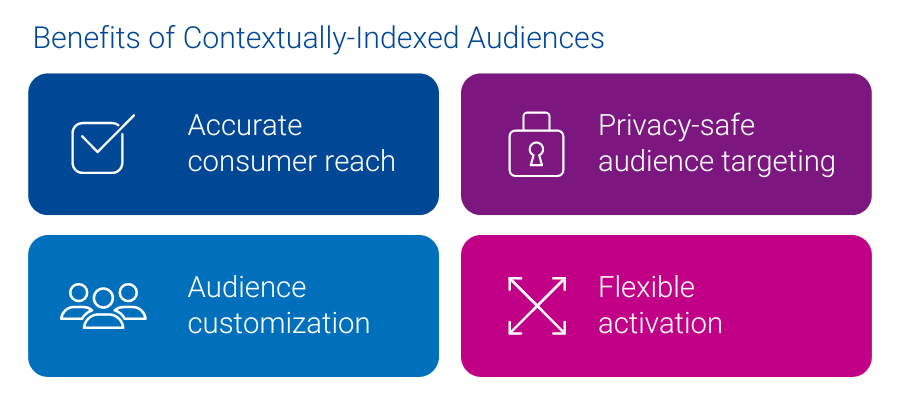
A graphic that explains four benefits of Contextually-Indexed Audiences

Experian’s Contextually-Indexed Audiences offer advertisers a powerful solution that combines the precision of audience targeting with the flexibility of contextual targeting. With real-time analysis of over two million sites and access to 1,400 trusted audience segments, advertisers can reach consumers based on their exact behaviors and interests. This is done in a privacy-safe, yet scalable way since it’s not reliant on cookies or other user identifiers. Whether activating instantly through the top demand-side platform or customizing through Audigent PMPs, this is the future of audience targeting.

Ditch the cookie, not the data, and elevate your strategy today.


Latest posts
Loading…
Experian at CES 2024: Four key trends in advertising

Every year, the Experian team attends the Consumer Electronics Show (CES) in Las Vegas, to immerse ourselves in the world's most significant consumer tech showcase and stay at the forefront of the latest technological advancements and innovations that shape the AdTech industry. This year's event was a vibrant melting pot of innovation and vision, from streamers taking a bigger bite of the advertising pie to the emergence of AI-powered solutions and drone delivery services. Amidst these advancements, the dynamic interplay of technology, media, and advertising raised important questions, especially in the context of evolving regulations and cookie deprecation. During CES, we captured insights from various thought leaders, and in the coming months, we'll be sharing these valuable perspectives with you. Watch the video below for full insights coming from our content studio onsite during the event. Or, keep reading for a recap on four key trends from CES and what they mean for your business in 2024! “My first CES was a major success. You could feel the buzz in the air as new ideas and partnerships were being created within and across industries. The intersection of the different players within retail media, connected TV, retail technology, the demand and supply-side, and agencies all in an ever-changing world of regulation and privacy begs for a solution that can maximize a successful outcome for all.”anne passon, sr director, sales, retail & cpg 1.  Audience targeting: How first- and third-party data work together A central theme at CES was the importance of audience targeting, highlighting the crucial role of first-party data. However, it’s clear that to maximize its potential, this data needs to be augmented with sophisticated identity solutions and enriched with third-party insights, all while navigating the complexities of privacy regulations. This integrated approach is vital to understanding audiences and for creating more effective marketing strategies that comply with privacy regulations. 2. Standardizing metrics in retail media networks The challenges around retail media networks, particularly in terms of standardizing metrics like incremental return on ad spend (iROAS), were a hot topic at CES. This complexity around this topic underscores the need for neutral, expert third parties to help bring clarity and consensus, aiding businesses in navigating this multifaceted domain. 3. The challenge of switching data solutions Discussions covered the broader challenges associated with transitioning to new data solutions. For businesses, this involves a critical assessment of the benefits versus the costs and complexities of adopting new platforms or systems. This decision-making process is increasingly significant as data strategies become integral to marketing success. 4. Identity solutions in a cookieless future With the industry moving toward a cookieless future, the spotlight at CES was on the importance of robust identity solutions. Understanding the functionality and necessity of various universal IDs is essential to minimize data loss and maintain effective targeting. Investing in flexible and adaptable identity solutions like the Experian Graph is essential to maintain effective targeting and audience engagement in this new landscape. Announcements and advertising innovations at CES 2024 CES was a stage for significant announcements and innovative marketing initiatives: Criteo and Albertsons announced their collaboration in retail media. Instacart's partnership with Google for enhanced shopping ads and AI shopping carts. NBCUniversal's advancements in streamlining programmatic advertising. Brands like Netflix, LG, Freewheel, and Amazon Ads also captured attention with their creative marketing strategies, ranging from unique collaborations to themed promotions and captivating events. These insights from CES provide a glimpse into the future of technology, media, and advertising. They highlight the need for adaptability, innovation, and informed decision-making in these dynamic industries, especially in the context of privacy regulations. Stay tuned for our series of posts where we'll dive deeper into these topics, sharing exclusive insights from industry thought leaders.  Follow us on LinkedIn or sign up for our email newsletter for more informative content on the latest industry insights and data-driven marketing. Latest posts

Published: Jan 18, 2024 by Hayley Schneider

The current climate of ad-supported TV

Short-form video content is becoming more prevalent on video-sharing platforms. Keep up with trends and marketing strategies to stay relevant.

Published: Jan 10, 2024 by Experian Marketing Services

How accurate third-party data leads the way for advertisers

Experian received top ranks for hashed emails (HEMs) and demographic data from Truthset Data Collective  Advertisers, technology partners, and agencies are all chasing accurate data to power their marketing strategies. Turns out, not all data is created equal and unless you’re working with the right partner, high-quality data can be hard to find. That’s because accuracy can vary widely across the industry and the partner you choose is important. A recent study conducted by data validation company Truthset showed that 51% of the data used for ad targeting and audience measurement is wrong, with average accuracy rates ranging between 32%-69% across data providers. The data quality challenge The lack of high-quality data poses multiple challenges in the advertising world:   Wasted ad spend: without accurate data at the start, marketers can’t reach the right audiences, resulting in wasted impressions.  Privacy and compliance: in an increasingly privacy-centric world, advertisers need to be especially mindful of accurate targeting to avoid putting their brand reputation at risk.  Poor campaign performance: low-quality data skews metrics and attribution models, making it difficult to measure campaign success and optimize spend.  Low-quality data can come in different forms like inconsistent or outdated information – think demographics (age, gender) and interests (dog versus cat lover) or simply the wrong relationship can be made between datasets. Data records can be incomplete or duplicative and data segments could be misclassified or inaccurate. For example, a kids snack food company may think they’re targeting a 35-year old man, who lives in the suburbs with his young family when in fact it’s a 65-year-old woman who moved to the city after her kids went to college. It’s wasted dollars!Build the data foundation Data quality needs to be addressed if advertisers and advertising technology partners want to fulfill consumers’ demand for personalized marketing. Per eMarketer, more than 75% of internet users worldwide said they were willing to share their email address, brand interest, and name in exchange for personalized experiences. Without accurate data, marketers won’t be able to provide the level of personalization that consumers desire.   Validation can help advertisers evaluate third party data and help build trust across the ecosystem. Companies like Truthset review and provide an unbiased evaluation of data fidelity and quality on a regular basis.  "As cookies and mobile ad identifiers continue to phase out, consented, durable identifiers (hashed email, postal addresses) are going to serve as the foundation for identity solutions of the future,” said Chip Russo, President at Truthset. “And the only way to ensure you are transacting on the highest quality identity and demography data is to actively validate the data you rely on with a third party.”  Not all data is created equal: Experian leads the way In Q3 2023 Truthset reviewed Experian’s marketing data – as well as several other large data providers – and found:   Experian is the #1 data provider in terms of largest volume of high-accuracy hashed e-mails (HEMs) with demographic data  Experian ranks #1 in accuracy for 15 marketing data attributes, including but not limited to Age, Gender, Home Owner/Renter, Geography, Education, Presence of Children, and Pet Owner   Experian consistently has the largest number of HEMs with demographic data that are 90% or more likely to be accurate  “As a member of the Truthset Data Collective, Experian received top ranks across a variety of categories for its data,” continued Russo. “The entire digital advertising world runs on data, but focusing on data accuracy is going to drive the next phase of innovation for the industry, enhancing ROI for advertisers, CPMs for publishers, and relevant experiences for consumers.”  As Truthset's recent study highlights, the data matched between hashed e-mails and postal addresses is crucial, underpinning everything from targeted ads to TV audience measurement. Highly accurate HEMs linked to high-quality demographic data should be the foundation of any marketing plan. Advertisers are able to overcome the complexities of identity resolution by tying online and offline touchpoints together to deliver a consistent message across channels.  Companies are striving to eliminate marketing waste and provide consumers with personalized marketing and the advertising industry can have confidence that Experian’s marketing data has been externally validated as being highly accurate. The accuracy of our data will power smarter marketing initiatives, like insights, targeting, identity, and measurement.  Let's start a conversation about how we can fully realize the potential of data-driven advertising together.  Contact us today   Latest posts

Published: Jan 05, 2024 by Eric Farkas

Subscribe to our newsletter

Enter your name and email for the latest updates

This site is protected by reCAPTCHA and the Google Privacy Policy and Terms of Service apply.

About Experian Marketing Services

At Experian Marketing Services, we use data and insights to help brands have more meaningful interactions with people. As leaders in the evolution of the advertising landscape, Experian Marketing Services can help you identify your customers and the right potential customers, uncover the most appropriate communication channels, develop messages that resonate, and measure the effectiveness of marketing activities and campaigns.

Visit our website

Subscribe to our newsletter

Stay up to date on the latest industry news and receive expert tips from our marketing experts.
Subscribe now!