Today, Experian is excited to introduce our Offline Graph as a standalone product that clients can license, marking a significant step in our commitment to powering data-driven advertising through connectivity. Offline Graph empowers advertisers and advertising technology companies to build and refine consumer profiles, contributing to data connectivity, more offline audience reach, and improved offline measurement accuracy.
As a result of consumers engaging with content across more channels, there are more disparate data points than ever before. When you couple that with ongoing signal loss, the need for a unified identity solution has never been greater.
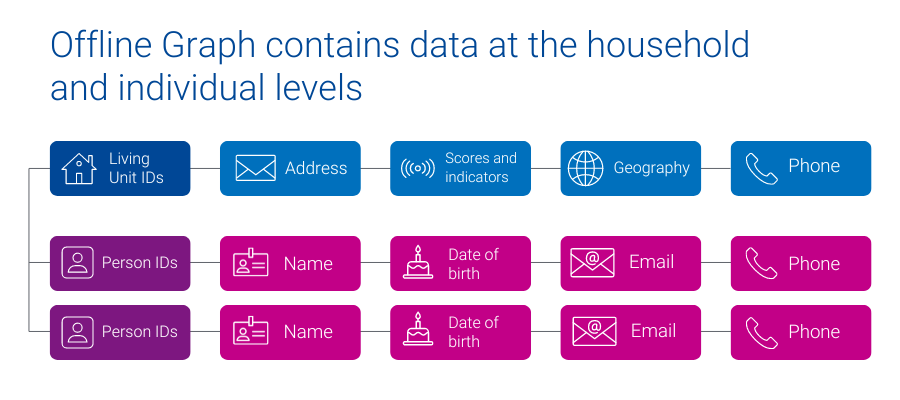
Experian’s Offline Graph offers companies a license of stable offline data points, like name, address, phone number, email, geographic information, date of birth, and additional attributes that provide a complete view of household and individual identities. The Offline Graph integrates known offline identity information from reliable deterministic sources like property ownership records, public records, and marketing data to provide access to all United States consumers and households.
How customers can use the Offline Graph
- A big box retailer fills in the blanks of their existing customer data and builds a database of prospects.
- A media platform more effectively onboards advertisers’ segments, enabling advertisers to reach more of their customers.
- A retail brand better understands their customer’s demographic and behavioral make-up, by licensing Offline Graph with Marketing Attributes.
- A connected TV (CTV) manufacturer increases audience reach and accurately quantifies the campaign impact for their advertising partners.
Experian’s Offline Graph is already driving value across industries. Here’s some in-depth client success stories:
Fusion92 licenses Offline Graph to help their clients transform their marketing
Fusion92 is a marketing partner that fuels business transformation in today’s digital economy and delivers exponential returns for brands.
Fusion92 licenses Experian’s Offline Graph to power their strategy: from research and discovery to audience creation, activation, and measurement. With access to our Offline Graph, Fusion92 ensures their clients get the insights, targeting, reach, and measurement they need to achieve their business goals.
“At Fusion92, we are always pushing the envelope to develop solutions that lead to success for our clients. Our desire to innovate pushed us to find an industry-leading partner in data and identity. This led to us licensing Experian’s Offline Graph product, which we use to build more complete audience profiles for our clients. In doing so, we help brands target, activate, and measure their marketing campaigns more effectively, leading to superior results.”
dave nugent, executive vice president of data and analytics, fusion92
Using Offline Graph to deliver relevant messaging to multiple audience cohorts
A leading direct-to-consumer (DTC) company with strong customer relationships built a robust first-party data set, enabling effective customer retention. To attract new customers, they partnered with Experian to access offline identity data from Experian’s Offline Graph. The Offline Graph provides them with the data needed to validate their first-party data and with the keys to unlock new customers.
With this data, the DTC company delivered the right message to both sets of consumers: existing customers and new prospects. By integrating Experian’s Offline Graph they broadened their reach, personalized their messaging, and improved their marketing.
What sets Experian’s Offline Graph apart from the competition
- Stability of data: With data from deterministic sources, our Offline Graph ensures that your view of consumers – and your ability to connect with them – is stable over time.
- Connected digital and offline data: Seamlessly connect offline data with digital identifiers through our Digital Graph, enabling a holistic approach to marketing, while ensuring consumer privacy is prioritized.
- Tailor made for your use cases: Build the Offline Graph to fit your specific needs, selecting the exact offline identity information required for your campaigns.
- Expanded consumer insights: Connect more data points to enrich your understanding of consumer demographics and behavior, using Experian’s Marketing Attributes and Audiences data.
Offline Graph: Your gateway to consumer connectivity
As signals fade, there is a large emphasis on procuring and having accurate consumer data. Experian’s Offline Graph delivers the connectivity and insights necessary to stay ahead. Whether you aim to strengthen your existing data or access entirely new data sets, Experian’s Offline Graph offers a solution tailored to your needs. Transform your data strategy with Experian’s Offline Graph — your gateway to a unified consumer identity solution.
Latest posts

If the time spent on the Internet for personal computers was distilled into an hour then 27 percent of it would be spent on social networking and forums across the United States, United Kingdom and Australia. In the U.S., 16 minutes out of every hour online is spent on social networking and forums, nine minutes on entertainment sites and five minutes shopping. Global comparison In the UK, 13 minutes out of every hour online is spent on social networking and forums, nine minutes on entertainment sites and six minutes shopping. Australian Internet users spend 14 minutes on social sites, nine on entertainment and four minutes shopping online. Across all three markets, time spent shopping online grew year-over-year, but the UK market emerged as having the most prolific online shoppers, spending proportionally more time on retail Websites than online users in the U.S. or Australia. British Internet users spent 10 percent of all time online shopping in 2012, compared to nine percent in the U.S. and six percent in Australia. This was in part due to a bumper winter holiday season in the UK where 370 million hours were spent shopping online, 24 percent higher than the monthly average. Consumption of news content also increased across all three markets with Australian users emerging as the most voracious consumers of news online. Six percent of all time spent online in Australia in 2012 was on a news Website, compared to five percent in the UK and four percent in the U.S. Meanwhile, the time spent on social media proportionate to other online activities declined across all three regions. The U.S., which has been the most dominant market for social media consumption in the last three years dropped from 30 percent of all time spent online to 27 percent. In Australia time spent on social dropped from 27 percent to 24 percent while in the UK it dipped from 25 percent to 22 percent year-over-year. This highlights the rise in access via 3G and 4G networks as consumers spend increasingly more time online while on the move. "Understanding consumer behavior across channels is more important than ever as more visits are being made on the move, particularly among social networking and email,” says Bill Tancer, general manager of global research for Experian Marketing Services. "With smartphones and tablets becoming more powerful, our data clearly indicates the difference between mobile and traditional desktop usage further enabling the ‘always on’ consumer mentality. Marketers need to understand these differences, as well as regionally, to ensure campaigns can be tailored for better and more effective engagement.” Mobile browsing When looking at the U.S. browsing data for mobile devices, email accounted for the largest time spent on average, for the same categories for Q1 2013. Email made up 23 percent of time spent on mobile devices for Q1-13, while social networking accounted for 15 percent. Entertainment had the third highest time spent with 13 percent, followed by shopping with 11 percent and travel with 9 percent. The mobile data does not include app usage, but does include mobile browsing within an app. Read more of the latest consumer trends in The 2013 Digital Marketer Report Learn more about consumer online behavior by visiting our Online Trends page Learn more about the author, Matt Tatham

The 2013 Digital Marketer Report is almost here. One section of the report includes key segments of the consumer landscape. In a previous post we looked at budget and luxury travelers and in this excerpt we focus on millennials – specifically tactics to target early adopter millennials: The generation of 18- to 34-year-olds known as millennials is an increasingly influential group that impacts many aspects of the American lifestyle, including fashion, technology, entertainment and beyond. Almost one-quarter (24 percent) of millennials have a college degree, 34 percent are married and many (60 percent) own a home. They have an average discretionary spend of $11,317 annually. Brands and marketers are taking notice of millennials and the fact that they communicate and behave differently than other generations. Marketers increasingly understand that they need innovative marketing programs in order to engage this important segment of the population Early adopter millennials Fifty-two percent of millennials rank far above or above average when it comes to being early adopters of technology. That means more than half of adults ages 18 to 34 want to be the first to have the latest electronic equipment, are willing to pay almost anything for an electronic product and actively want to be a source of information on electronic equipment to others Marketers trying to reach this group can look at the types of Websites driving millennials to online retailers in order to understand other sites that would be effective partners, advertising outlets and content providers: Millennials are more likely than the online population to visit search and social Websites before visiting a retail Website They are less likely to look at email or visit reward and directory sites before visiting a retail Website They are more likely to visit fashion content and portal sites before visiting a retail Website There is a major opportunity to reach early adopter millennials via mobile, as they spend 14 percent more time engaged with their mobile devices in an average week than their generational peers. Early adopter millennials are 20 percent more likely to use a tablet and 32 percent more likely to IM/chat than the average millennial. Other top activities include reading media, listening to music and email. Source: Experian Marketing Services’ Simmons® Source: Experian Marketing Services’ Simmons Source: Experian Marketing Services’ Simmons For more insights on millennials and other key consumer segments, pre-order The 2013 Digital Marketer Report.

The 2013 Digital Marketer Report is almost here. In anticipation of its release, here’s an excerpt from the online display advertising section: Here’s what marketers and advertisers need in order to lay the groundwork for success in their online advertising campaigns: Solid audience-based data is the foundation for display advertising success. Start with your CRM file and work with the right partners who can best leverage it and enhance your audience definition with robust data assets to create a highly targeted display audience. Actionable, value-based segmentation is a key campaign driver. Value-based segmentation assigns predicted economic values to customer or prospect audience targets – based upon the campaign objective – for the more cost-efficient real time display ad buying. Applying value-based segmentation to an audience according to sound consumer insights and analytics allows for more dynamic and cost-effective display media bidding. Scalability to drive campaign efficiency. You’ve defined your target audience with value-based segments. Now you need to reach that specific audience at scale to maximize campaign efficiency and get the most from your media budget. High-quality creative to drive engagement and conversion. Developing the right audience, targeting parameters and media strategy is only as good as the creative message displayed so the importance of highly relevant, targeted creative cannot be underestimated. Work with a partner who understands your target audience and campaign objectives to develop and deliver the most compelling message. Approaching your online display campaign set up this way will ensure it is built on a solid foundation, greatly increasing the likelihood of your program’s success. Keep in mind that data-driven, audience-based campaigns typically take a little more ramp-up time than more traditional advertising. Sometimes, if companies don’t see results right away, they might change or abandon their strategy too quickly. This new, digital path truly requires a shift in advertiser behavior and thinking. All is not lost if you don’t see results right out of the gate. The systems need time to use the data to target the best audience, hone in on the right media for that audience and bid on it accurately. All of these steps take time but are needed to drive performance. Marketers in the trenches may get comfortable as they start to see results, but they sometimes struggle with getting their senior leadership to accept the longer time frame and keep spending on display programs. Brand advertisers tend to buy into display better than performance-based advertisers because they are used to the time required to create repeated exposure that builds awareness, consideration, favorability and intent. The key takeaway is that you need to go into these campaigns feeling comfortable about the longer timeline required to allow traction and drive the results you seek. Pre-order The 2013 Digital Marketer Report today and be one of the first to get more great data, trends and insights.