Cuebiq’s mission, as an offline intelligence and measurement company, is to deliver the most accurate and reliable insights on how digital marketing efforts impact offline consumer behavior. This case study shows how Cuebiq, despite signal loss, partnered with Experian to continue delivering in-store lift analyses. To achieve this, Cuebiq used Experian’s Activity Feed to resolve digital ad exposures to in-store purchases, so that marketers could know the effectiveness of their clients’ media campaigns.
Activity Feed helped Cuebiq increase its match rates by using all the identifiers supported in Experian’s signal-agnostic Digital Graph, reducing its reliance on third-party cookies. By partnering with Experian, Cuebiq could help their clients, marketers, more accurately measure their campaigns and optimize their media.
What is Activity Feed?
Experian’s Activity Feed pulls together fragmented digital event data from all digital channels, including browsers like Safari and Firefox that restrict traditional tracking methods. Activity Feed ingests and ties this digital ad exposure data to household or individual profiles hourly, helping clients associate that data to offline purchase activity made by that household or individual. Activity Feed plays a crucial role in overcoming fragmented data and helping marketers accurately measure their cross-channel marketing efforts.
Challenge: Increasing match rates across digital platforms
Cuebiq wanted to enhance how well they connect digital ad exposures, across web, mobile and connected TV (CTV) to specific mobile ad IDs (MAIDs), of those who visited clients’ stores. They needed a single technology partner who could collect data across these environments and improve these connections, especially as iOS updates, like iOS 14.5, posed potential challenges.
With the ability to resolve exposures to households, individuals, and MAIDs to then facilitate attribution of digital exposures to offline store visitation, Cuebiq could continue to provide accurate reports on how online ads impact offline consumer behavior. This clarity in data enables their clients to fine-tune their marketing strategies.
Cuebiq’s key objectives included:
- Resolving digital exposures to MAIDs
- Increasing overlap of offline and online data
- Improving the effectiveness of offline measurement offerings
Activity Feed: The solution to increase match rates
Cuebiq used Activity Feed to resolve data from cookieless environments like Safari to a single household or individual and saw significantly higher match rates. Cuebiq was able to track cross-channel media exposures, resolve them to MAIDs, and then use the Activity Feed output to correlate in-store visitation and sales to their clients’ media campaigns. Cuebiq also implemented the Experian pixel, which they placed to track all their marketers’ impressions (mobile, CTV, web traffic, etc.). The Experian pixel collects information in real-time, such as:
- Timestamp
- Cookies
- Device ID (MAID/CTV) when available
- IP address
- User-Agent
- Impression ID
“Before we started working with Experian, we couldn’t fully maximize ad views across the complex digital landscape. In just a few weeks, they were able to maximize the match rate across the fragmented digital inventory, solving a huge problem when it comes to cross-channel attribution.”
Luca Bocchiardi, Director of Product, Cuebiq
Results
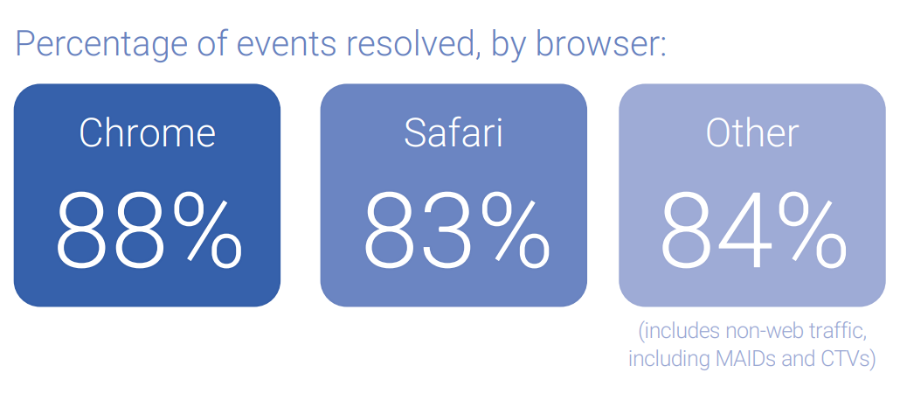
Activity Feed combines separate data streams and matches them back to a household. This enables Cuebiq to expand household IDs and accurately identify MAIDs that are seen in-store for cross-channel measurement. Over a 21-day period, Cuebiq passed ~1 billion events to Experian. Activity Feed resolved 85% of total events to a household, 91% of which were tied to MAIDs.
By implementing Activity Feed, Cuebiq was successfully able to:
- Gain clearer insights into the success of their client‘s campaigns
- Match consumer engagements in a privacy-compliant manner
- Tell the story of the key performance indicators (KPIs) related to their marketing efforts
Prepare for a cookieless future with higher match rates
Activity Feed is prepared for a cookieless future and uses alternative IDs, like ID5 IDs, hashed emails, and IPs for identity resolution, ensuring no reliance on third-party cookies. Experian remains fully committed to exploring a suite of next-generation solutions and prioritizing continued testing of different industry solutions, including the Google Privacy Sandbox, to help customers prepare for a future without cookies. We’ve identified six viable alternatives to third-party cookies, how these alternatives fall short, and how Experian can help you navigate these alternatives.
“Experian’s customer service is extremely efficient and collaborative. We trust them to keep putting our business first long-term.”
Luca Bocchiardi, Director of Product, Cuebiq
Download the full case study to discover how Cuebiq used Activity Feed to overcome their challenges. Your path to maximizing match rates and resolving data from cookieless environments starts here.
About Cuebiq
Cuebiq is transforming the way businesses interact with mobility data to providing a high-quality and transparent currency to map and measure offline behavior. They are at the forefront of all industry privacy standards, establishing an industry-leading data collection framework, and making it safe and easy for businesses to use location data for innovation and growth.
To learn more, visit their website at www.cuebiq.com
Latest posts
With the emergence of email addresses as a currency for brands to communicate with their consumers offline; attaching email data to in-store purchases lays the groundwork for future advertising strategies. However, this advantage in having an additional digital touchpoint also creates a new challenge for marketers. How do they connect what they know about their customers via offline data and PII, or personally identifiable information, with what they want to know about their online behaviors and interactions? Taken a step further, how can they create actionable strategies that connect these two streams of consumer insights in order to drive them to make more future purchases; and even become loyalists? At a time when the shift from traditional to online shopping feels more like a landslide; connecting online and offline data has never been more valuable or more urgent. The solution for these marketers lies in the framework of identity resolution; and a key capability called hashed email onboarding. Hashed email onboarding is a privacy-safe way to connect consumer email addresses to their related digital devices and other digital identifiers. The methodology prevents the consumers actual email address from being readable; while still providing marketers a connection between those emails and other touchpoints for an individual. Instead of understanding the customer journey in two distinct parts; how they interact with a brand or company offline and separately how they interact with a brand online; hashed email onboarding allows for the two parts to be woven together in a holistic view of that consumer. The power of connecting these data sets can be seen when combining offline and online attribution and measurement to improve frequency capping and look-alike modeling. It’s important to note that not all identity resolution vendors that onboard hashed emails function in the same way or provide the same level of data. Some connect only to desktop or only to mobile devices; while others don’t actually make direct linkages at all- they simply provide the hashed emails as a targetable digital audience for upload. While hashed email onboarding and the connection between offline and online data is a powerful strategy; it needs to be as structured as possible across the most data available to reveal truly efficient targeting and measurement strategies. Tapad, a part of Experian has built a hashed email product feature that works with the existing flexibility of The Tapad Graph to deliver the most holistic consumer view in the structure that works best for your business objectives. Get started with The Tapad Graph For personalized consultation on the value and benefits of The Tapad Graph for your business, email Sales@tapad.com today!

One of the biggest challenges marketers face when planning digital advertising campaigns is getting an adequate number of impressions that yields measurable results at the lowest possible cost. As agencies, operators and advertisers are increasingly challenged about media budget, it is more important than ever to plan campaigns that generate enough information at the lowest possible cost. Through our design, deployment and measurement of advertising on a variety of platforms, Experian has developed best practices when planning digital advertising campaigns. We share some of these here, to help marketers with future campaign planning to maximize marketing effectiveness at a minimal cost. Using Path to Purchase to Determine the Right Number of Touch Points The Path to Purchase Funnel provides a framework to determine the number of touchpoints required to turn a prospect into a buyer. There are various phases the consumer goes through at each contact, and these phases dictate the number of touch points (or ‘touches’) required to induce a purchase. In the table below, we’ve described what these phases are, and the number of touch points required for those phases. The required number of touches will vary greatly among marketers, who must consider the expected time for a prospect to make decisions, competition in the marketplace, the novelty of the offer, and the level of engagement of the audience. For example, 15-second or 30-second audio and video ads played during scheduled breaks in programming may require more repetition than an ad played at a moment of high engagement, such as when the user interacts with the app, or during a “pre-roll” advertisement view prior to streamed content. Determining the Target Number of Impressions Needed to Persuade The next step involves determining how many exposures will be required to get the impressions or touch points needed to satisfy the consumer’s path to purchase. Let’s say a marketer has decided that four impressions are enough to make the case for the consumer to purchase, and that the marketer plans to reach 1 million prospects during the campaign. Perhaps the most intuitive solution is to provide four impressions for each reached prospect, such that 4 million impressions would be served during the campaign. However, during a normal digital campaign, some prospects will have zero impressions while others will have many. Because of this, we recommend planning to reach a target fraction (typically 80%) of the audience to receive the required number of impressions for purchase. The following table shows the predicted percent of audience exposed by average number of impressions served. Factoring Advertising Half-Life into Impressions Required Advertisement decay, or the fading consumer memory that reduces ad effectiveness, should also be factored into determining the right number of impressions for a successful campaign. For example, if a campaign length is planned to be 6 weeks, but the half-life of the advertisement is only three weeks, then more impressions would be needed to attain the number of touches required for the path to purchase. When planning campaigns for our partners, we adjust the target mean exposure frequency by the square root of the proportion of campaign length over advertisement half-life. For example, assuming a 3-week half-life and a 6-week campaign, we should multiply our target 5.5MM impressions by to get 7.78MM impressions. In the table below, we’ve demonstrated several scenarios of varying advertisement half-life. Other Considerations During Post-Campaign Analysis Once the campaign is completed, Experian recommends analyzing the distribution of impression frequency to determine how closely the actual impression frequencies matched to what was predicted. If frequencies do not align with the predicted, check to see if these assumptions are met: Make sure that advertising impressions are independent of each other. If rules are in place such that a prior impression affects the likelihood of a subsequent impression, this can affect the impression frequency. Check that the entire targeted population is on the ad platform long enough to be available for targeting. Some campaigns may have been instructed to be deployed in phases, which could limit the number of impressions to be delivered. Confirm that exposures can only occur one at a time, so that the impressions are deployed at distinct time intervals, giving the consumer the opportunity to view the advertisement Planning a successful campaign is critical for a test-measure-learn environment for an agency, operator, platform or advertiser. While initial up-front costs can be expensive, the long-term value to the business is significantly greater if tests are designed and administered appropriately. As a result, spending a little extra time thinking about your consumer’s path to purchase, exposure frequency, and the half-life of your advertisement can pay significant dividends in developing your digital advertising strategy.
To our valued customers and partners,It’s been an exciting week here at Tapad! As announced in a press release this morning, Tapad is now a member of the Experian family. We’re thrilled to continue to grow as a leader in identity resolution under the umbrella of a global expert in data, analytics and technology. Tapad and Experian are deeply connected by our commitment to serving the needs of our customers; and with a focus on quality of the data we provide, we have a common goal for the future of identity in the advertising ecosystem. As part of this announcement, we wanted to assure you, our valued customer, that we remain deeply committed to serving you today just as we always have. Nothing will change in your daily operations with Tapad. Experian immediately recognized that the success and growth of Tapad was directly tied to the strength and depth of its team members. As such, the acquisition will not result in any changes to day-to-day contacts at Tapad, or processes with weekly graph deliveries and other product support. Experian’s faith and investment in Tapad’s future and the future of identity resolution underscores what we’ve always believed our products could achieve and that we will be able to continue serving brands, advertisers, publishers, and the advertising and marketing ecosystem for years to come. On a personal note, I am excited to be transitioning my role as Chief Operating Officer of Tapad to the General Manager position of a global business that’s achieved exponential growth over the past several years; culminating in this strategic acquisition that will no doubt bring even more value to our customers in the future. We remain committed to open communication and welcome any questions you may have. Thank you, Mark Connon | General Manager, Tapad