Cuebiq’s mission, as an offline intelligence and measurement company, is to deliver the most accurate and reliable insights on how digital marketing efforts impact offline consumer behavior. This case study shows how Cuebiq, despite signal loss, partnered with Experian to continue delivering in-store lift analyses. To achieve this, Cuebiq used Experian’s Activity Feed to resolve digital ad exposures to in-store purchases, so that marketers could know the effectiveness of their clients’ media campaigns.
Activity Feed helped Cuebiq increase its match rates by using all the identifiers supported in Experian’s signal-agnostic Digital Graph, reducing its reliance on third-party cookies. By partnering with Experian, Cuebiq could help their clients, marketers, more accurately measure their campaigns and optimize their media.
What is Activity Feed?
Experian’s Activity Feed pulls together fragmented digital event data from all digital channels, including browsers like Safari and Firefox that restrict traditional tracking methods. Activity Feed ingests and ties this digital ad exposure data to household or individual profiles hourly, helping clients associate that data to offline purchase activity made by that household or individual. Activity Feed plays a crucial role in overcoming fragmented data and helping marketers accurately measure their cross-channel marketing efforts.
Challenge: Increasing match rates across digital platforms
Cuebiq wanted to enhance how well they connect digital ad exposures, across web, mobile and connected TV (CTV) to specific mobile ad IDs (MAIDs), of those who visited clients’ stores. They needed a single technology partner who could collect data across these environments and improve these connections, especially as iOS updates, like iOS 14.5, posed potential challenges.
With the ability to resolve exposures to households, individuals, and MAIDs to then facilitate attribution of digital exposures to offline store visitation, Cuebiq could continue to provide accurate reports on how online ads impact offline consumer behavior. This clarity in data enables their clients to fine-tune their marketing strategies.
Cuebiq’s key objectives included:
- Resolving digital exposures to MAIDs
- Increasing overlap of offline and online data
- Improving the effectiveness of offline measurement offerings
Activity Feed: The solution to increase match rates
Cuebiq used Activity Feed to resolve data from cookieless environments like Safari to a single household or individual and saw significantly higher match rates. Cuebiq was able to track cross-channel media exposures, resolve them to MAIDs, and then use the Activity Feed output to correlate in-store visitation and sales to their clients’ media campaigns. Cuebiq also implemented the Experian pixel, which they placed to track all their marketers’ impressions (mobile, CTV, web traffic, etc.). The Experian pixel collects information in real-time, such as:
- Timestamp
- Cookies
- Device ID (MAID/CTV) when available
- IP address
- User-Agent
- Impression ID
“Before we started working with Experian, we couldn’t fully maximize ad views across the complex digital landscape. In just a few weeks, they were able to maximize the match rate across the fragmented digital inventory, solving a huge problem when it comes to cross-channel attribution.”
Luca Bocchiardi, Director of Product, Cuebiq
Results
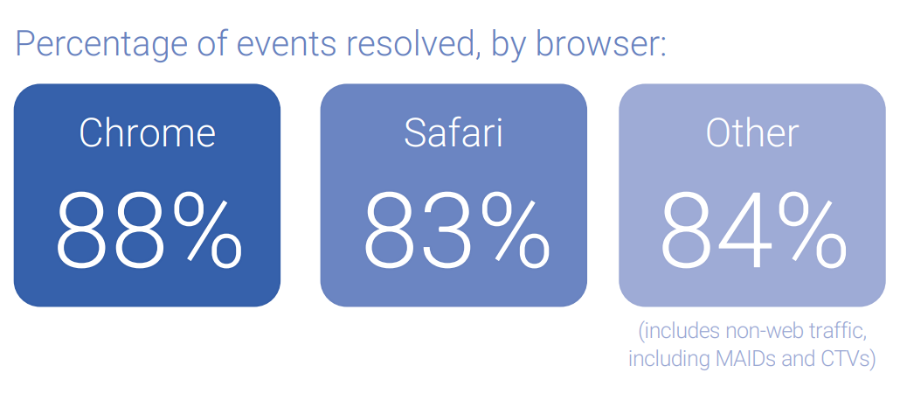
Activity Feed combines separate data streams and matches them back to a household. This enables Cuebiq to expand household IDs and accurately identify MAIDs that are seen in-store for cross-channel measurement. Over a 21-day period, Cuebiq passed ~1 billion events to Experian. Activity Feed resolved 85% of total events to a household, 91% of which were tied to MAIDs.
By implementing Activity Feed, Cuebiq was successfully able to:
- Gain clearer insights into the success of their client‘s campaigns
- Match consumer engagements in a privacy-compliant manner
- Tell the story of the key performance indicators (KPIs) related to their marketing efforts
Prepare for a cookieless future with higher match rates
Activity Feed is prepared for a cookieless future and uses alternative IDs, like ID5 IDs, hashed emails, and IPs for identity resolution, ensuring no reliance on third-party cookies. Experian remains fully committed to exploring a suite of next-generation solutions and prioritizing continued testing of different industry solutions, including the Google Privacy Sandbox, to help customers prepare for a future without cookies. We’ve identified six viable alternatives to third-party cookies, how these alternatives fall short, and how Experian can help you navigate these alternatives.
“Experian’s customer service is extremely efficient and collaborative. We trust them to keep putting our business first long-term.”
Luca Bocchiardi, Director of Product, Cuebiq
Download the full case study to discover how Cuebiq used Activity Feed to overcome their challenges. Your path to maximizing match rates and resolving data from cookieless environments starts here.
About Cuebiq
Cuebiq is transforming the way businesses interact with mobility data to providing a high-quality and transparent currency to map and measure offline behavior. They are at the forefront of all industry privacy standards, establishing an industry-leading data collection framework, and making it safe and easy for businesses to use location data for innovation and growth.
To learn more, visit their website at www.cuebiq.com
Latest posts
NEW YORK & LOS ANGELES / BUSINESS WIRE / Jan. 30, 2017– Tapad, part of Experian, and Rubicon Project (NYSE: RUBI) announced today a new global partnership offering a unified, cross-device campaign delivery solution within an automated advertising marketplace. Tapad is the leading provider of unified, cross-screen marketing technology solutions and Rubicon Projectoperates one of the largest advertising marketplaces in the world. The Tapad Device Graph™, which enables buyers to expand their high-value display data signals to associated mobile devices, will be integrated across Rubicon Project’s leading advertising exchange and Orders platform, significantly improving consumer mobile reach. The new global partnership will empower Buyers within Rubicon Project’s exchange to find and engage audiences across their entire digital experience. Rubicon Project operates one of the world’s largest mobile exchanges connecting to approximately 1 billion unique mobile devices globally. “We’re excited to partner with Tapad to continue to provide our customers the very best data for managing their advertising businesses,” said Harry Patz, Chief Revenue Officer, Rubicon Project. “Cross-device delivery is crucial for buyers today with more than 81% of internet users currently relying on more than one device for digital access[1]. Through our partnership, buyers will be able to extend their desktop private marketplace campaigns to mobile, allowing them to find and engage their audience across devices, anywhere in the world. The net result will also benefit sellers; the increase in mobile reach will better position publishers and app developers to strategically capitalize on their inventory, ultimately increasing bid rates and mobile revenue across the board.” “Our partnership with Rubicon Project marks the first time advertisers and publishers alike are able to use cross-device solutions at significant scale outside of Google and Facebook,” said Pierre Martensson, GM of Tapad’s Data Division and APAC. “Our Device Graph will help Rubicon Project’s advertisers make more informed buying decisions and find the audiences who matter most.” Barry Adams, VP of Commercial Development at Bidswitch, said, “As digital advertising moves away from desktop and increasingly toward a mobile-first model, cross device data becomes critical to finding consumers. The rich data buyers will now be able to leverage at scale through the Tapad and Rubicon Project integration will enable us to provide a state-of-the-art cross-screen solution for the 150+ buying platforms that use our service, and the tens of thousands of advertisers they represent.” For more information about Rubicon Project’s inventory, please visit www.rubiconproject.com. For more information about Tapad’s cross-platform advertising solutions, please visit https://www.experian.com/marketing/consumer-sync. Get started with us

Tapad expands linear TV analytics solution, enabling optimal reach and frequency across TV and digital platforms NEW YORK, Jan. 24, 2017 /PRNewswire/ — Tapad, now a part of Experian, has partnered with WideOrbit, the leading provider of advertising management software for media companies, to develop the industry's first programmatic TV-buying platform powered by a device graph. Tapad is the leading provider of unified, cross-screen marketing technology solutions and was first to market with a device graph, the Tapad Device Graph™. WideOrbit's robust supply platform and industry-leading footprint offers access to premium TV inventory on top networks, reaching more than 99 million households across local affiliates. The partnership pairs Tapad's demand-side technology with WideOrbit's supply-side inventory. As a result, marketers can leverage cross-device audiences in their TV buys for the first time. Additionally, integrating the Tapad Device Graph™ with digital feedback loops and audiences both accelerates optimization and enables precise audience discovery for TV marketers. "The integration of WideOrbit's quality TV supply takes orchestrated cross-screen media buys to the next level," said Marshall Wong, Tapad's SVP of TV market development. "Marketers can now optimize TV campaigns within days instead of weeks. This also untethers them from buying against generic demographics like age and gender. By allowing brands to employ their own CRM or third-party data, we can move them much closer to audiences who will take action." "Integrating Tapad's device graph with WideOrbit's programmatic marketplace delivers enormous value to marketers looking to add TV to cross-device campaigns," said Ian Ferreira, EVP of programmatic at WideOrbit. "Television still delivers the most efficient reach of any medium, and Tapad's platform now allows marketers to purchase premium broadcast inventory that extends the power of cross-screen campaigns to TV with a single, unified solution." "Our clients build lasting relationships with consumers through thoughtful and pioneering marketing," said Jeff Giacchetti, VP of digital at Mediavest Spark. "The strategic partnership of demand-side technology and supply-side inventory makes it easier for brands to find efficient, incremental reach and are critical in this endeavor." For more information about Tapad's cross-platform advertising solutions, please visit https://www.experian.com/marketing/consumer-sync Contact us today!

Personal skill development for marketers to foster a broader view of the industry is critical to marketing programs success.